
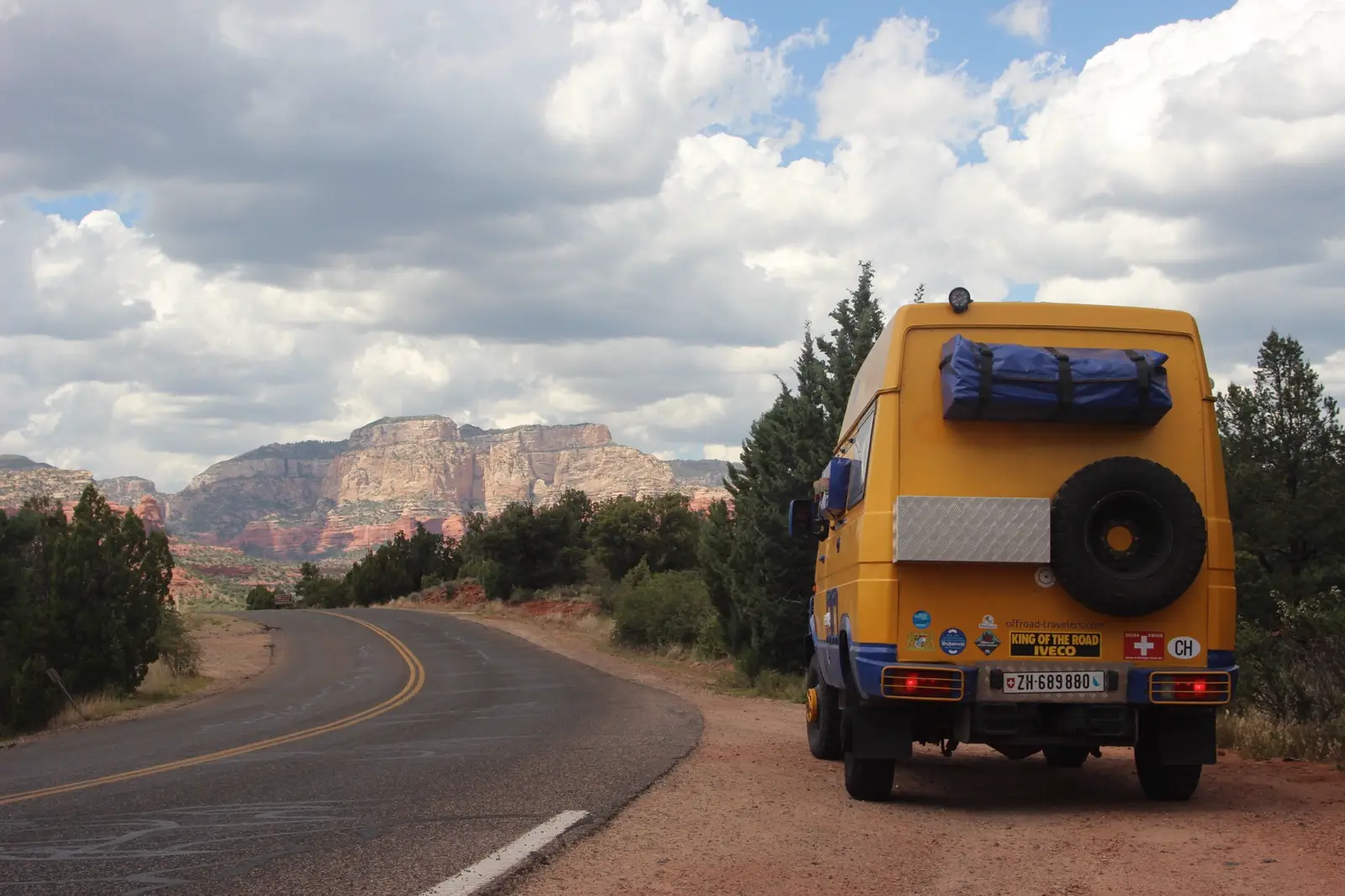
How we found our way back on track after our detour to Arizona – and discovered the most beautiful national parks along the way
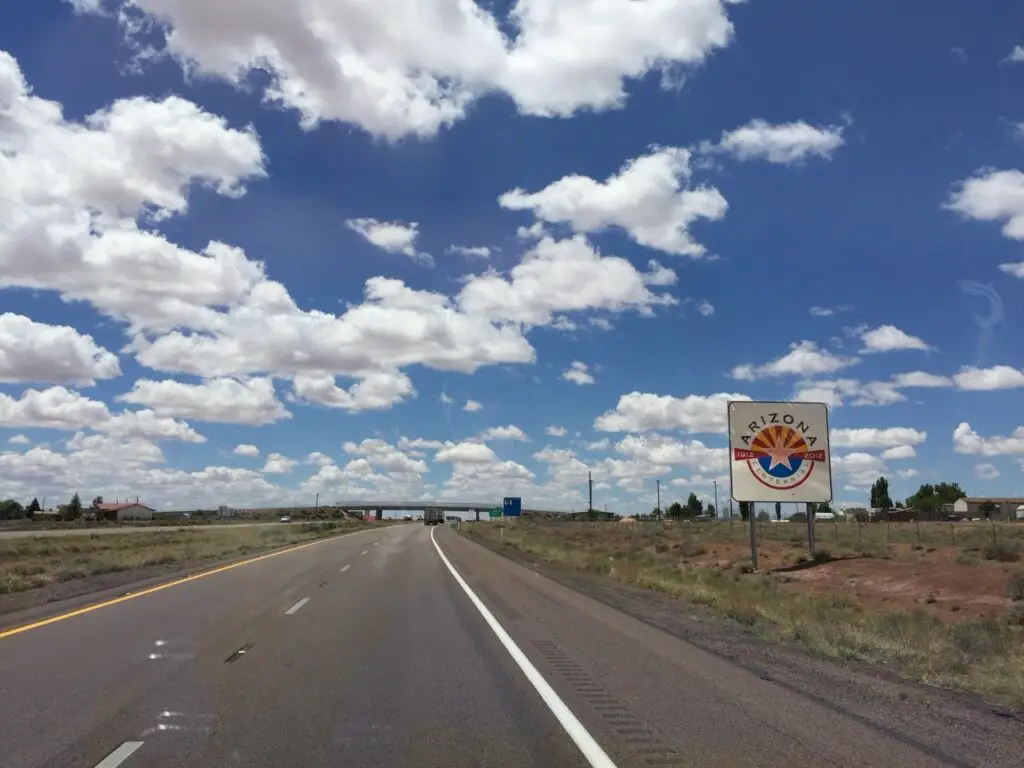
Originally we wanted to go to Alaska, but now we’re sitting in Arizona at Lake Mead studying the map to find the best route north. In hindsight our detour turns out to be a stroke of luck. Our odometer will go up by an estimated 6,500 kilometres, but in return some spectacular national parks and sights now lie on our route that we would otherwise have missed – and that really would have been a shame. We don’t even have to deviate from the route, as they’re all right on our way!
As we’re already down here, we took the opportunity to visit Las Vegas. In May it isn’t as hot here as in August or September, and we had planned the side trip to Las Vegas on the way down anyway. I’d been there once before; for Christoph it’s the first time. I think you have to have seen Las Vegas once – at least once. And as you all know: “What happens in Vegas, stays in Vegas.” So I won’t say any more about it.
After Las Vegas we visit the Hoover Dam, take a sightseeing flight over the Grand Canyon and camp for three days at Lake Mead before setting off again. The first national park on our route is Zion National Park. With its red, rocky earth and the green of the trees and bushes, it offers a truly impressive picture. Unfortunately it’s holiday season (end of May) and it’s incredibly busy. We decide on just one hike, and since we’re fit when it comes to mountain climbing, we choose Angels Landing. With almost 500 metres of ascent (its summit is 1,765 metres high), it’s a challenge, especially as there are warnings that you absolutely must have a head for heights.
We set off at 8 am, which turns out to be too late. There aren’t many people on the trail yet, but when we head back, whole hordes come towards us. Once you’ve made it to the furthest point of the platform at the very top – the last stretch has to be walked along a chain, which with my limited alpine knowledge I’d classify as an easy via ferrata – you look almost 500 metres straight down. No wonder you need a head for heights!
On the way back we meet a trembling Chinese woman clinging to the chain who asks whether it’s still far. We advise her to turn back if she’s already so scared, because it keeps getting steeper. But she doesn’t turn around and holds up the traffic. As long as you can say afterwards that you made it to the top. Still, it was beautiful up there, and for us the worst part wasn’t the height or the steep drops but the crowds.
A little outside Zion National Park, to the east, we find a beautiful, quiet spot to camp by a small stream with a sandy beach. We stay there four days to recover from all the driving and enjoy the sun. When we arrive, someone is just pitching his tent. I ask whether he’d mind if we set up camp next to him. “No, not at all,” replies Bruce, a retired teacher from Vancouver who is travelling by motorbike for a few weeks. We spend the evening together swapping travel stories over Kaiserschmarrn with fruit compote. As Bruce’s space is limited, his meals mostly consist of instant noodles and packet soups. So his first Kaiserschmarrn is a welcome change, and he invites us to visit him in Vancouver. We should let him know shortly before when we’re nearby.
Oh, we could have stayed forever. This place is already one of our favourite spots, not least because of the nearby Forscher Bakery, which bakes delicious rye bread in a wood-fired oven, just like in Bavaria. But our destination is Ushuaia! On the short way from Zion National Park to Bryce Canyon National Park we pass Horseshoe Bend. This impressive whim of nature lies just before Page in northern Arizona, near the Utah border. At first you only see a huge car park, from which you walk for about ten minutes through the desert until you’re standing at the edge of a cliff. Below you the Colorado River winds in a tight loop through the rocks of Marble Canyon. From above, as the name suggests, it looks like a horseshoe. Some natural wonders are so beautiful because of their simplicity, and Horseshoe Bend is one of them. The green water of the canyon between the reddish rocks, and the blue sky in the background.
From Page we book a tour to Antelope Canyon. These days the canyon can only be visited on a tour; entry without a guide is no longer possible and is also life-threatening. In a sudden thunderstorm the canyon fills with water within minutes. A few years ago a whole family died like that. So we queue with hundreds of other tourists and wait. At least we managed to get tickets, as we have a talent for always ending up at particularly popular sights on public holidays. The wait isn’t bad; we’re a fun group, and two American retired couples keep us entertained. Antelope Canyon lies on Navajo land, and a young woman leads us in. The soft light, the terracotta tones and the shapes are so warm and soft that you can hardly believe you’re walking through rock. You immediately feel at ease and don’t want to leave.
We spend almost an hour in the sometimes narrow passages, climbing steps up and down and being shown formations reminiscent of eagles or Native American chiefs. Not far from Page lies Bryce Canyon National Park, which shows a fascinating variety of stone and rock formations. I’d never have thought stones and rocks could be so impressive. You can drive through the whole park by car and there are spectacular viewpoints from which you can look far out over the Grand Staircase. Rocks in all kinds of shapes – towers, arches, windows – some formations look as if someone had built them. And yes, someone did: nature built them, or more precisely water, which in the form of snow, hailstorms or rain has washed out the limestone to create the most bizarre shapes. A hailstorm surprises us that afternoon too. Quite suddenly it starts to rain, and when we turn on the windscreen wipers, a white rim quickly forms. I wouldn’t have expected a hailstorm here in the otherwise barren desert landscape. The next morning we hike among the huge limestone formations.
You feel very small, even though the rock formations don’t look that big from above. But when you’re standing in the middle of them, the landscape looks completely different. Chipmunks and prairie dogs keep us company, and down there you seem to be on another planet. After a few days we reach Grand Teton National Park. It’s now early June, and it’s nice and warm during the day. There’s still a lot of snow on the peaks of the Teton Range, but down below the dandelions are blooming and we almost feel at home – except that bison graze here instead of cows. Goslings hatched here a week ago, and the meadow in front of the visitor centre is teeming with the fluffy little creatures. We hike around half of Jenny Lake, as one side is closed. Helicopters are flying building materials to higher elevations, because the heavy snow that fell so late destroyed large parts of the trails.
We realise how incredibly lucky we were with our detour to Flagstaff! At the visitor centre we’re told that it was still snowing heavily at the beginning of May and that this winter set an absolute record with well over 600 inches of snow – that’s 15 metres. We should be careful, because the bears are now coming out, hungrier than usual in spring, as they too had to wait for the snow to melt before they could successfully forage. The lakeshores are flooded; the meltwater is driving up the water level. We hike along the east shore of the lake and with difficulty spot a moose – or is it just a deer? – in the tall grass in the distance. Hard to tell at that distance. The weather couldn’t be better, and the sun beats down pretty hard during the day. We have to be careful not to get sunburnt. We camp just outside the national park by a lake with a fire pit, where we grill burgers in the evening and listen attentively to our surroundings. But no animal shows itself.
North of Grand Teton National Park lies Yellowstone National Park. On Thursday 8 June we reach it around midday. We drive past snowfields and marvel: it’s warm, we’re wearing shorts and flip-flops, but the snow isn’t melting as fast as it suddenly got warm. The late onset of winter is clearly visible. We’re glad we took the detour via Flagstaff, otherwise we’d have ended up here in a snowstorm at the beginning of May. The park is just waking up from its winter sleep and it’s quiet. We drive out to camp for free and find a lonely spot. A small plateau east of the park, a little higher up at the edge of the forest, becomes our place to sleep. On the way there we come across elk, bison and a herd of bighorn sheep. We haven’t seen so much wildlife on the whole trip. We quickly cook something and retreat into the car so as not to provoke any bears. It gets cool in the evening, so we watch a film on the laptop.
And then we see him: a grizzly lumbers from the edge of the forest along the meadow, straight towards us. Christoph says, startled: “There’s your grizzly!” I had been waiting the whole time to see wild bears. The bear sniffs around the car, so close that I can no longer see him. He can apparently smell the grey water we tipped out 20 metres away. Grizzlies have an extremely good sense of smell – they say over two kilometres. He scrapes at the ground, finds nothing and briefly looks in at the window, where Christoph is just looking out. Unimpressed, he walks over to where we tipped the water, finds nothing there either and disappears into the undergrowth. Our first grizzly! Christoph won’t forget this encounter.
The next day we drive back into the park and see geysers that erupt at certain times. The colours of the geyser basins are a spectacle in the sunshine; steam rises everywhere. The landscape seems alien, almost like another planet. We walk through the park on boardwalks and bridges, as the surface is too dangerous and fragile. We hike to a small waterfall; at the end of the trail a family of marmots has its burrow. The young come out curiously, even though we’re sitting close by. The mother isn’t there, but you can hear her whistling to warn the little ones when they stray too far. That night we leave the park through the north-west exit and find a place to sleep by a small stream. Early the next morning we return; deer, stags and fawns are still sleeping in the meadow in front of the Albright Visitor Center. They know they’re safer from wolves and bears there. We don’t see any wolves, but we do see lots of bison herds, deer, elk, bighorn sheep and bears with cubs.
It’s spring. Our last national park in the USA is Glacier National Park. It’s a bumper year for bears, we’re told. The mother bears are finding plenty to eat and raising most of their cubs. At the end of June everything is in bloom and there are lots of berries. On our first day in Glacier National Park we see a female grizzly with a cub. They cross the road leading us out of the park. The cub, probably born in spring, stands curiously at the roadside, rears up on its hind legs and then follows its mother. The female wears a collar and is monitored by the national park. Once on the other side, they carry on eating. The cub peeks out curiously from behind the grass, almost like a baby panda with black rings around its eyes. In the car opposite a dog barks; the cub stretches up even more, the mother remains unimpressed and moves on. That was an exciting day – seeing a grizzly with a cub for the first time. We’re glad to be in the car, as grizzlies with cubs are considered aggressive. The next morning we’re back in the park early, want to do a four-hour hike and have bear spray with us. It’s like pepper spray, only stronger, and is supposed to disorient the bear in an emergency if used correctly.
The weather is glorious, and we plan a hike to Iceberg Lake, 16 kilometres there and back in total. The narrow path leads through forests and over flower meadows, gets steep in places, and at the end we cross a snowfield. The panorama at the lake is impressive – and icy. On the way we meet Lynn, an older woman who is hiking the trail for about the hundredth time. She lives near the park and has been observing the grizzlies for years. She tells us about a female grizzly called Panda, whom she has been observing in the national park since her birth. Panda now has cubs of her own, and Lynn plans to write a book about her. I mention that we saw a female bear with a cub the day before that looked like a panda, and that we took photos. Lynn, whom we guess to be in her mid-seventies, is thrilled and asks for the photos. We exchange mobile numbers, and as soon as we have internet I’ll send her the pictures.
On the way to the lake Christoph spotted red-capped boletes but didn’t want to take them so as not to squash them. On the way back we find them again, because Americans rarely pick mushrooms. We buy toast at the park kiosk and ask the restaurant for some cream so we can cook creamy mushrooms with bread dumplings. At the edge of the forest outside the park we prepare our dinner. The next morning we drive via Chief Mountain to the Canadian border and Waterton Lakes National Park. The route passes snow-covered mountains and blooming meadows. The border lies alone in the middle of idyllic nature, and I wonder how often a bear passes by here. Once in the park, we pick up the free annual pass, as Canada is celebrating its 150th birthday. We save 140 Canadian dollars and plan to hike to Upper Rowe Lake early the next day. Today we only take two short walks and get told off by an irate squirrel – we probably entered its territory.
We spend the night outside the park to save money and find a quiet farm track. The next morning we get up early to see animals and are the first in the car park. With sturdy mountain boots, bear spray and a bell, we set off. Christoph rings the bell wildly to warn bears, which nearly drives me mad, as I have good hearing. When we find fresh bear droppings, the bell rings even louder. The bear is certainly not far away; it’s probably hiding and hoping we’ll disappear soon. The Upper Rowe Lake Trail gets steep and snow-covered, so we have to turn back. On the way back we make a detour to Lower Rowe Lake and rest on the shore. The snow is thawing, and you can see how deep it was in winter. We see few animals, just birds and squirrels making a lot of noise.
Back at the car park we pack our things and drive to the visitor centre. On the way we spot a big brown black bear eating dandelions. We stop and I take photos. Only when a dog barks does the bear become alert, but it stays calm. It only has half a year to eat, so it thinks carefully about how to use its time. Yes, there are brown black bears, which we had to learn first. You can recognise grizzlies by the hump on their shoulders and their size. Our detour ends here, and the next national parks, Banff and Jasper, are on our list.