

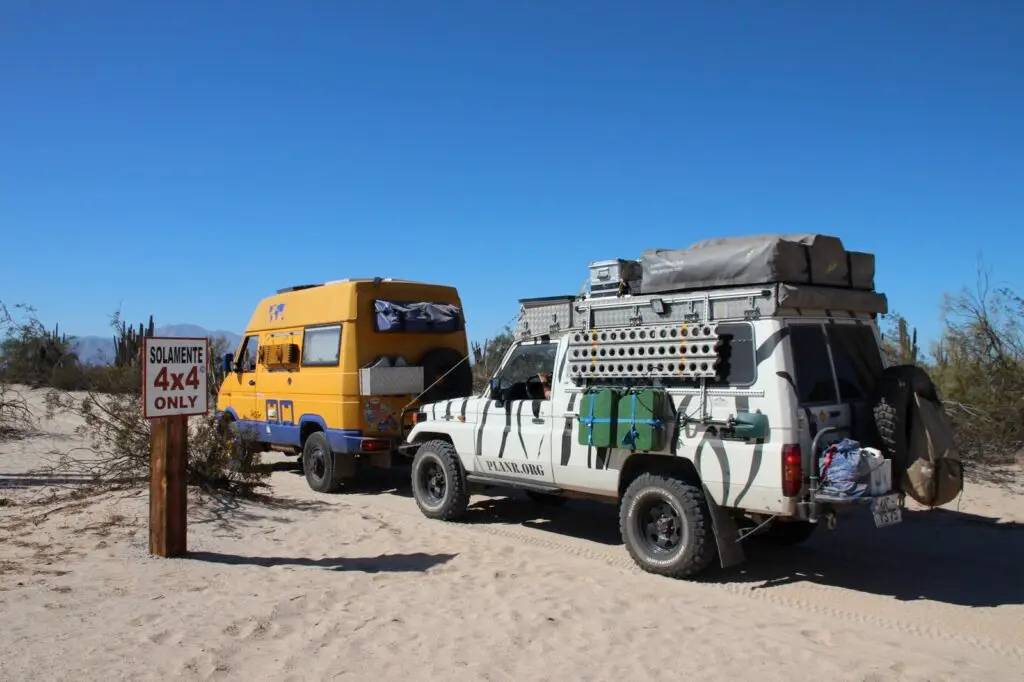
It’s time to leave the USA! We’ve covered 35,000 kilometres so far, and now we’re ready to discover something new. On 9 October 2017 we cross the border into Baja California, Mexico, at Tecate. Our first stop is Ensenada, where we meet Yasmin and Stefan. They’re travelling in the Zebra, a 1992 Toyota Land Cruiser, and have similar plans to ours. They started in Halifax and have two years in total. Christoph and Stefan had already been in contact via Facebook, as our travel plans matched. Until now our paths hadn’t crossed, but now the time has come, as our car insurance policies expire at the same time. We decide to travel together for a while, which is an advantage on sparsely populated Baja with its poor road conditions.
In Ensenada we stock up on food and move on south. Shortly after Ensenada we turn onto a gravel road to look for a place to sleep and come across the route of the Baja 1000 rally, which runs 1,000 miles (1,600 km) from Ensenada to the tip at La Paz. Since we’re already there, we let some air out of the tyres and stay on this route. We find a spot for the night in the middle of nowhere, under a sparkling starry sky and in the company of wild horses.

The next day we head for San Felipe, where we land in the middle of filming for a BF Goodrich commercial. Dune buggies race across the terrain, and we position ourselves behind a crest to watch the action and wait until filming is finished. After all, we don’t want to get in the way, as we’re not exactly fast – we’ve got our house with us. The route is well marked with green and orange signs, but we still take a wrong turn once and pass a somewhat run-down rancho. Suddenly two pick-ups follow us determinedly. “You can’t go any further here!” the men say firmly. “The road ends!” We turn around, and one of the men drives ahead and the other behind to escort us back onto the right track. What might we have found? We’ll leave that to your imagination.
Having arrived in San Felipe, we look for a place to spend the night on the beach. That’s not so easy, as there are no detailed maps and the GPS doesn’t know any route. The tracks leading in the right direction are either fenced off or filled in. Just as we’re about to give up, a fisherman on a bicycle crosses our path and says: “Follow me!” We follow him, curious where he’ll lead us. As fast as he’s pedalling, he must know the way, and he skilfully navigates us through the maze of tracks. We would never have recognised the right way. He leads us to a small cove, where the last part of the track is steep and rocky. When we’re almost at the bottom, he asks whether we have 4×4 – better late than never. His name is Daniel, and he fishes here illegally. Sometimes the police come and he has to hide quickly, but we shouldn’t worry, they leave tourists alone. He helps us collect firewood, and we invite him for a beer.
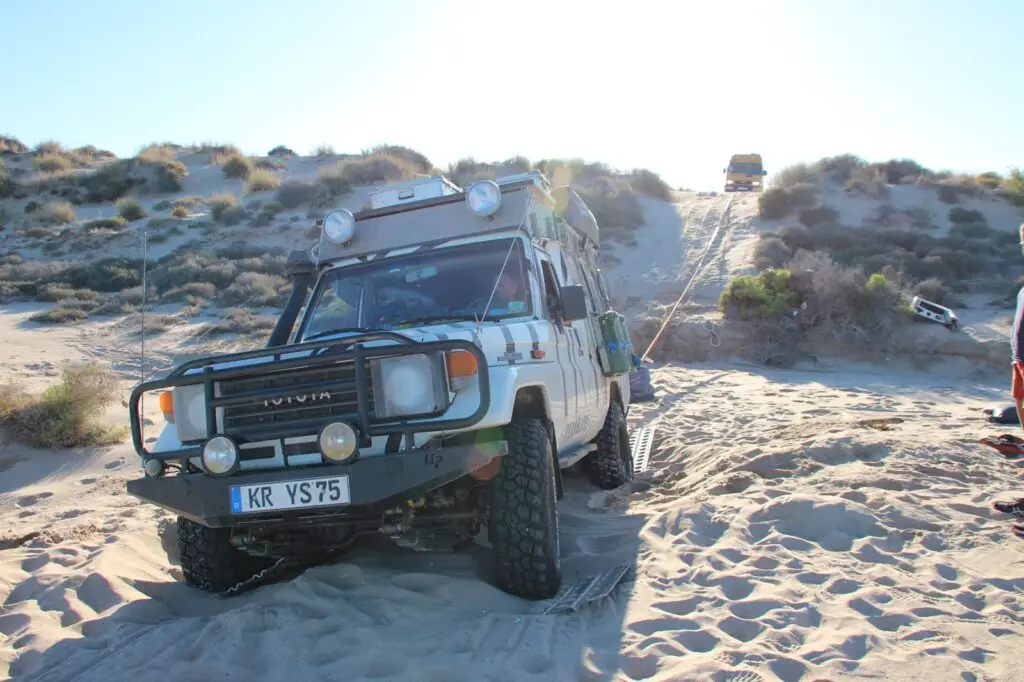
The first beach spot wasn’t easy to find, and the second attempt was to fail. A little south of San Felipe we look for our next spot for the night. Muggl was actually supposed to lead that day, but as the Zebra is closer to the turn-off, it drives down the narrow track towards the sea first. The track is sandy, and suddenly the Zebra disappears in front of us, sinking down behind the dune. There it sits, sunk in the sand. We walk around to see whether there’s a way out over the beach, but it doesn’t look good. The Zebra has to go back up in reverse! We shovel and dig to free the tyres and first try to pull it up with Muggl. But as Muggl also has sand under his feet up on the hill and threatens to dig himself in, we stop. In the end we dig even more and lay all six sand ladders we have one after the other, again and again, to create firm ground so the Zebra can free itself under its own power. Two hours of sweaty work, it’s slowly getting dark, and we still don’t have a place to spend the night. The next campsite is closed, the one after that pretty expensive, so we simply park in the desert and sleep among the cacti in the middle of nowhere – also nice.
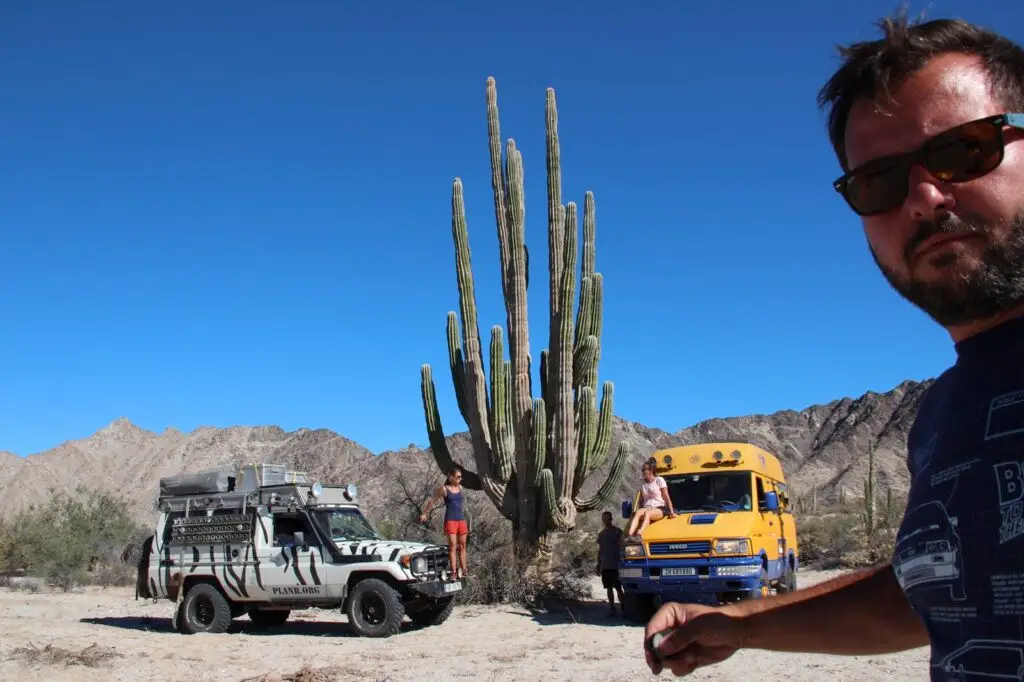
The Baja 1000 route runs partly on tarmac, but mostly through the backcountry. The road and track conditions are varied: sometimes sand, sometimes stones, sometimes rock, through the desert with cacti (I didn’t know there were so many different kinds!) and through dry riverbeds – there’s everything. Above all, you keep finding beautiful places to spend the night, sometimes on the beach, sometimes under giant cacti or in the Calamajué Canyon, where we wake up in the morning with a flat tyre! How did that happen? Everything was fine the day before?! First we pump it up again and wait. It only seems to be losing air slowly, so we carry on with an “injured foot”. The route gets demanding, and we check the tyre pressure regularly. Strange, hardly any air is escaping – but all the better! We make the 54 kilometres to Bahía de los Ángeles and only have to pump in a little air twice.
Having arrived in Bahía de los Ángeles, it’s tacos first. With Gina’s taco stand we’ve found the best one in town straight away, and there’s no point looking for a garage when you’re hungry. Then it’s off to the supermarket – and how handy, right opposite is a garage that seems to do everything. We put our name down but first restock our supplies at the supermarket. In the supermarket Dennis and Rainy speak to us; they had been sitting at the table next to us at the taco stand. They ask what we’re doing and whether we’re looking for a campsite. Yes, in fact, for once we actually wanted to go to a campsite because we need internet to contact the ADAC. Our brake discs seem to be worn out, and the car shakes badly when braking. Dennis says: “Come with us – you can camp on the beach, shower at our place, use the kayaks and sort things out with the ADAC.” They’re expecting more visitors in the late afternoon anyway, because they’re planning a quadruple birthday party for the coming week. Then we won’t stand out. He explains where we have to go, and the directions are adventurous. Finally he places an arrow in the middle of nowhere on the map on my phone. “That’s where we live,” he says. I’m curious whether we’ll find it.
Once our tyre is patched and we’ve done everything, we head south. We have to turn off twice; somewhere a tyre lies at a fork, where we have to go left, and suddenly there’s a Sprinter in front of us. When it stops, we ask whether they’re going to Dennis and Rainy’s. “Yes!” say Don and Susy, “we’re just waiting for friends who’ve never been there and don’t know the way.” How handy – we don’t know the way either and probably would never have found it if we hadn’t met them. So we drive into the bay in a convoy of four, where Dennis and Rainy and a few others have their holiday homes. We’re welcomed very warmly, shown the way to our camping spot and the way to Jeff and Susan’s, where there’s dinner in the evening. We can’t believe it – we’ve landed in paradise! The people are so helpful and open, all of retirement age but still so young at heart and full of joie de vivre. In the end we stay there for two weeks. Alan, a friend of Jeff’s, picks up our brake discs at the international airport in San Diego and brings them with him. He comes to Bahía de los Ángeles with his wife Jen a good week after we arrive. There’s a separate report about the brake discs!
In those two weeks we experience so much that I can only summarise it briefly. We snorkel with whale sharks, paddle with dolphins and see tarantulas for the first time. Every day someone different comes to us and asks whether we need anything from town. Jeff and Susan take us to the laundry, the supermarket and to collect firewood. We spend many evenings at Dennis and Rainy’s over delicious food, cooked by someone different each time. We make a small contribution too, and Christoph and Stefan cook Käsespätzle. When the day of the big party arrives, we offer to help. We set up tables and chairs, decorate and hand out cake. But there’s still time to join in the celebrations and dance. The Mexicans from the village are invited too and turn up in large numbers. Gina makes tacos, a Mexican band plays, and a piñata is hung up for the village children to knock down. A lovely party where we met many interesting people, such as Dave and Debbie, with whose help we later buy a solar panel in La Paz.
On the second-to-last evening we’re invited to dinner at Jeff and Susan’s. Alan and Jen have arrived with our brake discs, and Alan tells us how the customs officer questioned him about the vehicle and he didn’t really know what an Iveco was. He then steered the conversation to his classic car. On our last day, a Sunday, Christoph and Stefan fit the new brake discs. Dennis has a superbly equipped garage with all kinds of tools that we’re allowed to use. Dennis’s workshop and his house are somehow the centre of this community and a meeting point at any time of day. So the boys are in the best company, accompanied by the technically savvy retirees who help out with advice and a hand – cerveza in hand. We leave the following Monday with mixed feelings. On the one hand we’re happy to have new brake discs and finally be able to move on; on the other hand we’re sad to have to leave these lovely people.

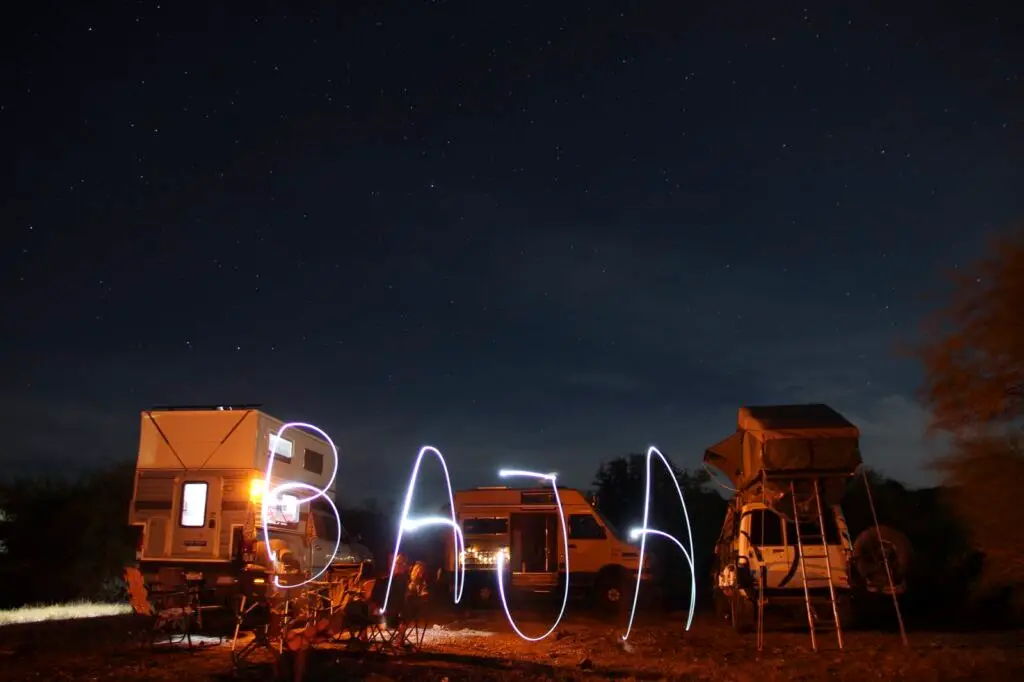
We continue south, literally over hill and dale along the Baja 1000 rally route. In Santa Rosalía we meet Shay and Monika from Vancouver, Canada, who are on a five-week holiday on Baja. As we’re taking the same route, they spontaneously join us and we travel on as three couples. The further south we get, the more beautiful the beaches we find to spend the night, and the roads there often lead over gravel, sand, dry and not-so-dry riverbeds. However, when we look for a beautiful beach on the opposite side of Bahía Concepción, it turns out to be a bit difficult. All three couples have information about this spot from different sources. The Zebras read about it in a blog, the Canadians got the info from locals, and we got the tip from other travellers who were there the year before. So, as explained in the directions, we open the gate that goes off left onto the gravel road after the bay and drive into the rancho. Horses and cows look at us in disbelief, a road is hard to make out, and we remember Jeff’s words: “On Baja you have to keep this in mind: follow the most travelled road!” So that’s what we do, but progress is very slow, as it’s one of the worst trails we’ve ever driven. It gets dark, the beach isn’t particularly nice and is stony, but we settle down and set up camp anyway. We spend a lovely evening, cook a vegetable stir-fry with chorizo, bake cinnamon rolls in the Dutch oven and take photos of an incredible starry sky above us. We’re so far off the beaten track that there’s practically no light pollution here. Because we’re on a roll, we also start writing in the air with torches. The results – “Baja” and “Mexico” – are pretty impressive.
The next morning we see how far we can get and suddenly find ourselves facing a rock face. Well, if there ever was a beautiful beach somewhere here, it has disappeared, or a landslide has buried the access so that it can’t even be recognised any more. So we turn around! We decide to meet at the exit, i.e. where you get back onto the highway. Somehow, though, we come out at a different place from where we went in. The Zebra and Muggl arrive at the same time, but the Canadians have fallen behind. We start pumping air back into the tyres and discuss how to find them when they finally arrive too – apparently they, like us, took a wrong turn somewhere. Great joy – all the greater when Monika comes towards us with our roof hatch! Yes, you read that right, we lost our roof hatch, turned Muggl into a convertible and didn’t even notice! Apparently a branch brushed us somewhere and ripped the poor hatch off the roof!
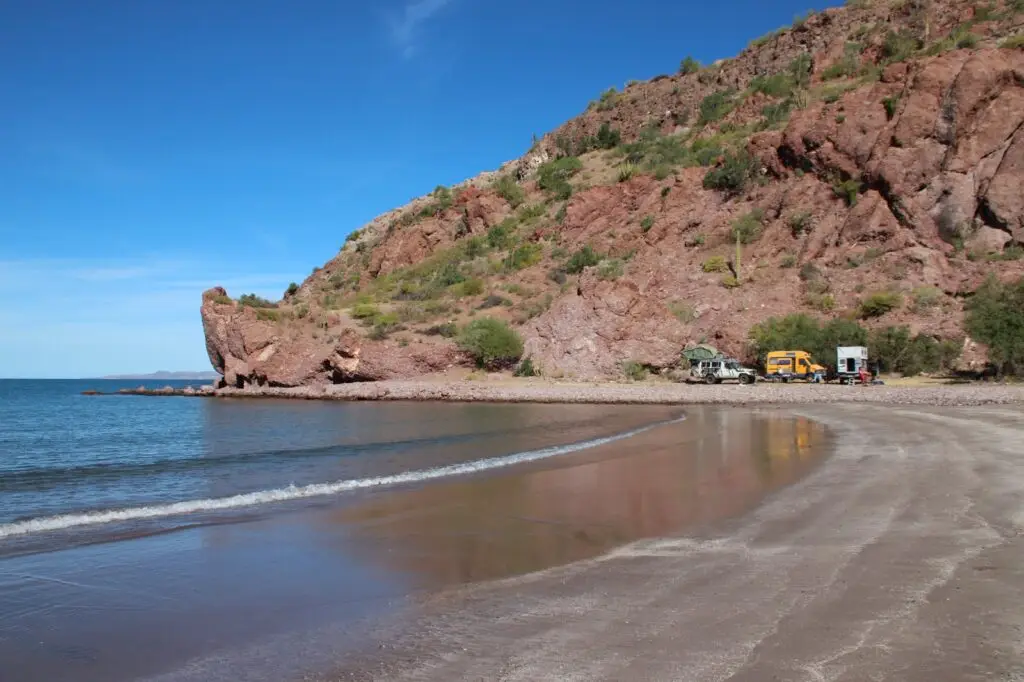
The next beach spot is already waiting, and we find a snorkelling paradise with fine white sand. Here we first remove the bush from our wardrobe and fix the roof hatch so that it holds for a while. After two days of relaxing on the beach, where we can snorkel brilliantly and have lots of fun playing UNO, we move on to Loreto. A sweet little town with a beautiful historic centre that we really liked. From there it’s back onto the track to Agua Verde – and “track” isn’t an exaggeration here. A very narrow gravel road winds steeply down in hairpin bends. At the bottom, though, a quiet bay with a small rocky island in the middle awaits us – another snorkelling paradise with great coral.
The next morning it’s time to say goodbye to the Canadians. They need to get a move on – after all, they only have five weeks and have to go all the way back too! We, the Zebra and Muggl, start a little later. But it doesn’t take long before we find the Canadians at the roadside with their camper jacked up. A nut had come loose on the right front wheel, and the bolt had worked so far out that the wheel had come away from the suspension and simply buckled! It happened on an incline, but on tarmac and just a few kilometres after the steep, winding gravel track. The nut was gone, of course, and we searched Muggl and the Zebra for a spare nut – nothing! Stefan patches up the damage temporarily, and we can send the two of them to the next garage like that.
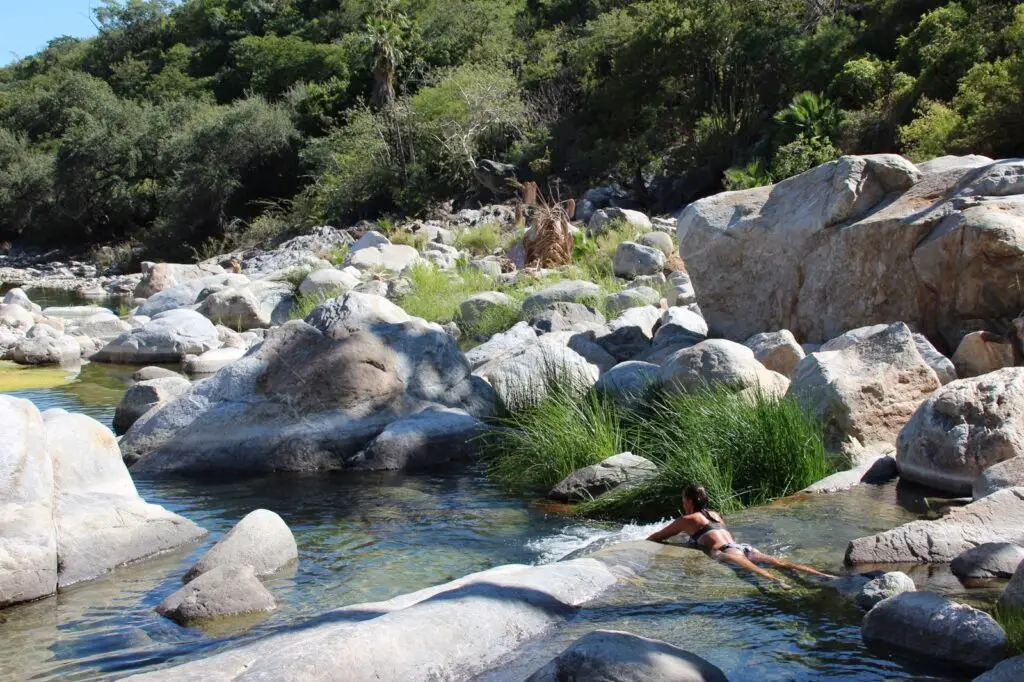
We continue towards La Paz, where after almost five weeks we also say goodbye to the Zebra. We’ve decided not to travel all the way down to Argentina, but only to Panama. There’s so much to see and discover, and we don’t want any stress. A year and a half seemed a lot at the beginning, but once you’ve been on the road for a while, you realise it’s not enough. So now we have more time and can dawdle a bit on Baja. First we get ourselves a new solar panel, as the old ones aren’t as efficient any more. Then we have Muggl checked by a diesel specialist, because the new injection pump is already causing problems again. “He has rust in the tank, and the single-filter system can’t cope with that,” the Mexican explains. He cleans our tank quite thoroughly, and we’re curious whether it’ll help. My technical Spanish for car repairs is getting better and better.
We enjoy the “lower loop” of Baja, as we call it, to the full. Todos Santos is one of our favourite little towns on Baja. In Cabo San Lucas we treat ourselves to a hotel for two nights. You can read about the consequences in the next report. Nothing bad – that much I can say already. We have a delicious meal at “Mi Casa”, a somewhat touristy but very tasty restaurant with a mix of modern and traditional Mexican cuisine and a huge collection of Catrinas. These are the skeleton figures you can buy in Mexico mainly for the Día de los Muertos (Day of the Dead) or All Saints’ Day. There’s also a boat tour around the tip of Baja California off Cabo San Lucas, where we look at the rock formations, beaches and sea lions. A bit of tourist programme is allowed too – after all, we’re on holiday, and besides, it’s the low season. It’s best to get price information from locals and then ask tour operators for the local price. That actually always works.
Via the Camino Cabo Este we head back up the other side towards Cabo Pulmo and Los Barriles. There we were held up for a while, and there’s a separate report about that: “The days that take an unexpected turn.” From Los Barriles we try our off-road luck one last time on Baja and want to drive along the coast to La Paz. The road is marked on the map and Google knows it too, so off we go. The first few kilometres are even paved, then only gravel, and finally it gets quite bumpy and narrow. After almost 40 kilometres a cyclist from England comes towards us and doesn’t know what to make of us at this spot. His face is a mixture of astonishment and delight. “If you want to keep going that way, you’re crazy. The track gets even worse, narrower and steeper.”