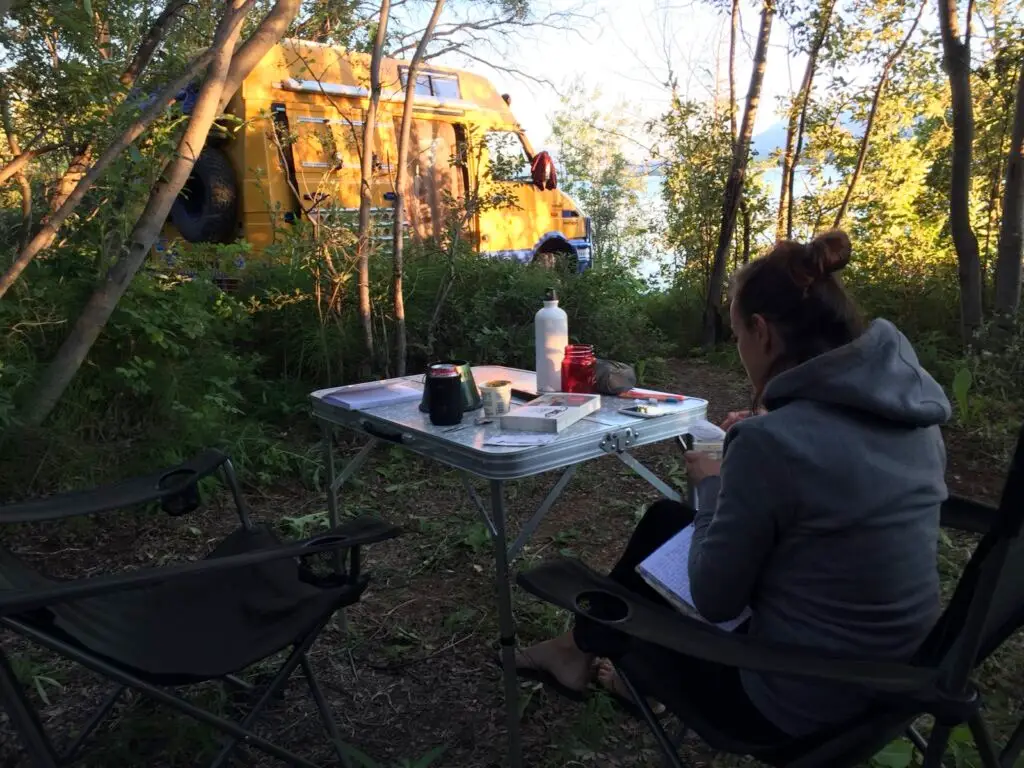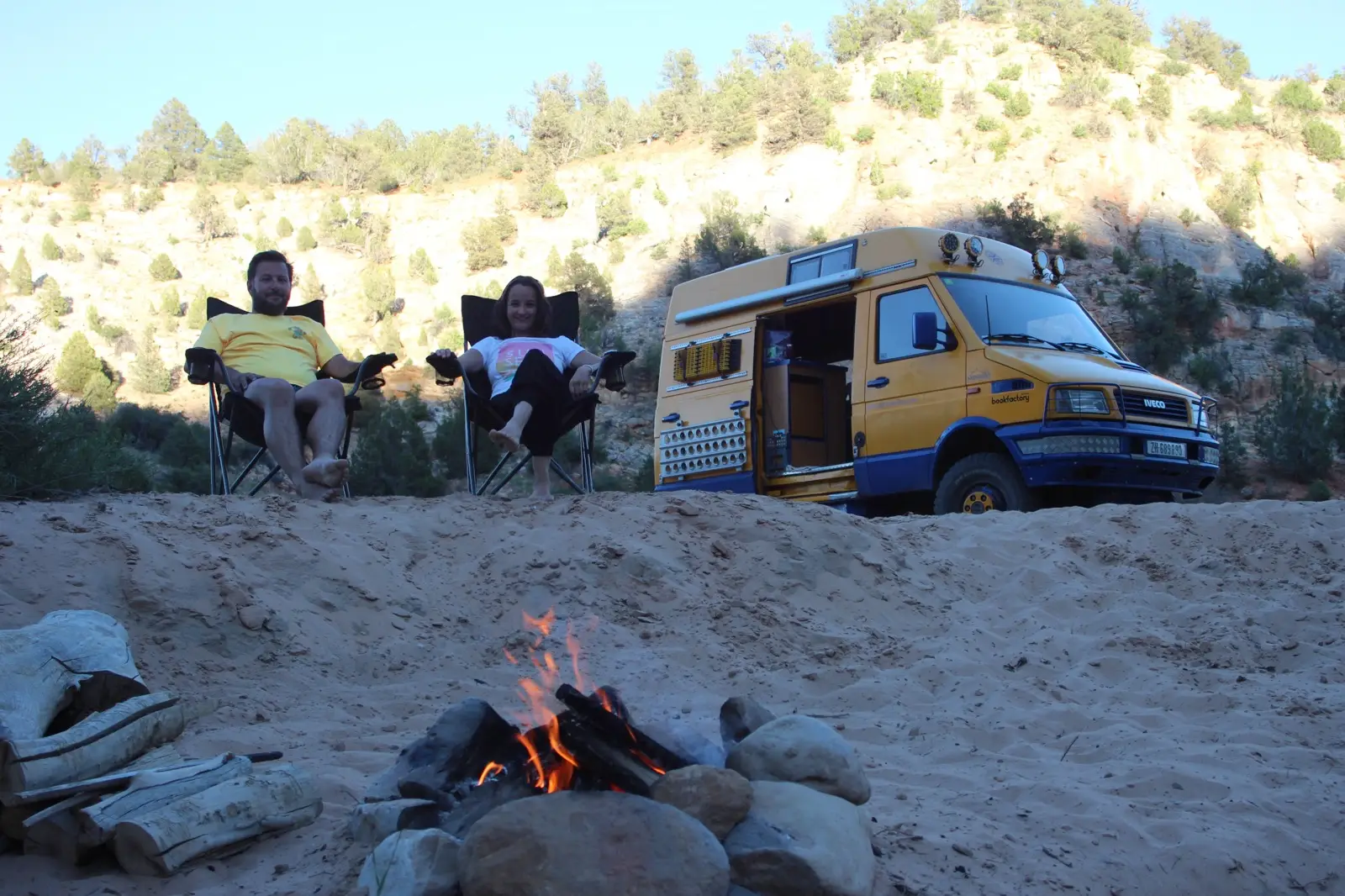
Before we left, one question kept us busy: where will we find places to sleep? In the long run it’s expensive and impractical to stay at campsites all the time. Prices vary: state-run sites (National Forest or State Park) cost between 10 and 40 USD, private ones like KOA are more expensive. State-run sites often have no showers or Wi-Fi, while private ones have clean showers and fast Wi-Fi. But campsites aren’t ideal, as you’re parked between huge motorhomes that often have bigger TVs than at home. The atmosphere is like a trailer park or an all-inclusive hotel, which doesn’t suit our travel style. National Forest and State Forest sites offer more privacy and are often nicely wooded. We prefer to look for free spots where we feel comfortable and can stay longer to recover from travelling.

There are various ways to find such places:
- iOverlander app: this free app for Android and iOS shows nearby places to sleep, even offline. Users can rate places and add new ones, so the app keeps improving thanks to the participation of many travellers. [iOverlander](http://ioverlander.com)
- Free Campsites website: this site lists campgrounds and their costs. However, it can’t be used without internet access. [Free Campsites](https://freecampsites.net)
- Supermarket car parks: overnight stays are allowed in most Walmart car parks, with few exceptions. Safeway and Cabela’s also offer this option. [Walmart](https://www.walmart.com), [Safeway](https://www.safeway.com), [Cabela’s](http://www.cabelas.com)
- Truck stops or travel centres: these are noisy, as lorry engines often run all night. But they offer showers and laundries. Showers usually cost 10 USD, but nobody minds if two of you use one.
- KOA (Kampgrounds of America): these luxury campgrounds offer Wi-Fi, showers, often a spa and laundry. Electricity and water are included. [KOA](http://koa.com)
- State Park campgrounds: these state-run sites cost 15–25 USD and often have showers. Wild camping is prohibited, but rangers are sometimes lenient. [State Parks](http://www.camping-usa.com/stateparks/)
- National Forest campgrounds: these offer self-registration and allow dispersed camping if your vehicle is suitable. There are rarely showers, but the toilets are usually clean. [National Forest](https://www.forestcamping.com)
- BLM land (Bureau of Land Management): this land is open to everyone; sometimes a permit is required. Information is available at visitor centres. [BLM](https://www.blm.gov/programs/recreation)
- Social media: contacts via Instagram and Facebook often lead to invitations to stay in someone’s garden or guest room. The hospitality in the USA and Canada is impressive.
- Just ask: if all else fails, it often helps to ask someone for permission to stay on their property. Americans and Canadians are open and helpful.
- Another helpful site with information on where you can stay and for how long: [Your RV Lifestyle](https://www.your-rv-lifestyle.com/how-to-find-free-rv-camping-sites/)