Camping in the USA & Canada

Organisation & Planung – Offroad Travelers

Before we left, one question kept us busy: where will we find places to sleep? In the long run it’s expensive and impractical to stay at campsites all the time. Prices vary: state-run sites (National Forest or State Park) cost between 10 and 40 USD, private ones like KOA are more expensive. State-run sites often have no showers or Wi-Fi, while private ones have clean showers and fast Wi-Fi. But campsites aren’t ideal, as you’re parked between huge motorhomes that often have bigger TVs than at home. The atmosphere is like a trailer park or an all-inclusive hotel, which doesn’t suit our travel style. National Forest and State Forest sites offer more privacy and are often nicely wooded. We prefer to look for free spots where we feel comfortable and can stay longer to recover from travelling.

Camping in den USA & Kanada – Offroad Travelers

There are various ways to find such places:

  1. iOverlander app: this free app for Android and iOS shows nearby places to sleep, even offline. Users can rate places and add new ones, so the app keeps improving thanks to the participation of many travellers. [iOverlander](http://ioverlander.com) 

  2. Free Campsites website: this site lists campgrounds and their costs. However, it can’t be used without internet access. [Free Campsites](https://freecampsites.net)
     
  3. Supermarket car parks: overnight stays are allowed in most Walmart car parks, with few exceptions. Safeway and Cabela’s also offer this option. [Walmart](https://www.walmart.com), [Safeway](https://www.safeway.com), [Cabela’s](http://www.cabelas.com) 

  4. Truck stops or travel centres: these are noisy, as lorry engines often run all night. But they offer showers and laundries. Showers usually cost 10 USD, but nobody minds if two of you use one.

  5. KOA (Kampgrounds of America): these luxury campgrounds offer Wi-Fi, showers, often a spa and laundry. Electricity and water are included. [KOA](http://koa.com) 

  6. State Park campgrounds: these state-run sites cost 15–25 USD and often have showers. Wild camping is prohibited, but rangers are sometimes lenient. [State Parks](http://www.camping-usa.com/stateparks/) 

  7. National Forest campgrounds: these offer self-registration and allow dispersed camping if your vehicle is suitable. There are rarely showers, but the toilets are usually clean. [National Forest](https://www.forestcamping.com) 
  8. BLM land (Bureau of Land Management): this land is open to everyone; sometimes a permit is required. Information is available at visitor centres. [BLM](https://www.blm.gov/programs/recreation)
     
  9. Social media: contacts via Instagram and Facebook often lead to invitations to stay in someone’s garden or guest room. The hospitality in the USA and Canada is impressive.

  10. Just ask: if all else fails, it often helps to ask someone for permission to stay on their property. Americans and Canadians are open and helpful.

  11. Another helpful site with information on where you can stay and for how long: [Your RV Lifestyle](https://www.your-rv-lifestyle.com/how-to-find-free-rv-camping-sites/) 
Camping USA & Kanada – Offroad Travelers

Diesel in Canada and the USA

USA & Kanada – Foto 36

Every European traveller with an older diesel vehicle in North America soon wonders why the car is blowing black smoke and cold starts are more sluggish than usual. That’s what happened to us when we picked up the car in Baltimore. At the time everything was still fine, because the tank was full of German diesel. The first few days went smoothly, as temperatures were high – over 30 degrees Celsius – and we were at sea level.

But when we drove higher and temperatures dropped, the problem began. Our Iveco started badly in the mornings. I often had to crank the engine brutally, which was painful. This procedure took 10 to 15 seconds until the engine ran. Then the car smoked black, grey and white for a minute. I was seriously worried that something was broken.

Today I know that this isn’t unusual for older diesel engines. Diesel in North America is of a different, poorer quality than in Germany, Switzerland and other Western European countries. The magic words are “low-sulphur diesel”. This diesel lubricates less and has a lower cetane number, which means lower combustion quality and performance.

Diesel in Kanada und den USA – Offroad Travelers

What you can do

You can’t eliminate the problem completely, but some measures mitigate it. Choose your petrol station carefully; the cheapest isn’t always the best. Here’s a list of petrol stations and their cetane numbers:

Canada:
– Petro-Canada (45–52)
– Sunoco Gold (45–50)
– Shell V-Power Diesel (no figure given, but one of the best)
– Husky Diesel Max (42–45)
– Autogas/Cascadian Biofuels, BC only (45–50)
– Red River Co-op (41–44)

USA:
– BP – Amoco branded (51)
– Chevron (49, with Techron 51)
– ConocoPhillips (48, in California 48–53)
– Petro-Canada (47–51)
– Shell (46)
– Sinclair (46)
– Marathon (45)
– Exxon/Mobil (43–46)
– BP (40–42)
– Hess (40–45)

((All cetane figures without guarantee)

Advantages of diesel with a higher cetane number:
– Lower consumption
– Quieter engine
– Good cold-start behaviour
– High power/torque
– Low emissions

A low cetane number has the opposite effects. In Europe the cetane number starts at 58; in the USA it can drop to 40, which causes problems.

Useful links:
– [Best Diesel Fuel Additive](https://autofella.com/best-diesel-fuel-additive/)
– [Cetane number – Wikipedia](https://de.wikipedia.org/wiki/Cetanzahl)
– [Diesel fuel – Wikipedia](https://de.wikipedia.org/wiki/Dieselkraftstoff)

Avoid filling up in national parks, as the diesel there has often been in the tank for a long time and can have a high water content. Also avoid petrol stations where a tanker is currently parked or has recently been, to avoid sediment from the tank. Fill up before longer stretches to avoid dubious petrol stations. It’s a myth that you won’t see a soul or a petrol station for 500 km on the Alaska Highway, but I’d rather play it safe.

Gib hier deine Überschrift ein – Offroad Travelers

Diesel additive

Many travellers use a diesel additive to combat the problem of poor diesel. The additive is poured into the tank before filling up. It increases lubrication and the cetane number, which is good for the engine.

We use the product from STANADYNE Fuel Systems, Diesel Fuel Additive (blue label). It’s recommended by Bosch Service and many travellers are happy with it. One bottle is enough for about 1,000 litres and costs around 25 US dollars. Alternatively, there’s the Lucas product, available at every Walmart.

STANADYNE is available at:
– NAPA Auto Parts
– AutoZone
– O’Reilly Auto Parts
– Tractor Supply (similar to Landi or BayWa)

In states like Oregon and Montana there’s no sales tax, so you should stock up on STANADYNE there if you have enough space.

Have a good, smoke-free drive! 😉

Diesel Additiv – Offroad Travelers

Border Crossings Between the USA and Canada

USA & Kanada – Foto 37

Border on Route 221 at Lacolle, QC, towards Montréal

The first border we crossed was on Route 221 at Lacolle, QC, towards Montréal. It was Sunday 23 April 2017. This border crossing is small and apparently little used, as the border officer’s surprised reaction showed. He asked in astonishment: “What are you doing here?” Our answer: “We want to go to Canada.” There was great interest in our vehicle; a colleague came over to take a look. Our passports were checked, and we answered questions about how many of us there were and whether we were carrying alcohol, tobacco, weapons, pets or animal products. The officers were curious and also asked about the shipping: cost and duration.

They sent us off with: “Welcome to Canada and enjoy!”

Grenze an der Route 221 in Lacolle QC in Richtung Montréal – Offroad Travelers

Border from Canada to the USA – Port Huron

On 29 April 2017 we returned to the USA via Point Edward into Michigan. We were asked how many of us there were, whether we had weapons, and about our insurance – both car and health insurance. He didn’t want to see the papers. He didn’t ask about food, but about our destination. Finally he asked whether we spoke Spanish and said, reassured, “very good” when I answered “yes”.

After five minutes we were through.

Grenze von Kanada nach USA - Port Huron – Offroad Travelers

Border between Canada's Waterton NP and the USA's Glacier NP

On 22 June we travelled from Glacier National Park to Waterton National Park at Chief Mountain. It’s actually the same park: two-thirds is in the USA and called Glacier, one-third in Canada and called Waterton. The same questions again: how many are we, are we carrying weapons, what are our travel plans? They also asked about firewood. Yes, we had some with us and had to hand it over.

We were through in a few minutes.

Border from Canada to Alaska / Poker Creek

On 10 July 2017, a foggy morning, the border officer greeted us with: “Hello, how are you?” She asked whether there were two of us and whether we had pets, weapons or tobacco with us. She didn’t ask about food. She admired our world map in the cab and asked whether we were travelling “all over the world”. We said, for now just North to South America. She asked about our jobs and disappeared with our passports.

Three minutes later she happily handed back our passports and said she had given us a “special stamp”: “because you made it :-)” A caribou now adorns our passports.

Border from Alaska to Canada / Beaver Creek

At Beaver Creek, done in five minutes: questions about weapons, animal products and the length of our stay. The officer wanted to know how to ask in German: “How long do you want to stay in Canada?” We gave a short language lesson and were sent off with “Willkommen in Kanada”.

Border from Canada (BC) to Alaska / Dalton Cache

At Dalton Cache the officer rolled out of the building into the booth. Apparently not many people come by here on Sundays. “Where are you from?” – “Germany.” “What is this? A Mercedes?” – “No, an Iveco, he is Italian.” “You German guys driving an Italian vehicle? Seriously?!” The officer had a sense of humour. He asked whether we had any food from Canada with us. We said no. As a farewell he said: “Enjoy Canada and Tschüss.” Yes, he really said “Tschüss!”

Through in five minutes again.

Grenze Kanada BC - Alaska /Dalton Cache – Offroad Travelers

Border from Alaska to Canada / Fraser

On 3 August 2017 at Fraser: a young officer and the following conversation:

“Where do you live?” – “Switzerland.” “Vehicle shipped over?” – “Yes.” “Where did you start?” – “Baltimore.” “When do you fly home?” – “Next year August.” “How many days will you stay in Canada?” – “About three weeks.” “Are you working while traveling or just took time off?” – “No work, please! We took time off.” “Have you more than 10,000 cash with you?” – “Unfortunately not!” “Doing everything with credit card?” – “Yes.” “Enjoy your time in Canada!” – “Thank you.”

Grenze Alaska - Kanada /Fraser – Offroad Travelers

Border from Victoria, Vancouver Island, Canada, to the USA / Port Angeles, Washington

On 26 August 2017 from Victoria, Vancouver Island, to Port Angeles, Washington, USA, by ferry: this time the border crossing took a little longer. Time was running short. We were supposed to leave the USA for Mexico on 3 October. As our vehicle had arrived late, our insurance was valid until 10 October. We planned to ask for a two-week extension at the border. Border control took place in Victoria harbour while we were waiting for the ferry. The first questions were: “How many travelers?” “Where do you live?” “What are you doing for work?” “How long do you wanna stay in the US?”

Then it’s our turn. We say that we have to be out by 3 October and still want to travel down the coast to Mexico. Could he extend our visa by two weeks because we spent too much time in Alaska? I add that the summer there was particularly beautiful this year because it was so hot, so there were hardly any black flies and mosquitoes. He briefly lifts his sunglasses, grins and says: “Good to know.” Hesitantly he then asks whether we can confirm our jobs, employers and place of residence, and sends us into the office. We pack papers and laptop and go in. Again they ask us the same questions, and we explain our request again.

The officer sends us outside and makes us wait. I think he wants to deal with the other travellers first because we’re holding up the traffic. When nobody else is queuing, he calls us back in and asks more questions: where we entered the USA, when we were where and for how long. You really have to think about that when you don’t even know what day of the week it is. He wants to know whether we shipped our vehicle here, what vehicle we drive, what the shipping cost and how long it took. He also wants to know how much we saved for the trip, or what our budget is. We wait patiently while he deals with other travellers in between. He says it will cost 6 dollars per person and we can pay by credit card. We’re delighted, and even more so when he says he has now given us another six months. He staples a slip into our passports and says we have to hand it in when we leave for Mexico. He doesn’t know whether we could then immediately get a third six months – that’s at the officer’s discretion. We pack our documents back up; he didn’t look at them.

When we’ve stowed everything away, we look at our passports and notice with astonishment that they say “Germany (West)”… That was 28 years ago now!

Grocery Shopping in the USA & Canada

USA & Kanada – Foto 38

Grocery Shopping in the USA and Canada

Anyone travelling to the USA or Canada will often be given this advice: “Go to Walmart, you’ll find everything you need there, it’s cheap and you can even camp in the car park!” That may be partly true, but as so often, the truth lies somewhere in the middle.

Spending the night in your camper in a Walmart car park can indeed be very practical (more on that in another post). In my opinion, though, the food you get there is often borderline, and the pack sizes simply aren’t made for our fridges!

As you may already have guessed from my first sentences, we’re not big Walmart fans. Please don’t let us influence you; we’re just trying to share our experiences and don’t receive any commission from any shops.

For Germans and Swiss it’s often confusing that vegetables and fruit are more expensive than meat. For example, you can buy a kilogram of beef steak for 10 USD, while a kilogram of strawberries costs 14 USD! Annoyingly, it’s also cheaper to eat at McDonald’s than to buy vegetables and cook them yourself. That’s probably why many people here carry a little more weight.

We’ll now take a closer look at the following shops: Walmart, Safeway, Albertsons, Aldi, Trader Joe’s and Real Canadian Superstore.

Lebensmittel einkaufen in den USA und Kanada – Offroad Travelers

Walmart

As already mentioned, we’re not big fans, but there are differences from Walmart to Walmart. In Dawson Creek, Canada, we found many good, partly European products at affordable prices in the Walmart – we could hardly believe we were in a Walmart! However, that’s probably a Canadian peculiarity, as we didn’t come across this phenomenon in the USA. There all Walmarts look roughly the same. Walmart certainly has the advantage that you can get everything here, from garden chairs to pans to food. I don’t want to badmouth it, but I don’t have a good feeling buying a kilogram of meat for a few dollars – I can’t imagine that this meat comes from a happy cow! Vegetables, as already mentioned, are relatively expensive and quickly become a luxury item. We’ve never seen good bread at Walmart.

You’ll find Walmart everywhere in the USA and Canada.

www.walmart.com

Food USA & Kanada – Offroad Travelers

Safeway

On the whole, Safeway offers a higher-quality range. But let’s say it straight away: without a member card there’s no point even starting, because prices are very high without it. It only becomes affordable if you take advantage of the discounts. On one shop of over 120 USD we saved 30 USD and only paid 90 USD! That’s always worth it, and best of all, you collect points that you can redeem 1:1 when filling up at a Chevron petrol station – so you win twice! Not always, but often, you’ll also find edible bread. There’s always a counter with European sausage and cheese, though they’re relatively expensive.

Albertsons, we believe, is connected to Safeway, as the only difference we could see is the shop colour, which is blue instead of red. Maybe we’re wrong and these two shops don’t belong together. What remains is that the product range is very similar, but prices are a little higher.

You’ll find Safeway almost everywhere in the USA and Canada; Albertsons is far less common.

www.safeway.com

Food USA & Kanada – Foto 2

Aldi

Now it gets interesting 😉 Yes, that’s right, there’s Aldi! We were very surprised too, and after a lot of back and forth we decided to do a shop there. That wasn’t to our disadvantage, as Aldi USA actually surprised us enormously positively. The range is varied, and there are many German products too, such as Nuremberg bratwurst (the real ones!) or Apfelschorle. There’s also a rich selection of cheese and cold cuts that taste quite good. We were particularly surprised by the selection of vegetables and fruit, offered at reasonable prices. Depending on whether the shop is in a state where alcohol may be sold in supermarkets, there’s a decent selection of beer and wine.

But there are a few things we don’t like so much here either, such as a dozen eggs for under a dollar. I can’t imagine that hens can be kept humanely for that price! All in all, Aldi came second in our supermarket ranking!

Aldi is actually only found in the East and Midwest. There’s no Aldi on the West Coast. It’s split up a bit like Aldi Süd and Aldi Nord in Germany – but more on that later.

www.aldi.us

Food USA & Kanada – Foto 3

Trader Joe's

Without doubt our no. 1 for price, quality and range! Trader Joe’s is a subsidiary of Aldi Nord and is found mainly on the West Coast and occasionally in the rest of the USA. TJ’s is a mecca for vegans, vegetarians and people with lactose or gluten intolerance. You can get everything here, a bit like in a health food shop. The selection of vegetables and fruit is also varied and affordable. Meat is relatively expensive, but everything is organic, so you can assume the animals were kept humanely. The selection of cold cuts and cheese is also quite good, and depending on the shop you can get the odd product from home that you miss when you’ve been travelling for a long time. For me, one of the highlights at TJ’s is the very varied selection of wine and beer. You’ll find both US wines and overseas wines from Italy, France and so on. Wine prices are reasonable and the quality very good. Beer costs about the same as in a liquor store. There are always a few locally produced products in the shops, so with luck you can get decent bread (not always).

www.traderjoes.com

Trader Joe`s – Offroad Travelers

Real Canadian Superstore

As the name suggests, this shop only exists in Canada. At first glance it resembles a Walmart a little; at second glance you’ll find lots of great products, such as liver sausage from the Frey company, which presumably has German roots, if the name is anything to go by. You can certainly trust the taste – it’s very German 😉 But there’s more here that’s really pretty good. The selection of vegetables and fruit is rich and good, at affordable prices. I particularly like the cheese and sausage selection, e.g. an oversized Camembert for 7 CAD (approx. 5 USD).

www.realcanadiansuperstore.ca

Canadian superstore – Offroad Travelers

Farmers' Markets

Farmers’ markets can now be found all over the country, and you can shop quite well there, e.g. farm eggs or fresh seasonal vegetables, homemade jam, honey, bread and so on. We love shopping locally at markets. It’s usually not even more expensive than in the supermarket, so it’s certainly a good option if you don’t want to live on chemically produced food. The markets are usually on Wednesdays and Saturdays and are often announced at the entrance to town.

The Good Bread Question

Across the USA and Canada you’ll come across Swiss and German bakeries every now and then, some of which have very good bread. Especially in big cities like Vancouver, Seattle etc. it’s easy to find one. But we’ve also been lucky a few times at farmers’ markets, of which there are now quite a lot, and been able to buy very good bread. As already mentioned, Safeway and Trader Joe’s often have good, crusty bread.

For those of you who bake yourselves and like to use rye or spelt flour: stock up on these flours in Canada, as they’re much harder to get in the USA. Even though they’re generally easier to get in Canada, we mostly only found them in organic markets. In the USA it’s probably easier to get good flour on the West Coast, as people here generally live more consciously.

Forscher Bakery near Zion National Park, USA (our no. 1 bread)
forscherbakery.com

Farmers’ Market St. Jacobs, Canada
stjacobs.com/Farmers-Market-General-Information.htm

Dawson Creek Swiss Bakery
oldfashionedbakery.ca

Vancouver: Breka – a chain, but good bread
breka.ca

Victoria on Vancouver Island: Cobs Bakery
cobsbread.com

Alpine Bakery in Whitehorse (just behind Forscher, no. 2 of our top breads)
alpinebakery.ca

Valemount, Canada: Swiss Bakery
valemountswissbakery.com

Das Thema Gutes Brot – Offroad Travelers

Alcohol

You should find out in advance in which states you can buy alcohol in the supermarket and where you have to go to a liquor store. As a Bavarian I really shouldn’t say this publicly, as I’ll probably no longer be allowed back into Bavaria, but I like the microbrewery culture in Canada and especially in the USA. There are so incredibly many small breweries, some of which brew excellent IPAs and pale ales that you absolutely have to try! The selection is so huge that you could drink a different one every day and would probably need 1,000 years to taste them all. There’s also plenty for our better halves, such as grapefruit-flavoured IPA etc., which, I admit, I quite like too 😉 There are also an incredible number of brewpubs, simply called “breweries”. They usually serve burgers, salads etc. – good quality at reasonable prices – and best of all, each of these microbreweries brews its own beer, which in most cases tastes very good. Our personal favourites so far are in Oregon and Washington.

Somewhere in the Middle of Nowhere: a Strange Noise and an Apocalyptic Mood

USA & Kanada – Foto 33

Muggl is filled up with diesel and water, food and drinks are restocked. We’re ready for the outback! On 7 July we drive onto the Dempster Highway, which runs from Dawson City to Inuvik, Canada’s northernmost town. This lonely, wide road is unpaved and used mainly by big trucks as a transport route.

Irgendwo im Nirgendwo, ein seltsames Geräusch und Weltuntergangsstimmung – Foto 3

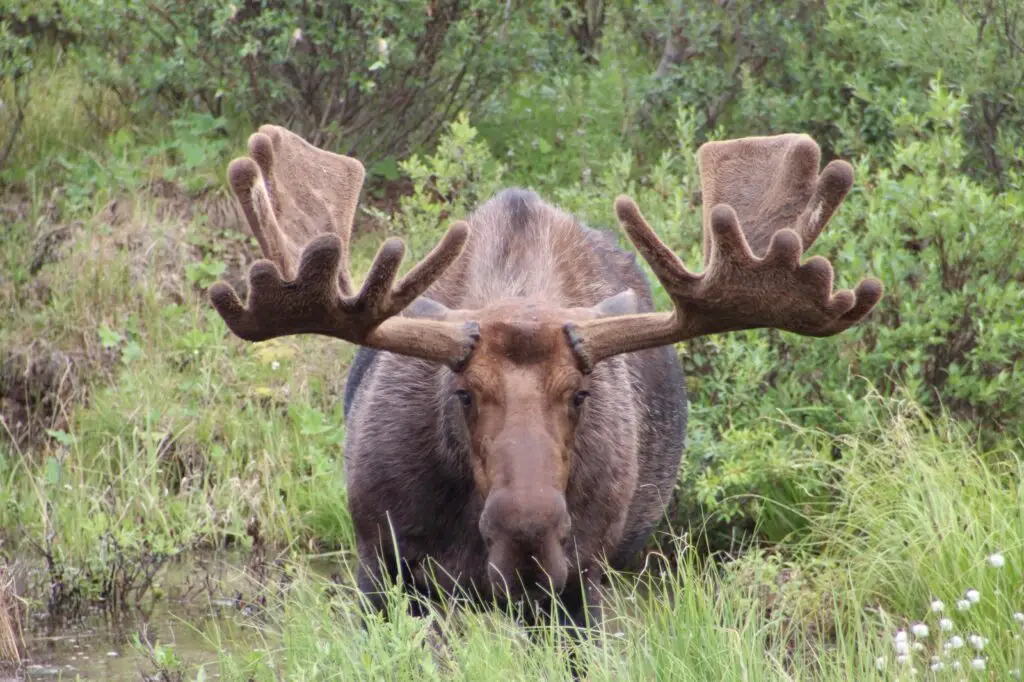
On the way to our first stage destination we finally see our first moose. The names here are a bit confusing: the huge animal with the rounded antlers that Germans call “Elch” is called a moose in the USA and Canada. “Elk” there refers to a large species of deer that’s hard to find. The ratio of animals actually seen to warning signs along the road is about 1 to 1 million. We were starting to think they didn’t exist at all and the signs were just there for fun. As we drive past a pond next to the road, I see a mound of fur and think: they’ve got big beavers here! When I spot the second animal, I realise it’s a moose. I shout: “Stop! Moose!” Christoph stops immediately and reverses. What I took for a giant beaver were actually just the shoulder blades of a moose that had just dived down to eat seaweed. So there are two of these mysterious animals in all their size and glory in front of us. You don’t really want to get out – it doesn’t look like it, but apparently they can be pretty fast.

On this Friday we drive 160 km before looking for a spot to spend the night in a dry riverbed. It’s already late, but still hot and light. Summer in Canada means it doesn’t get dark – not at all. At best there’s a bit of dusk between 1 and 2 am, and that’s it. We saw the last car hours ago, and this “evening” only one more truck drives past us. As it doesn’t get dark, the mosquitoes don’t go to bed either. We still don’t have a mosquito screen on the sliding door, as we’ve been pretty lucky with the little beasts so far. I quickly cut the net to size and attach it to the door with Velcro. Now we can open everything up for a through-draught, and it’s more or less bearable.

Irgendwo im Nirgendwo, ein seltsames Geräusch und Weltuntergangsstimmung – Foto 4

We hadn’t expected summer in Canada to be so hot, but the locals tell us this summer is also unusually hot and sunny. Because of the heat and drought, Canada has big problems with wildfires. When we look north, the sky is orange-pink. As it doesn’t get dark, you can read a book here without light until midnight and don’t get tired at all. After a few weeks it feels like permanent jet lag and is pretty exhausting. So at 11:30 pm we’re still sitting in Muggl reading. Absolute silence around us – until I hear a noise. It slowly gets closer and I wonder what it could be. It sounds like stones or sticks clattering and doesn’t stop. As always, Christoph hears nothing, and I peer out of every window. Although it’s still almost as bright as day, I see nothing. Picture a sunny late afternoon in midsummer, around half past four – that’s what half past eleven at night is like in July in Canada!

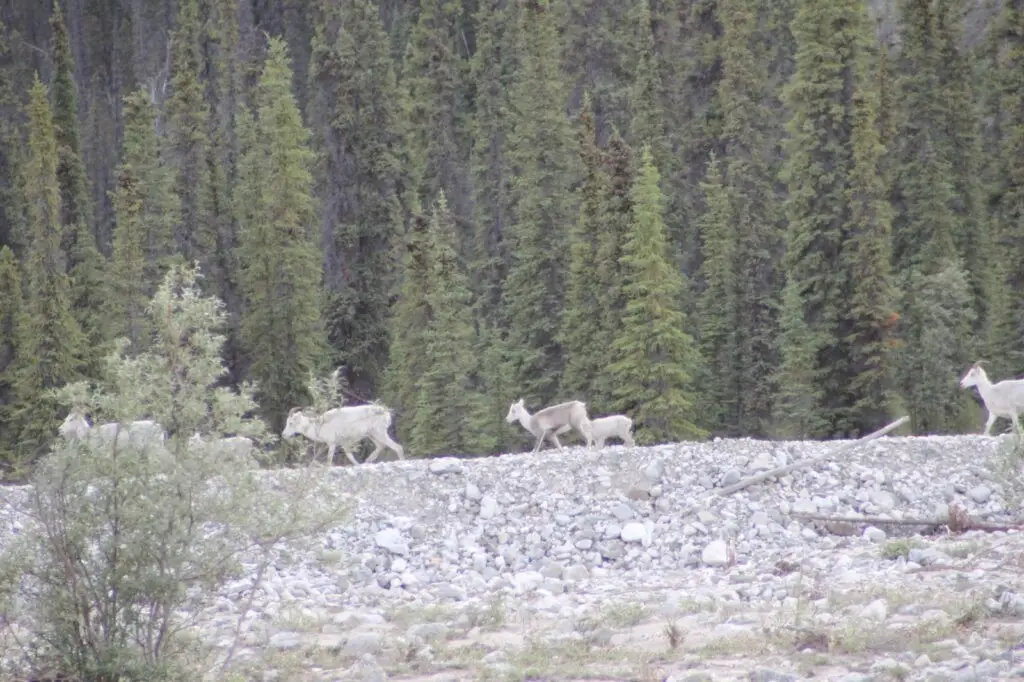
The noise gets closer, and I remember that other travellers saw a wolf here last year. The tension rises, because the noise is coming straight towards us. It’s now so loud that I can tell something is walking on stones, and it must be big, because it’s getting really loud. Christoph still hears nothing, and I don’t understand how anyone can’t hear the racket! I’m getting pretty excited and curious about what’s coming towards us. Just as Christoph is about to declare me crazy, I see what’s causing the noise and have to laugh out loud. Goats! A whole herd of little goats – tiny ones, slightly bigger ones, old ones, young ones, and lots of them. I couldn’t count them, but they march past Muggl one after another about five metres away. I really hadn’t expected that, especially as this kind of goat isn’t actually found here. The people we told about it afterwards didn’t know anything about goats like that here either. Anyway, after all the excitement we go to bed and decide to get up and drive on whenever we wake up the next morning. That turned out to be 3 am.

Irgendwo im Nirgendwo, ein seltsames Geräusch und Weltuntergangsstimmung – Foto 5

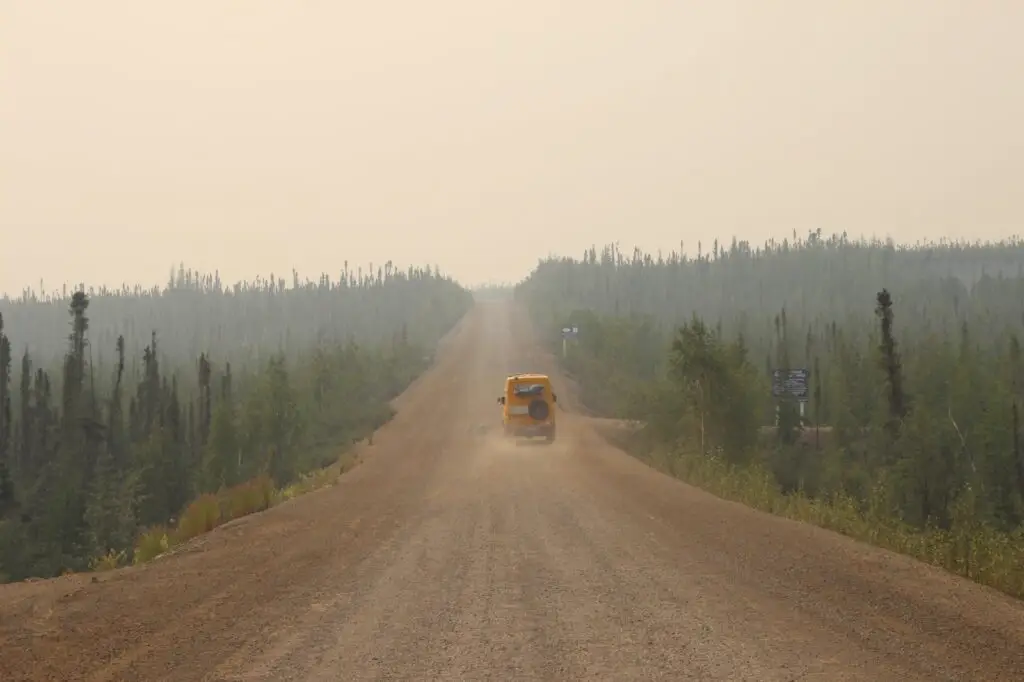
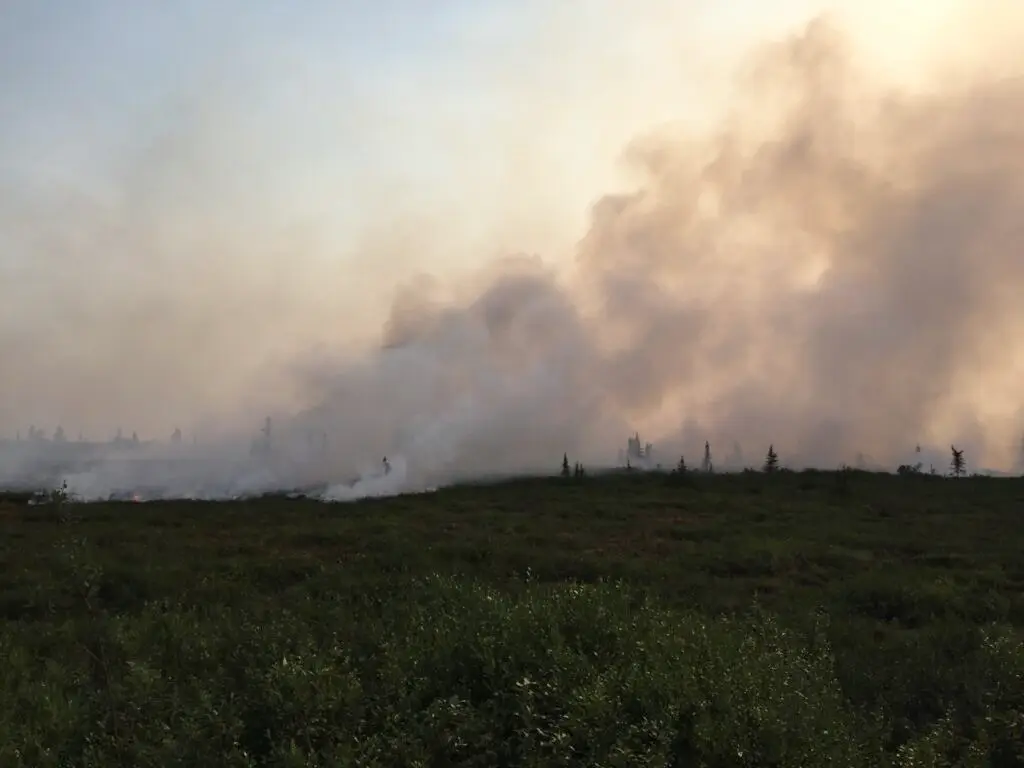
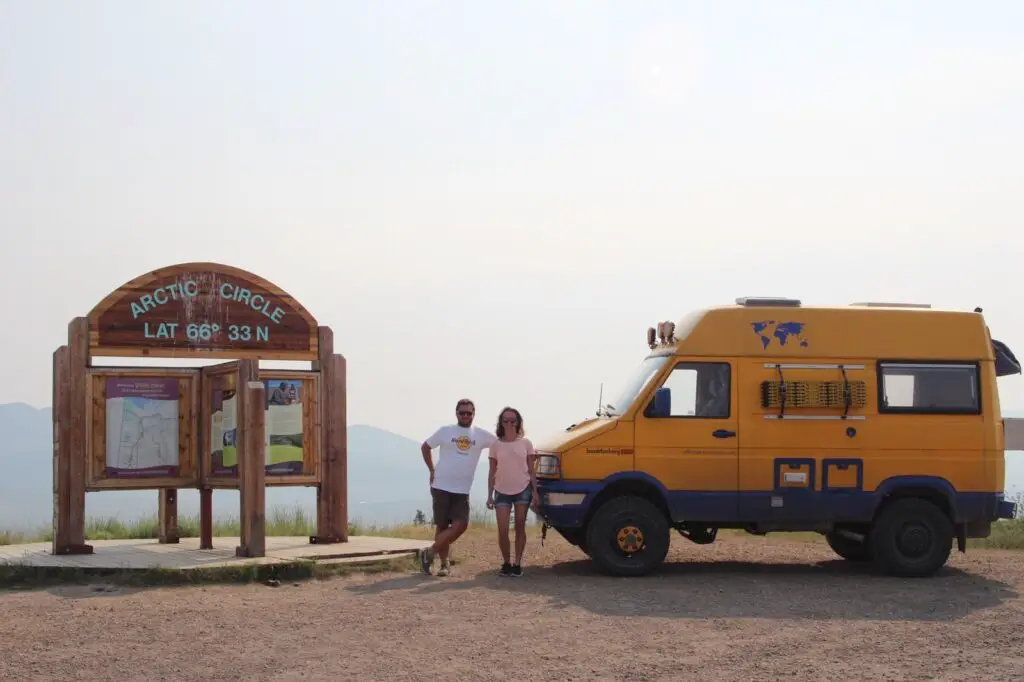
But we don’t get far, because about 40 km further on the road is closed because of wildfires – or more precisely, tundra fires, as there isn’t much forest left this far up. The vegetation this far north is quite different. Next to the roadblock there’s an entrance to a large gravel area. Two big trucks and a car are waiting there. We recognise one of the trucks as the last one we saw drive past us the evening before. So the road must have been closed for a while. We had heard that fires had broken out along the Dempster Highway and that it was sometimes closed from the north, especially at night, to prevent accidents due to poor visibility. We decide to wait two hours at most, have breakfast first and then take a nap. About an hour and a half later the road is open and we drive on. Hundreds of kilometres of gravel road lie ahead of us. To our right we see burnt little spruce trees. They don’t grow very tall here anyway; all that’s left is a black stalk. They look like oversized burnt matches. The wind is coming from the west and blowing the smoke away from us. We have good visibility, but decide not to drive all the way to Inuvik, because we can’t assess the risk of getting stuck there should the wildfires spread. Our final destination that day is the Arctic Circle, which is also the northernmost point of our trip. There we take a souvenir photo of the three of us (the two of us and Muggl) at the sign, and then we head back quickly.

Irgendwo im Nirgendwo, ein seltsames Geräusch und Weltuntergangsstimmung – Foto 2

The return journey is less relaxed, because in the meantime the wind has turned and is now blowing the smoke straight across the highway. We see nothing, absolutely nothing. At times we work our way back at walking pace. We have the windows closed, and still we feel we can’t breathe properly. Fortunately we soon leave the dense smoke behind, but because of another change in wind direction the whole 400 km of our way back are pretty smoky. That day we drive almost 700 km and are glad to be able to breathe reasonably fresh air again at the end of the highway. We didn’t need most of our supplies, apart from the fuel, but you never know what will happen when you drive lonely roads in Canada.

Irgendwo im Nirgendwo, ein seltsames Geräusch und Weltuntergangsstimmung

A Nocturnal Visitor

USA & Kanada – Foto 35

As yesterday was a long day, we went to bed early

It’s Wednesday 9 August, shortly before half past midnight, when I hear noises. I look out of every window several times to spot the troublemaker. Although there’s a full moon and the night is clear, I see nothing. It goes quiet and I lie down again. After a few minutes it starts again: scratching, scraping and knocking. Above, below, at the sides. I wonder what it could be: a raccoon on the roof, a porcupine under the car, a squirrel climbing up the walls. Again I get up, search and see nothing. Again I lie down. The noises seem to be everywhere and getting closer.

Da der gestrige Tag lang war, sind wir früh ins Bett gegangen

An invasion? Are we under siege? That can’t be! What animal is that fast? Is something whizzing over the car like Speedy Gonzales? Through the car? Through the panelling? I think I’m hearing things. Suddenly there’s a rustling under the bonnet. Ha! Maybe a marten! I’m sure of it and wake Christoph, who had been sleeping peacefully until then. “Start the engine, I think a marten is going after the cables.” He hears the rustling and scratching too, starts the engine, and indeed: we manage at least to chase the little creature out of the engine compartment, and it plops into the passenger footwell! It’s a teeny-tiny mouse! We hadn’t expected such a little critter to cause so much excitement. But now it’s here – and immediately gone again. It has actually found its way into the insulation and seems to like it there. It races from front to back, from top to bottom, and occasionally peeks out of a slit or hole here and there. It seems to want to tell us: “Here I am, you won’t catch me, I’m moving in!” Great!

We sit on the bed wondering how to get rid of this little rowdy, while it happily explores the cab, climbing up the passenger seat to the headrest and back down again. Finally we build a trap from a plastic box propped up on a clothes peg. A biscuit about three times the size of the mouse serves as bait. On the first attempt I’m too quick; the mouse isn’t fully inside yet and escapes before the trap snaps shut. It doesn’t take long before the greedy little mouse comes back. On the second attempt it’s caught! It’s half past four. It has no idea what’s happening and looks sceptical. To make sure it can’t get out, we put the four-kilogram compressor on top of the box. You never know.

Da der gestrige Tag lang war, sind wir früh ins Bett gegangen – Foto 2

We only let it go in the morning, just before we drive off, so that it doesn’t come back. But it doesn’t let us sleep any more. It gnaws on the biscuit to build up its strength and then tries to dig its way out of the trap, which of course it doesn’t manage – but it makes a huge racket. In the morning I put it on the picnic table. It seems tired – no wonder, it was up all night. Now we almost feel a bit sorry for it, sitting there like that. Before I let it out of the box, I say to it: “Think carefully next time whether you want to move into a camper again.” I imagine it nodded. When I lift the box, it sits there for a moment as if turned to stone before disappearing into the bushes Speedy Gonzales-style.