
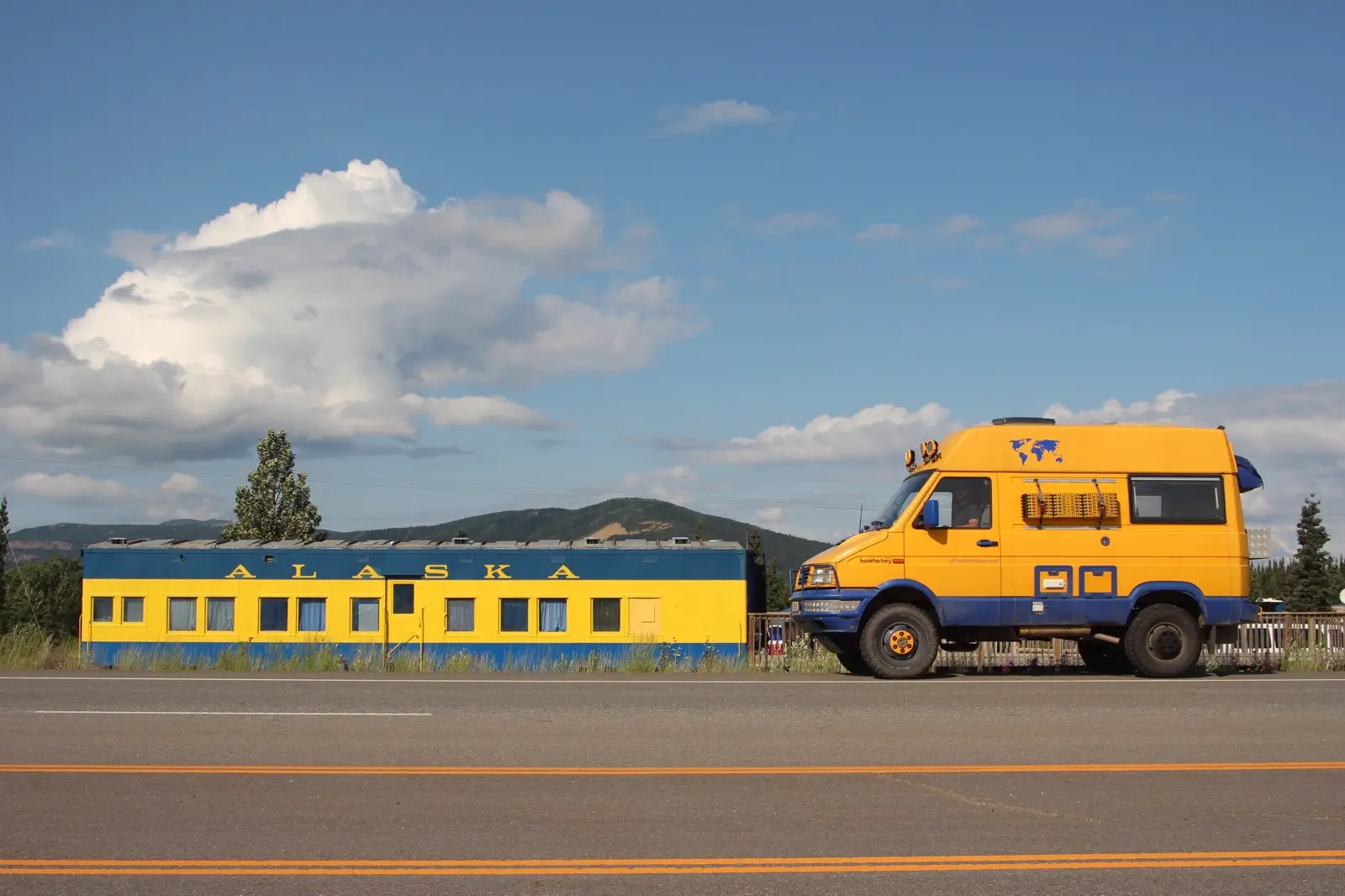
On 10 July we travel from Dawson City (Canada) along the Top of the World Highway and enter Alaska (USA) via North America’s northernmost border crossing, Poker Creek. For once the weather isn’t on our side: fog and drizzle shroud the landscape, which is said to be breathtaking here. But Alaska soon surprises us with hot, sunny days and crystal-clear lakes. Who would have thought we’d mostly be wearing shorts and T-shirts in Alaska? At the border a friendly officer asks whether we have pets, weapons or tobacco with us, which of course we deny. She admires our world map in the cab and asks whether we’re travelling the whole world. Again we say no: “No, just the Americas for now, then we’ll see.” She disappears into her booth with our passports and returns after three minutes, proudly announcing that she has given us a very special stamp: “because you made it!” Now a caribou adorns our passports, and we’re very proud.
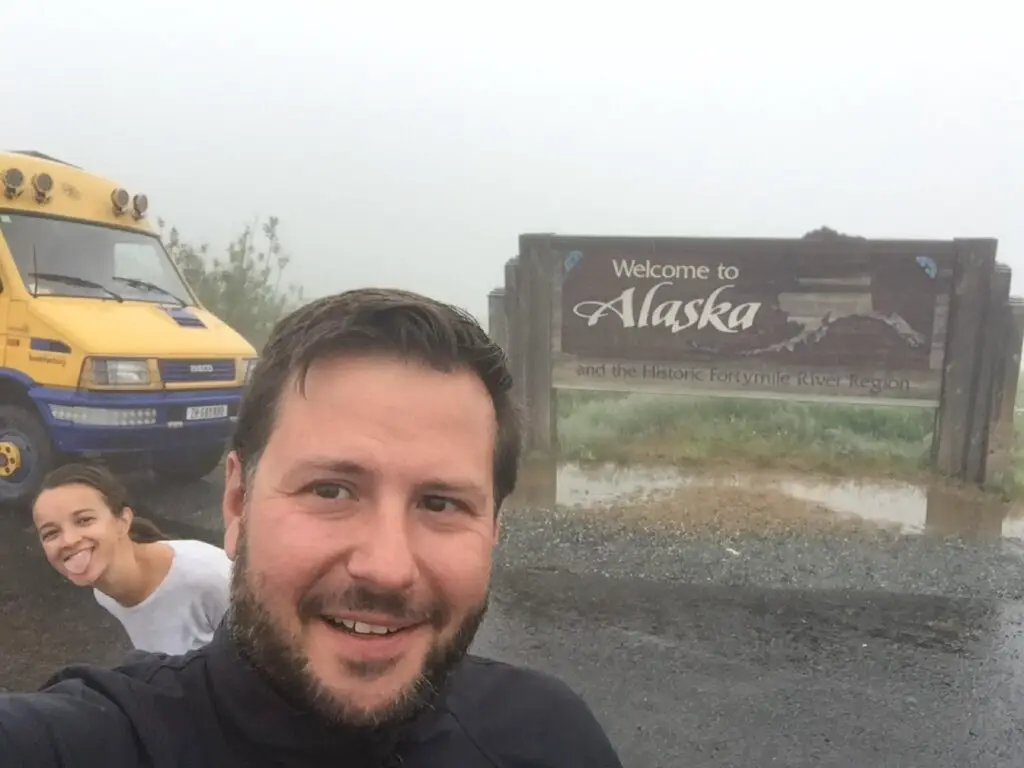
Shortly before we left Canada, we met Corinna and Reiner from Ahrweiler near Bonn at a small campsite. We only wanted to sit down briefly and say hello – suddenly it was 1 am. That can happen when it doesn’t get dark. As we’re now travelling in the same direction, we’ll see them often from now on and spend many evenings together, sometimes arranged, sometimes by chance. Our next destination, and the northernmost city we’ll visit on our trip, is Fairbanks. Originally we hadn’t planned to go this far north. If we make it to Anchorage, that’ll be good, we thought. But somehow we’re doing it like Forrest Gump: “We’ve come this far, we might as well keep going.”
Fairbanks is a sleepy city, and you really feel as if you’re at the end of the world here. You can see straight away that the winters here are long and hard: cables with plugs hang out of the car bonnets, supplying heating pads under the oil sump, on the diesel lines and the cooling system so that nothing freezes in winter. All car parks have power sockets where you can plug in your car while shopping or at the dentist. We camp for two nights with Corinna and Reiner in the university car park. Sometimes you just have to be resourceful when you have no fixed address. I even find out that you can pick up the university Wi-Fi – without a password. The evenings and nights aren’t cold, a bit fresh but pleasant, which invites cooking and lingering outside together. During the day, when the sun comes out, it even gets really warm, and we visit the farmers’ market, where we buy regional specialities such as fireweed jam. Fireweed is Alaska’s official flower and blooms in a beautiful pink.
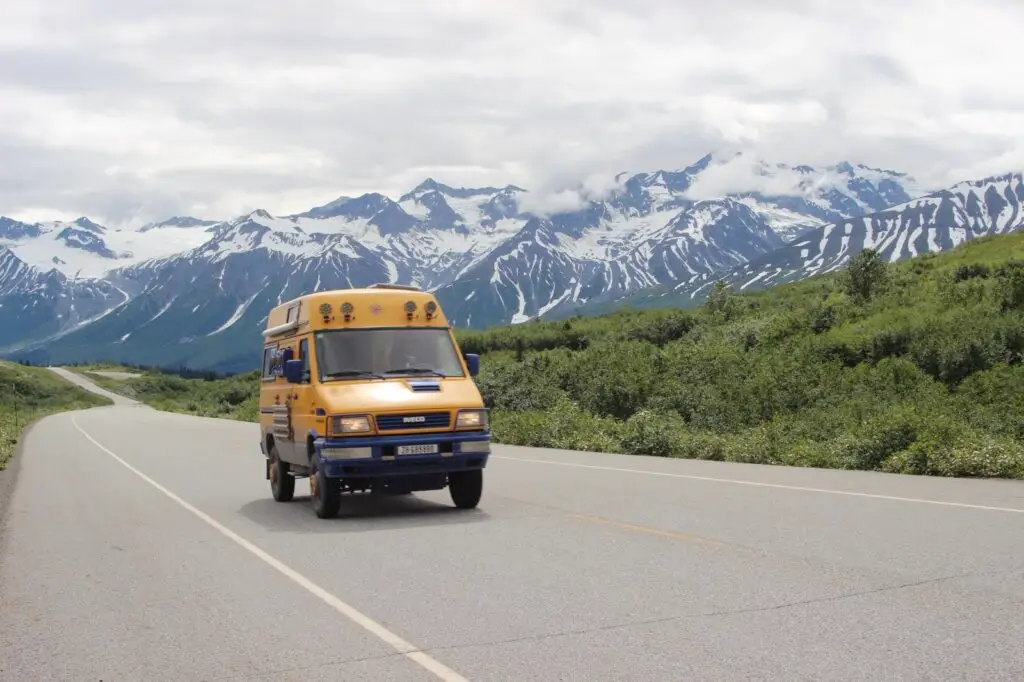
From Fairbanks it’s only south from now on. Our next destination is Denali National Park, where you may only drive the first 15 miles in your own car. If you want to go further or even to the end, you have to take a tour bus, which is a full 92 miles. You end up in Kantishna, at the end of the national park, and at Wonder Lake, which is crystal clear. It’s sometimes a bit annoying to spend the whole day with lots of other tourists and a non-stop chattering bus driver, but this far into the park nature is still completely untouched, so you can live with it. There are no kiosks, no food stands, no rubbish bins. You have to bring your own food and take your rubbish back with you, which is strictly checked. There’s not the slightest bit of litter lying around, and nothing is smeared or defaced in any way.
We see mountain goats as little white dots on the hills, grizzlies in the distance, some with their cubs, moose hidden in the bushes and lots of caribou, which often simply stand on the road. The landscape is impressively vast. Although it’s a bit cloudy and Denali, the highest mountain in North America, doesn’t show itself properly, we’re thrilled. On the way back it gets quiet on the bus. It’s been a long day and everyone is tired when suddenly we get into a traffic jam. Probably another caribou on the road, everyone on the bus thinks. But when the bus in front of us pulls aside, a wolf walks towards us, lies down on the road about five or six metres in front of us and rolls around on the gravel. He gets up again, sniffs the ground, stretches and lies down again to roll around. He does this four or five times. Then he slowly walks right past our bus. Everyone watches him in amazement, and even the bus driver, who has been doing this job for 17 years and is about to retire, has never seen anything like it and pulls out his camera.
We end this successful but exhausting day at the 49th State Brewery in Healy with excellent beer and burgers. By the way, you can see the film bus from “Into the Wild” here, with the original props. For those who don’t know the film, “Into the Wild” is the true story of a young American who in the 90s donated or gave away all his possessions and turned his back on the success-driven life that society and his parents wanted to force on him. He travelled across the USA for a few years and in autumn 1992 settled in an old Fairbanks city bus, which hunters actually used as a shelter in summer. The following spring he ran out of supplies, and the late snowmelt proved fatal. The “Magic Bus”, as Alexander Supertramp called it in his diary, became a place of pilgrimage. But if you want to follow the so-called Stampede Trail, you have to cross a river at one point, which isn’t without danger. As a young Swiss woman drowned only a year ago trying to reach the original Magic Bus, the brewery simply bought the bus from the film company, so that nobody has to risk their life for a souvenir photo any more.
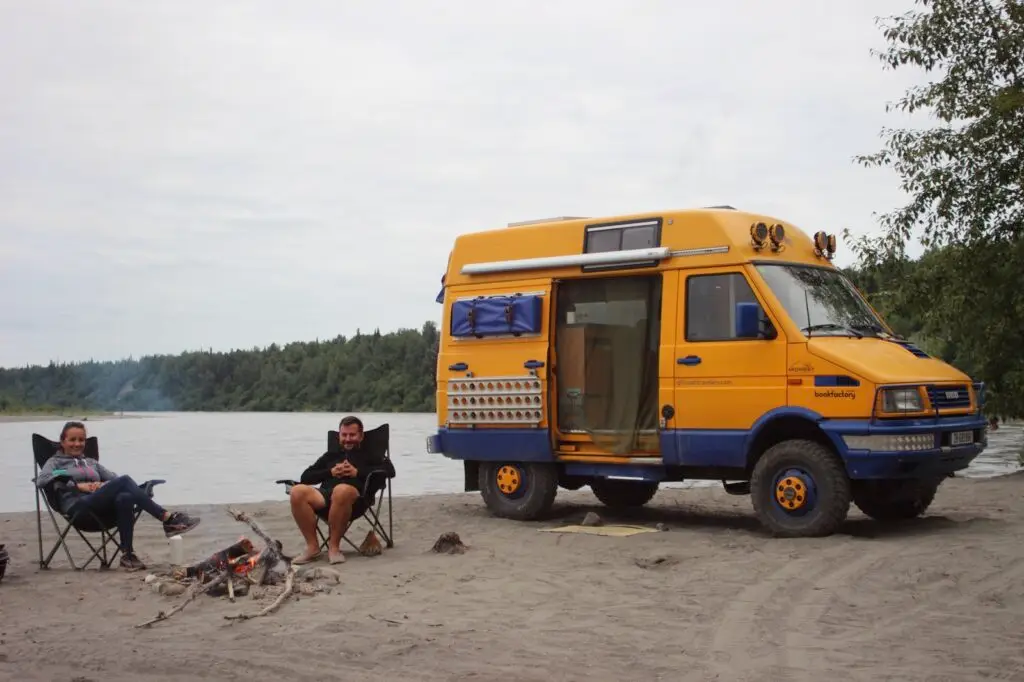
We continue south along the George Parks Highway, where we find a nice spot to camp on the bank of the Susitna River. The river bends at this point, and a grey sandbank offers good ground to park on. There’s enough driftwood around to make a campfire – the perfect opportunity to bake bread again. It’s a weekday and very quiet. It’s surely different here at the weekend, and while we’re enjoying the afternoon on the riverbank, a beaver even floats past. I had to look twice, as the piece of wood I thought I was seeing suddenly moved.

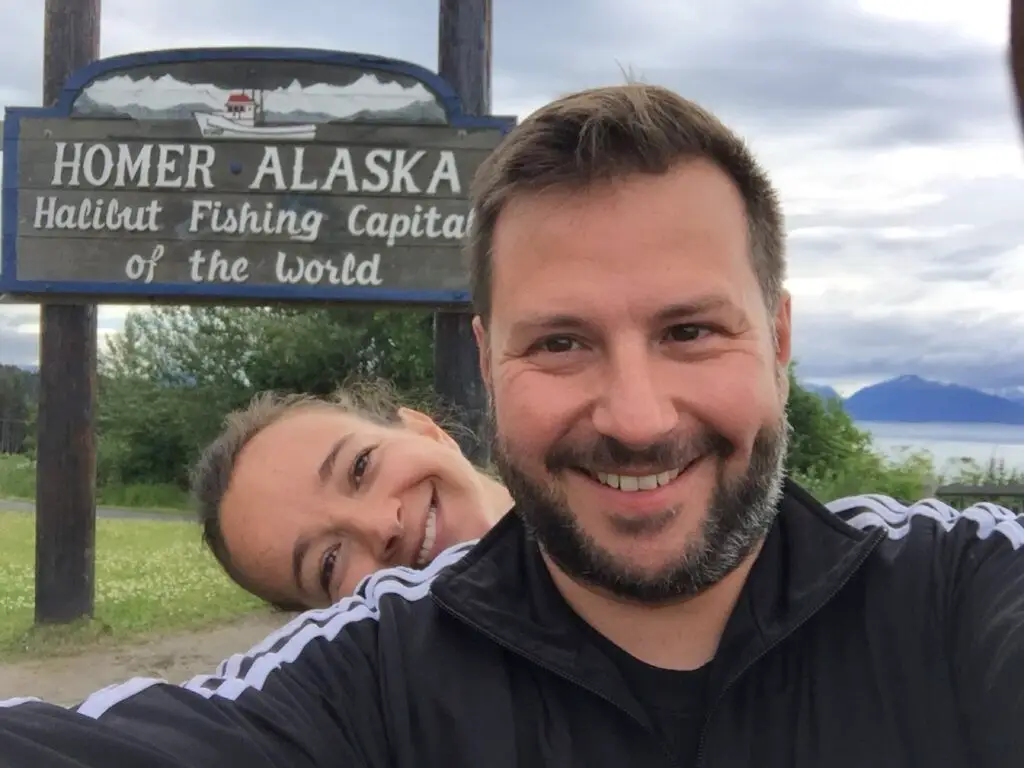
Anchorage didn’t particularly thrill us, even though the yellow street lamps and blue flower baskets are decorated in Muggl colours. We only spend an afternoon there. We want to go to the Kenai Peninsula, where once again we’re lucky with the weather. On the way there it’s still raining and dark with cloud, but the sun arrives with us (from wherever), and we park Muggl right at the end of the Spit and stroll along the harbour. All around are snow-covered hills and mountains, fishing boats are moored at the piers, the fishermen proudly show off the halibut they’ve caught, and bald eagles circle in the air. We watch, fascinated, how quickly and skilfully they fillet their halibut. A single fish is about 1.5 m long! A little further into the peninsula we quite by chance find a small turn-off at the side of the road. I just shout: “Right here!” and we end up in a small clearing by a stream among fir trees and fireweed. The evening sun bathes our home for today in a warm light, and although everyone warned us about mosquitoes and black flies in Alaska, to our delight they haven’t shown up so far – and that’s how it stays today.
Next we want to go to Kenai village. I had read somewhere that Old Town is supposed to be pretty, but in our eyes it isn’t. Still, something is going on in this sleepy little place. We follow the crowd and end up on the coast, where the Kenai River flows into the sea, and from the dunes we spot a lively bustle on the beach. We park the car and mingle with the crowd to find out what’s going on. People in waders with huge dip nets are standing in the water, some up to their necks. At first glance we can’t make out what they’re catching. And why all at once? A competition? It’s 21 July and salmon spawning season. For three weeks at this time of year, Alaskans may catch their annual supply of salmon. The rule: only with this type of dip net and “only” 25 salmon per household plus 10 salmon per child. For a family of five, for example, that makes 55 salmon! But not a single one too many – that’s checked and fined if you take too many. We watch in disbelief as the men and women proudly pull their huge salmon out of the water. Sometimes it’s a real fight, and a skilful twist of the net stops the salmon from escaping. The salmon are killed on the spot with a small club and a well-aimed blow to the head, gutted there and then, cut up and packed into cool boxes. I have to admit it’s not a pretty sight, but that’s how it is, and it’s been done like this here for decades. In between, children play and run around as if it were the most normal thing in the world – which for them it probably is, much like growing up on a farm back home. I still remember well when my grandma used to slaughter chickens.
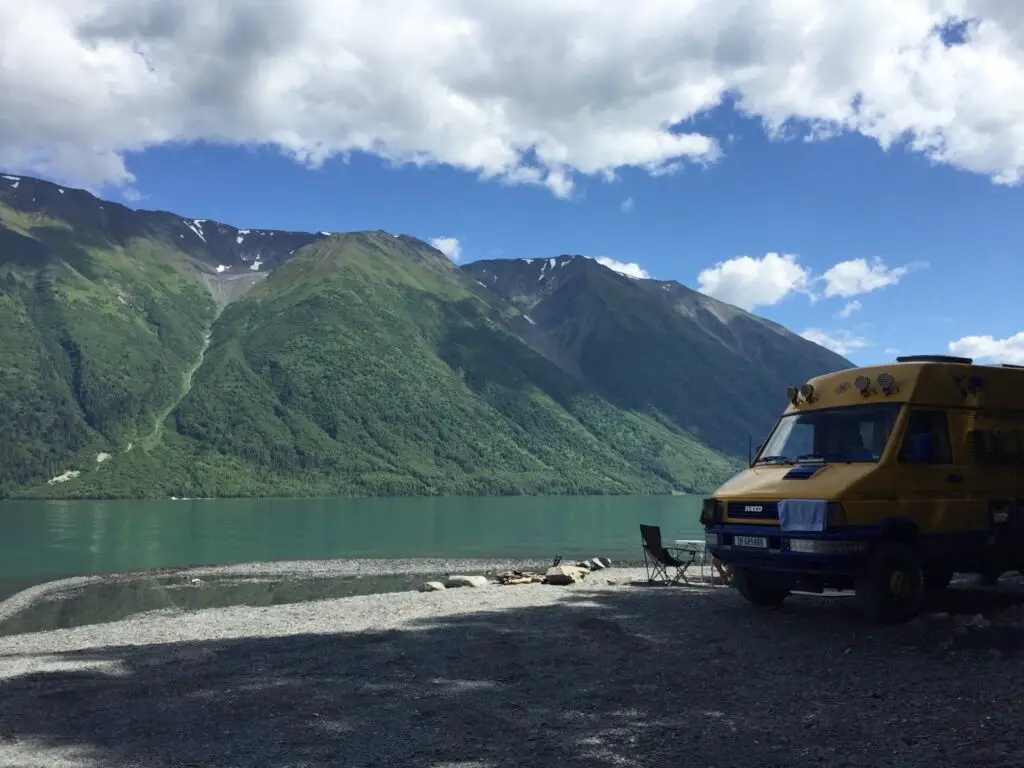
Our place to sleep and rest for the next few days is to be Kenai Lake. We’ve been told it’s steep down to the south shore and you’d need 4×4. No problem, and we’re pleased, because then there’s a good chance it won’t be too busy, as it’s Saturday. It really is steep going down, and the track is rocky, but before we’re even at the bottom we see one vehicle after another – normal cars – and we wonder how they got here, or rather, how will they get back up? Something that kept surprising us in the USA: no matter how bad the road, Americans are apparently quite unfazed and drive their cars everywhere – ideally towing a trailer as well. A small wedding is taking place at Kenai Lake today, and we’re told it’s a popular backdrop for wedding photos. Well then. We find a little spot at the end of the bay, and since it’s been a long day, all we want to do is sleep anyway. On Sunday morning most – well, almost all – of them leave again. There’s squeaking and clattering as they make their way up. Engines howl, and if it weren’t broad daylight, we’d see the sparks flying, I’m sure. We move to the other end of the bay for the next two days, where we have a slightly wider gravel beach and nobody can park right next to us. In the evenings we light a campfire and grill; during the day we enjoy the sun and the blue, ice-cold (12 degrees) water of Kenai Lake.
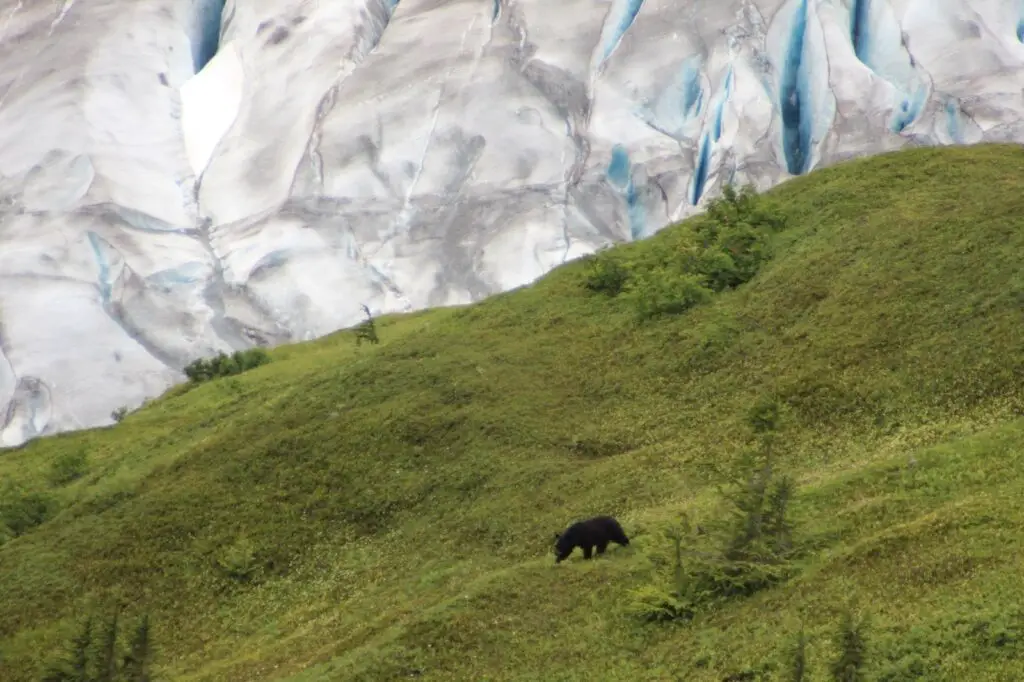
Having arrived in Seward, we first park at the visitor centre to get an overview of the area. Whom do we spot in the nearby supermarket car park? Corinna and Reiner, whom we now call Team Reico. I dash over, and we arrange to camp in a dried-up riverbed along Exit Glacier Road. Corinna, who does most of the driving, is pretty daring, as the riverbed is very stony and they’re travelling in a normal camper (Citroën). We’re proud! There we also meet Ludwig and Uschi from Regensburg, who are also travelling by camper. Yes, the world of travellers is small. That evening the six of us cook over the campfire. There’s freshly caught grilled salmon with remoulade and potatoes, and fruit salad for dessert. We also bake cinnamon rolls and bread in the Dutch oven. The next morning it’s raining a little, and our paths part again. Today we want to hike up to the glacier. Just as we’re making breakfast, someone suddenly peeks in through the door and says: “Good morning, are you by any chance driving to Exit Glacier?” Isabelle from Hamburg is travelling with a backpack and tent – alone! So we squeeze together, have breakfast first and then take her with us on the hike to the glacier. It has stopped raining and the sun comes out, so we can climb to the highest point in the best weather and visibility. Even a black bear and a few marmots show themselves, though far in the distance.
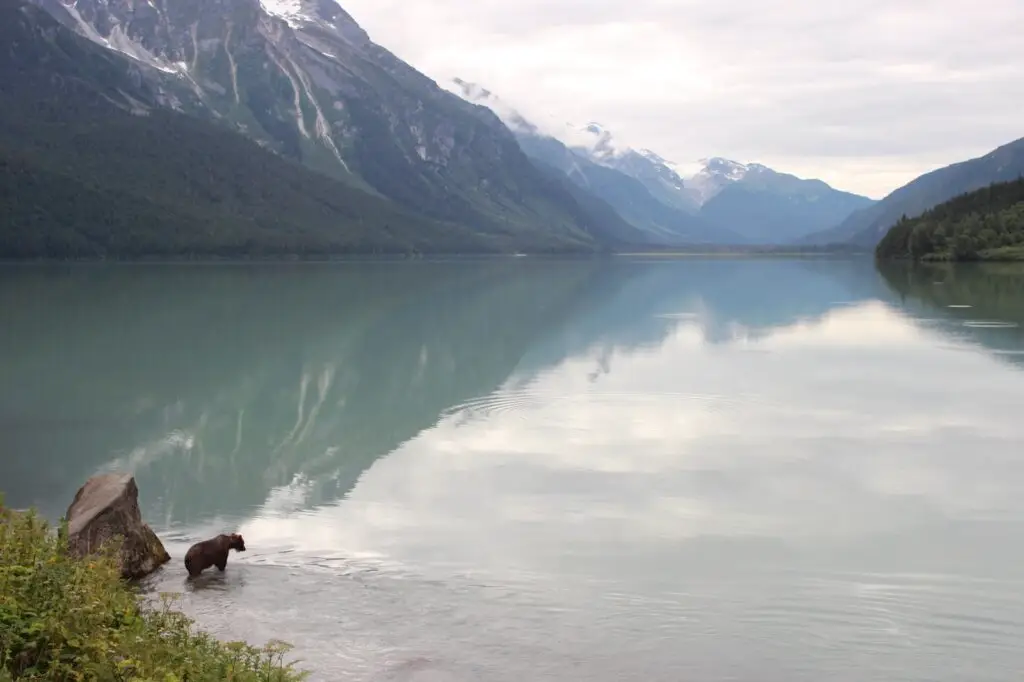
Getting to Haines is quite a drive, taking us along the last section of the Alaska Highway and through Canada back into Alaska to the sleepy little town. That’s 880 miles, i.e. 1,416 km, but we absolutely want to go to Haines, because bears are guaranteed there! The distances here are unbelievable, and you can’t imagine it if you’ve never travelled here. As soon as we arrive, our route takes us along the Chilkoot River to Chilkoot Lake at the other end of town. That’s where they’re supposed to be, the grizzlies. We park and wait, and after only about 10 minutes the people – local fishermen and a few tourists – become restless and jump back into their cars. Two young grizzly brothers walk along the river in knee-deep water, catching salmon as they go and devouring them with relish. The audience hides behind car doors and watches intently to see what happens. The two bears are about three years old, we’re told, and were chased away by their mother this spring because she’s had new cubs. They walk and splash to the end of the river, where it flows out of the lake, and where the water gets deeper, they just swim. When they’ve swum and splashed enough, they come ashore. Where the boat ramp is, it’s easy to get out. People jump into their cars and lock the doors. The two brothers are quick and explore everything very closely. The picnic bench and table smell of food and need to be thoroughly inspected. You can just walk over them, too. As there’s nothing to find and the two have already eaten one salmon after another anyway, they promptly disappear into the forest behind us. What a spectacle – we’re speechless!
For the night we look for a small lay-by between the riverbank and the narrow road leading to the lake and spend the night there. In the middle of the night we’re woken by a very loud snorting – both of us. It sounds as if the two bear brothers are out again and sniffing behind Muggl, exactly where we’re sleeping. Hopefully I won’t need the toilet tonight! We spend the next day entirely at the lake and the river. Further along there’s a metal weir in the river that the locals call the sushi bar. Bears like to come here during the day too to eat salmon. That’s why there’s a closed area next to it by the road where you’re not allowed to park or stand. That’s where the bears come out of the forest to have their meals. At midday a fully grown female bear is fishing there – and the sushi bar is called the sushi bar because the bears can easily press the salmon they catch against the grid and eat them. The female simply reaches into the water and pulls out a salmon, once with her right paw and once with her left. You could watch forever. Tonight we camp – or rather park – at Chilkoot Lake, even though camping there is actually forbidden. Officially it’s the first time we’ve knowingly spent the night illegally… well, “where there’s no plaintiff, there’s no judge”, and nobody knocked on our door at night. It was so quiet, in fact, that I don’t think even a bear came by – except Christoph. He caused a commotion, because some nights he has ants in his pants and finds it hard to lie still for two seconds. I tell you, that can be pretty annoying in a bed only 1.80 m by 1.20 m – and besides, the whole of Muggl wobbles too.
From Haines we take the ferry to Skagway, saving ourselves a long drive. Two hours later we reach the harbour, surrounded by huge cruise ships. Skagway is a popular cruise destination, which surprises me, as I’d never heard of Alaska cruises before. Why not? In Skagway we get creative looking for a place to spend the night and end up at the cemetery. That sounds worse than it is: the Gold Rush Cemetery was used until shortly after the turn of the century. As it lies below a slope and was partly buried by a landslide, it’s more or less closed. It looks like a cemetery from a Wild West film, with simple wooden crosses and crooked gravestones. When we arrive, the soft afternoon light falls through the trees and bathes the area in a magical atmosphere. A walk along a small path leads us to a waterfall that springs from a narrow gorge in the mountain. There’s a long-drop toilet at the car park, and it’s quiet at night. What more could you want? It stays quiet until 8 am, then the tourist buses arrive and the historic train to White Pass sets off.
Over the next few days we’re drawn back into the wilderness. We follow the Dyea Road a little way north, where a small river flows into the bay. Christoph has spotted mushrooms by the roadside and storms into the forest, while I walk to the river and the bridge. When I get there, I’m speechless: the river is teeming with salmon, packed tightly together, laying their eggs. I knew this happens here at this time of year, but we hadn’t specifically gone looking for it. All the nicer to find it by chance. I ask a guide who arrives with a group of tourists whether there are bears here. “Yes, right behind you!” he says. Startled, I turn around but see no bear. He laughs and explains that the bears only come at night; during the day it’s too busy for them. Aha! We drive on along the Dyea Road and camp with a campfire by a beautiful river, where the Jeepsters surprise us. The Jeepsters are a Hawaiian family: Sam, Lucie and three-year-old Kali, travelling in a 1966 Jeep called Jeepster with a roof tent. As the guide at the salmon river had explained that the bears only come at night, we get up at 4 am the next morning and wait. But the bears don’t show up. For us, it’s back inland from Skagway – and back into Canada.