
For a long time it was clear that we wanted to take a holiday from travelling somewhere, and in the end we chose Cuba. Our friend Hannes decided to visit us from Switzerland, and Cuba seemed an ideal destination. Some places in the world you should visit soon, and Cuba is one of them. Since we were already in Mexico, we were closer to Cuba than ever before! A flight from Germany or Switzerland takes 8–10 hours, from Cancún only one hour. Actually …
The flight from Cancún to Havana was booked for 18 December. At 6 am the owner of the campsite where we had safely stored Muggl for three weeks drove us to the airport. Everything went smoothly – check-in, security – until we boarded the plane. But then everything changed: on the runway we suddenly turned back! A technical fault forced us back to the terminal and we had to get off. A spare part had to be delivered from Mexico City, or we would get a replacement plane. Neither option promised speed. I wondered whether airports generally keep replacement planes on standby. We landed in Havana six hours late and only two hours before Hannes. So we didn’t get to Cuba that quickly after all …

A taxi took us to our casa particular – private accommodation where Cuban families rent out guest rooms. You can often have breakfast or dinner there too. The taxi dropped us next to the Museum of the Revolution in the centre, in front of a huge building that looked like a building site from the street. Great, I thought, that doesn’t look inhabited. But before I could finish the thought, a man with a rubbish bag came towards us. Who or what were we looking for, he asked. Casa de Toni, I replied. He stepped back and shouted loudly “TOOOONNNNIIIII” towards the balcony on the third floor. Yes, that’s where Toni lives with his wife Sonja. He came straight down and let us in through the side entrance. That was easy! Toni and Sonja welcomed us warmly and showed us our room and their flat. Our guest room was accessible via a separate entrance from the stairwell. The entrance area had a mini kitchen; from there you went into the room, to the right into the bathroom, and by the window a small spiral staircase led upstairs. The bed upstairs was bigger, and Christoph and I grabbed it straight away. Hannes slept downstairs, and I thought: beds in Cuba aren’t particularly long, but Hannes is tall. Oh well, he’ll fit – diagonally if necessary.
Toni explained the area to us and gave us our own key. So we set off, explored the neighbourhood and had something to eat while we waited for Hannes. For the next two days we explored Havana, strolled through the colourful streets, admired the old colonial buildings, enjoyed freshly squeezed juices and soaked up the joie de vivre. Toni helped us plan the rest of our trip. He used to be a lorry driver and knew all of Cuba. He knew which places are beautiful and how long it takes to get from A to B. Our next destination was Trinidad, and Toni offered to book a nice place for us there. That’s how it works in Cuba: you’re passed on and given a bundle of business cards to hand in at the next casas particulares. I like this system! After that we wanted to go via Cienfuegos to Playa Girón and from there to Varadero, which is supposed to be very touristy, but we definitely wanted to see the beaches. Finally we wanted to head for the Viñales Valley in the west of the island. With the rough plan in place, off we went!
Unfortunately the bus was fully booked for the next few days – it was peak travel season! So we asked some of the many taxis in Havana what the 317 km drive from Havana to Trinidad would cost. First I should mention that there are private and official taxis. A private taxi can be any vehicle, while an official taxi is easy to recognise, as it looks rather modern and uniform. A “taxi” sign stands, hangs or is stuck on 90% of all Cuban vehicles. One block from our accommodation, in front of a hotel, there were private and official taxis, and we asked around. Luis, a private taxi broker, quoted us 300 US dollars, which almost knocked me over. He went down to 250, which still didn’t convince me, and the game went on down to 180. Now that’s negotiating! On the spur of the moment I came up with a new trick and explained to him that a Cuban friend had forbidden me to buy anything without his approval. That worked! Luis went down another 20 dollars to 160 dollars. He didn’t push any further and let me get my Cuban friend’s approval. I thanked him and asked whether he would be here all day tomorrow. Then I’d consult my Cuban friend, and if I got the OK we’d come back. Handshake! I hoped that counted in Cuba, because we were still gaining experience.
Back home, we told Toni about our negotiations. He was pleased with us and also interested in a contact to Luis. Well, well … The next morning we booked Luis for the morning after. He said we’d get a classic car, a Chevrolet or something. We were curious whether he’d really come … 10 am was agreed.
The next morning Toni was the most sceptical of the four of us, because we didn’t have a phone number for Luis – a beginner’s mistake! In Cuba everything works by phone. Yes, Luis could indeed leave us stranded and drive other tourists who were willing to pay 300 US dollars – and there were plenty of those. I asked Toni whether Cubans were reliable and punctual people. “Cubans are a disaster,” he replied. That didn’t exactly encourage me, but to cut a long story short: Luis came at 10:02, apologised for being late and introduced us to our driver Juan in a white and orange Chevy. We were thrilled!
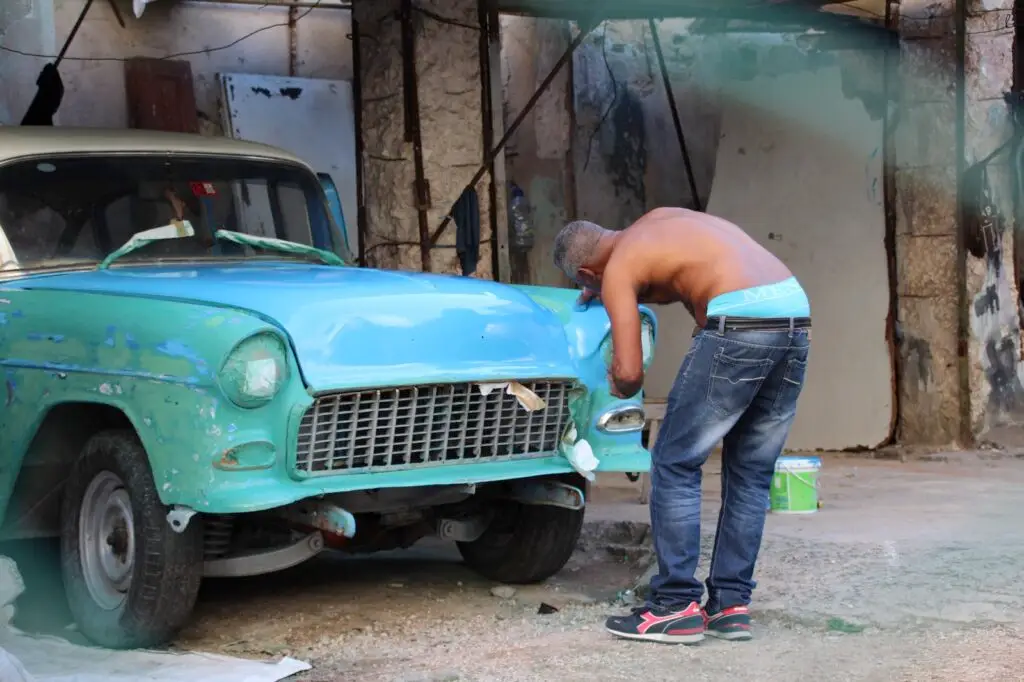
The drive took three and a half hours (with a short break), and Juan got us safely to Trinidad. He didn’t seem to like white cars, because whenever one wanted to overtake us, he floored the accelerator of his 1965 Chevy. We reached a top speed of 140 km/h! What else could we do but trust in life? He proudly told us that he had restored his car himself; he had even sewn the seat covers (also orange and white) himself. Well, if he loves his car that much, he must know what he’s doing. He really did seem to love his car and took good care of it, because when we arrived in Trinidad, the first thing he did was top it up with 1.5 litres of oil!
We spend four days in Trinidad. We hike to a waterfall and hire a guide to learn more about nature. Joanis, our guide, is actually a university professor of history but works in tourism to earn more money, mainly through tips. In Cuba, a communist country, state employees uniformly earn 27 CUC a month, whether doctor, nurse, professor or police officer. Salaries haven’t changed for decades, while the cost of living has risen sharply. That’s why you see teachers driving taxis or doctors waiting tables. From Joanis we learn not only a lot about life in Cuba but also about Cuban flora and fauna. On the way to the waterfall he explains a few things about Cuba and warns us not to try to understand Cuba – we won’t succeed. That will be difficult for Christoph, as he always wants to understand everything exactly.
On the second day, 24 December, we take a catamaran to the island of Cayo Blanco, home to iguanas and hutias (tree rats). The pictures of the hutias are below. I didn’t know what they were either, but I find them funny. For the first time in a long while this feels like a holiday. It’s no good for snorkelling, as the water is too murky that day, but it’s perfect for swimming, strolling along the beach and lounging in a deckchair. You just have to be careful not to step on an iguana, because they’re everywhere here. The hutias and iguanas were brought here by pirates, who used to eat them. Well, each to their own.

For the evening we’ve ordered dinner – or rather Christmas dinner – at our casa particular. Our host Señor Soto is a passionate amateur cook and serves us vegetable soup as a starter, a huge chicken (I think it was more of a turkey) as the main course and flan for dessert. At the next table sits a bus driver who drives a tourist bus during the day and is also staying here tonight – alone. We invite him to eat with us; it wouldn’t be nice for him to have to eat alone, especially at Christmas! He’s delighted and joins us without hesitation. We have a very funny evening. Cubans are simply sociable and cheerful people.
Over the next two days we visit an old sugar-cane plantation, where we also learn a lot about the slave trade. We stroll through Trinidad, including beyond the tourist streets. When an old woman standing at the window of her house with a walking stick begs me for soap, it almost breaks my heart. Yes, that’s the system. It may once have worked, but now it seems completely outdated and is leaving its mark. I have to admit I wasn’t prepared for Cuba. In the USA I missed buying a guidebook, and in Mexico there were none to be had.
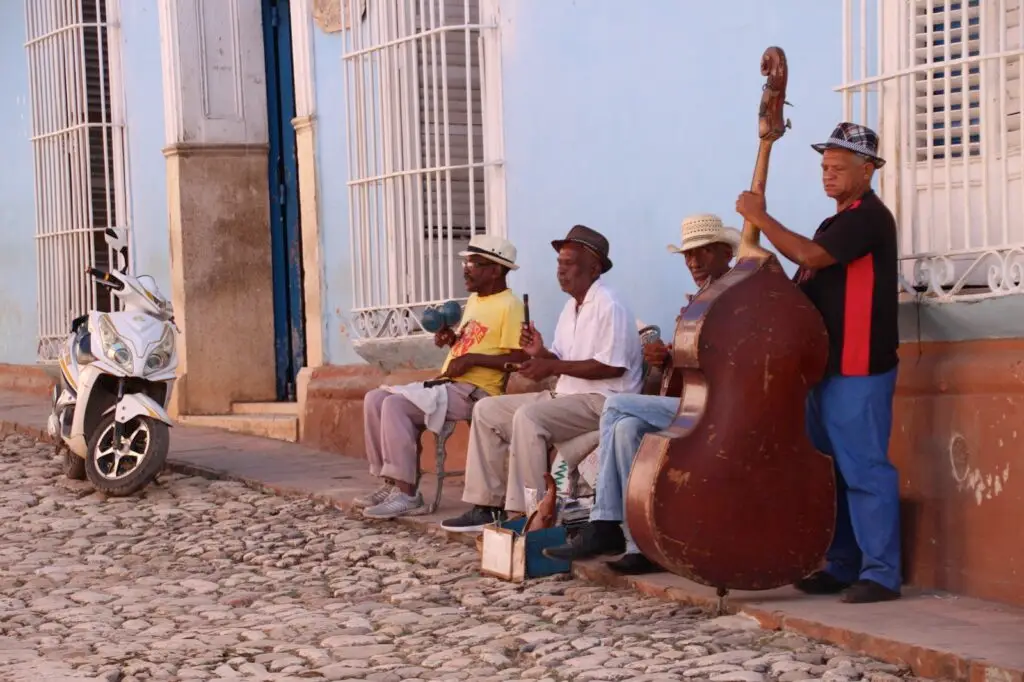
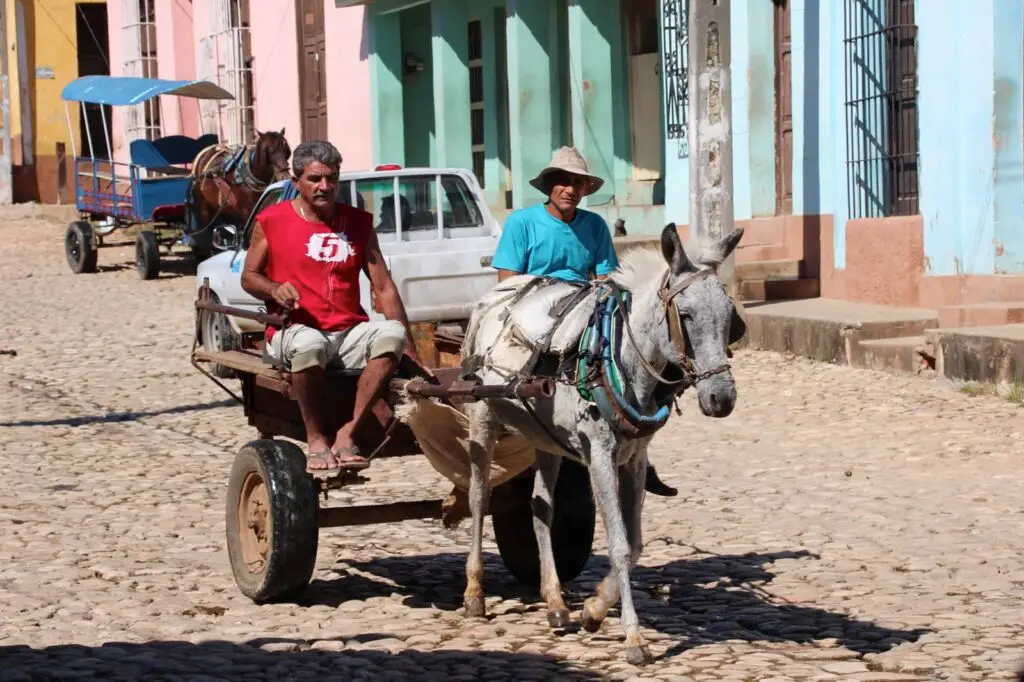
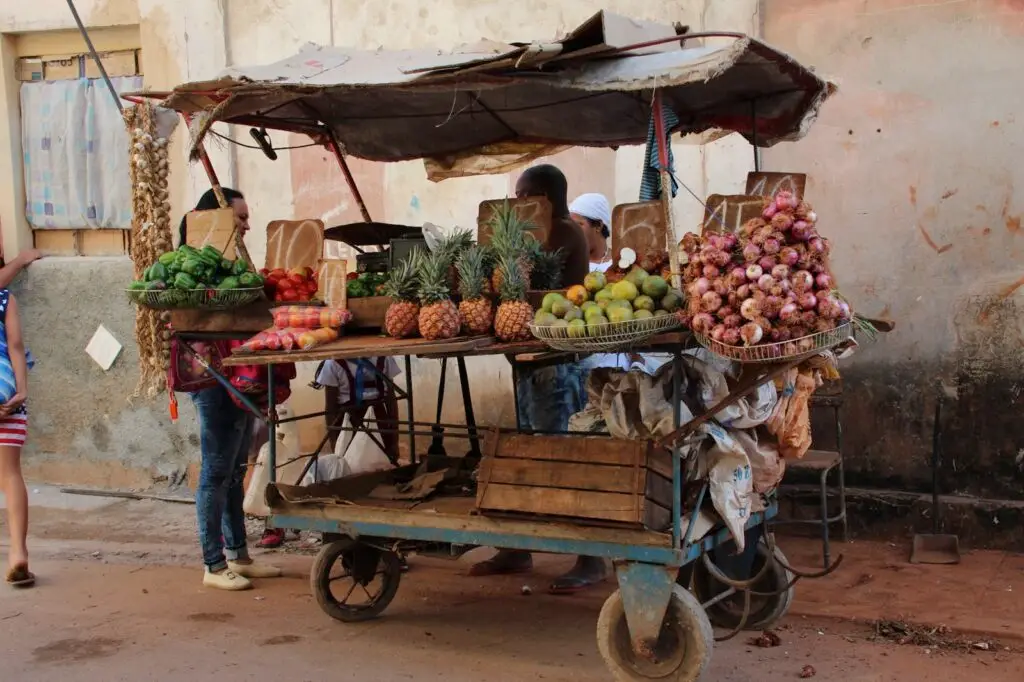
You feel a little as if you’ve gone back in time – not just because ox carts, horse-drawn carriages and the vintage cars so often printed on postcards still drive here, but also because the old buildings, the sparsely stocked “supermarkets” and people’s simple lives give the impression of having travelled into the past. There’s hardly any internet, and if there is, then only in hotels or in a few public squares at tourist hotspots. There you can buy a credit card for 1.50 CUC and surf for an hour. The first time I wanted one of these cards, I found a colourful crowd of people at the door of the office in question. I must have looked desperate, because an older lady immediately spoke to me and explained that she would help me. In Cuba you don’t queue in order; you ask who’s last and then wait. That worked quite well – you just have to know it.
From Trinidad we continue to Cienfuegos, where we only stay two nights. Cienfuegos is a clean, tidy town, well restored in the centre, with a small old theatre and some very beautiful colonial buildings. By chance we find the world’s best cocktails in Punta Gorda, at the southernmost tip of Cienfuegos, in a small bar in the park. If any of you are ever there, you absolutely have to try them! The barman spoke to us and claimed he made the best cocktails in the world, and if we didn’t like them we wouldn’t have to pay. Challenge accepted – and anyone who knows Christoph knows how critical he is. The upshot was that we were already tipsy by 2 pm. The barman didn’t promise too much; the cocktails were really unbelievably good, and now I can never drink another piña colada. It was also a pleasure to watch him. He’s a barman with real passion, and I’ve never seen anyone muddle mint for a mojito for so long.
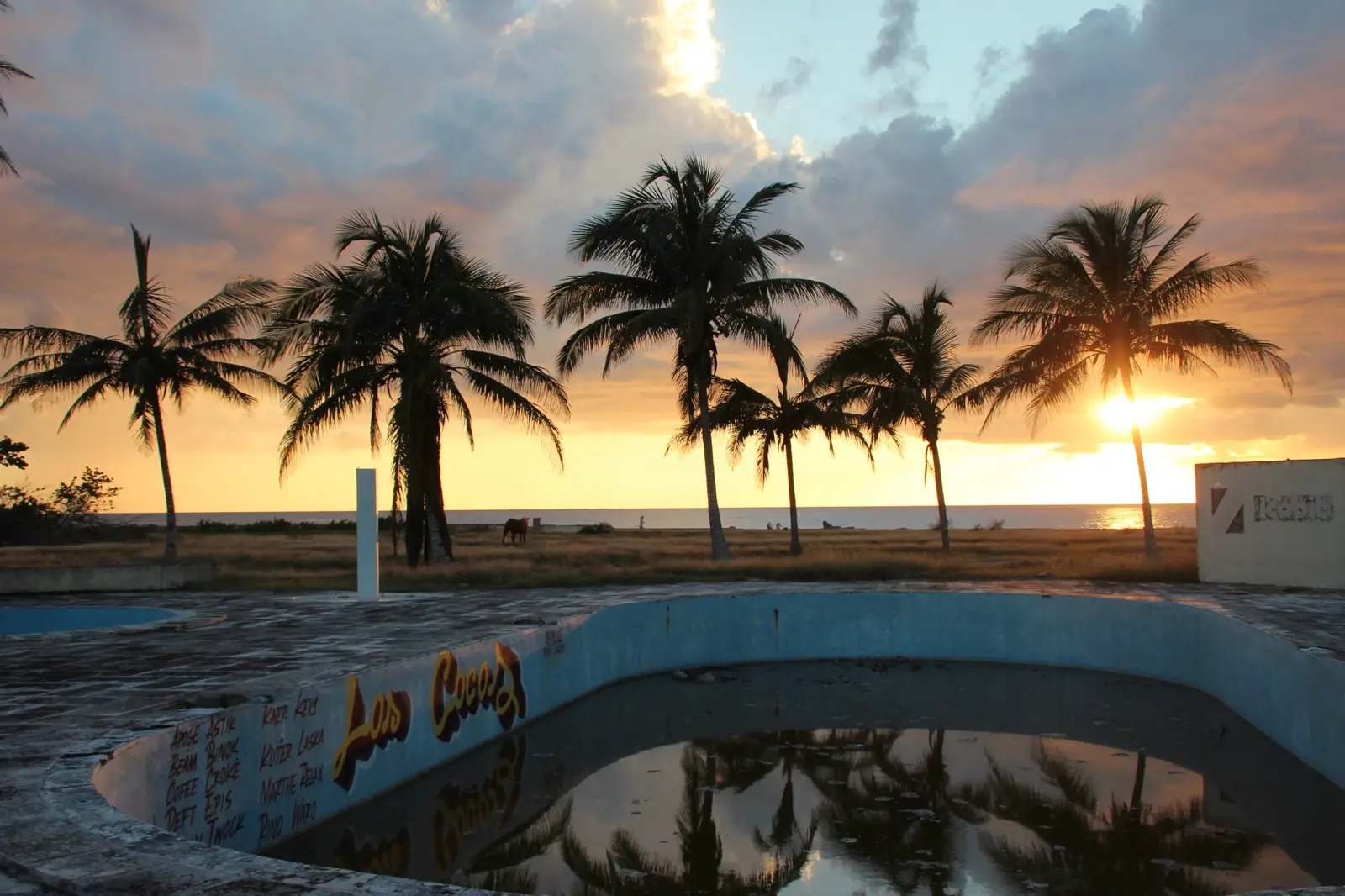
Our next destination is Playa Girón, where there’s lots of beach. We stay two days with Zoila, who makes us the best breakfast with fresh pineapple, guavas, papayas, fresh pineapple juice, eggs, cheese, ham and even pancakes with guava jam. We chill on the beach, snorkel at Caleta Buena, which means something like “beautiful cove”, and sip cocktails, none of which are as good as the ones in Cienfuegos, unfortunately. Along the beach promenade stand abandoned, overgrown concrete bungalows and an empty pool sprayed with graffiti – remnants of times past when communist tourism was still booming here. I suspect a hurricane once destroyed the holiday village and it was never rebuilt. Before we go to the Viñales Valley, we want to visit Varadero. Although it’s supposed to be quite touristy, with hotel after hotel along the beach, it’s said to be one of Cuba’s beautiful beaches. Yes, the beaches are beautiful, but we’re not in the mood for foam parties on the beach and tourists already drunk at midday, and we quickly make ourselves scarce.
It’s 31 December, and we’re staying very close to Varadero in Santa Marta with Barbara. When we come back late in the afternoon from our package-tourist trip to Varadero, she takes us to her neighbour, who is also her brother and has his birthday on top of that. Traditionally there’s a pig on the grill, along with yuca, also known as cassava (a potato-like root), rice and beans. People drink beer and of course rum, and after the meal you go round visiting the neighbours to wish them a happy new year. There’s even more rum and beer there, but mostly rum. A few houses further on we meet Sandra and Daniel, who have lived in Germany for more than 20 years and are visiting home. As everyone has been celebrating since midday, we first have to catch up. There’s dancing, and of course Cubans have rhythm in their blood, which doesn’t diminish with age either. Christoph and Hannes have to serve as dance partners for Sandra’s great-aunt. That gave me a lot to laugh about, believe me.
As we hadn’t actually planned a big New Year’s Eve party, we had booked a bus to Viñales for 8 am on 1 January. Pretty stupid, we now think. Who’s daft enough to voluntarily take a bus at 8 am on New Year’s Day? Yes, we were pretty tired when we set off for the bus station on New Year’s morning. When we arrived in Viñales, our luck with the weather ran out too. We stay four days; it’s unusually cold, about 16 to 18 degrees during the day, and it rains every now and then. The first day is the best. We rent bikes and explore the area, visit a tobacco plantation, see rock paintings that hippies painted in the 1960s, and a cave where Che Guevara supposedly hid. At the end of the day we happen upon a small roadside hut where Alberto Vitamina offers his delicious cocktails. In a coconut or bergamot (similar to grapefruit, but not as sour) he mixes rum, honey and fresh pineapple juice. Very tasty! The wall behind him is decorated with newspaper articles. “You’re famous,” I say. “Yes, a little,” he says. A few weeks ago Swiss television was here, he tells us, while cutting mini bananas and a fruit unknown to us, which he calls Mayan pineapple, into bite-sized pieces for everyone. We leave Alberto that evening with an overdose of vitamins, and afterwards I actually googled Alberto Vitamina. You do find a few things.
The next day we drive north to the beach at Cayo Jutías. A white sandy beach with turquoise water awaits us. It’s windy and a little chilly. Christoph and I are a bit spoiled by Mexico’s dream beaches. Hannes, who flew out of cold Switzerland in the snow, thinks it’s great, can’t be stopped and swims his laps. We’re spared the rain today.
During the night it rains heavily, and in the morning we’re undecided about what to do. In town we meet Andy, our neighbour at the casa particular. He’s from Alaska and travelling with his son Robert, who is feeling a bit poorly today and sleeping in the room. Andy asks whether we’d like to go on a little hike with him. Of course! We hike towards the rock faces where climbers are at work and pass through the Cueva de la Vaca, a cave that brings you out on the other side of the rocks. Inside there’s a squeaking, and it takes us a while to find the reason. Tiny bats are hiding between the stalactites hanging from the ceiling. Cuba is said to have the smallest bats in the world. Whether these are the ones we found here, I can’t say for sure. On the other side, the landscape is an impressive sight. The earth is red, which makes the green of the plants really glow. In between, huge limestone rocks rise vertically up to 400 metres. These so-called mogotes were formed around 170 million years ago through erosion and the collapse of the limestone. Since 1999 the area has been a UNESCO World Heritage Site. You can’t hike on the mogotes, though, as there’s still a risk of collapse.
So we continue hiking on the “ground”, and the red earth gets muddier and muddier because of the night’s rain and the past few weeks. Each of us sinks in at some point, and within no time we look like pigs, but it’s fun. Andy is a few years older than us, but pretty fit, and we have to work hard to keep up with him. We hiked almost ten kilometres through rough terrain until we came to the tarmac road that took us the three kilometres back to Viñales. As if sent from heaven, there’s a kiosk by the roadside. We’ve honestly earned that cold beer now!
On our last day in the Viñales Valley, with no improvement in the weather, we decide to make a trip to María la Gorda in the south-west of the island. There are supposed to be beautiful beaches, black coral and colourful fish, and it’s said to be a very beautiful diving area. Only we don’t dive, unfortunately. It has tempted me for quite some time, but the opportunity hasn’t come up yet. So we set off with our snorkelling gear and enjoy our last beach day in Cuba. If you don’t dive, one day in María la Gorda is quite enough, as there isn’t really much else going on.
The next morning we head back to Havana and to Toni and Sonja again, where we have one more day before returning to Cancún. Hannes has two more days before he has to go back to Switzerland and to work. Oh, we’ve got it good! We stroll through the corners of Havana we haven’t seen yet and at sunset watch the tourists on the Malecón getting splashed by the waves crashing against the concrete wall of the promenade. Until it gets us. A little wet, we sit down in a paladar on the promenade and enjoy Cuban cuisine for the last time. Oh, I’ve just realised I haven’t told you yet what a paladar is. Paladar means “palate”, and they’re small private restaurants, mostly family businesses, where you can eat cheaply and authentically. The service is always very friendly compared with the state restaurants, and you meet warm-hearted people who welcome you into their casa. The toilet is in their private bathroom, with toothbrushes and shampoo standing around. Proud of the little they have, they then show you the whole flat as well.
That was Cuba, and our recommendation is: see Cuba while it’s still the way it is. I think a lot will change there in the coming years.