Border Crossing from Chetumal, Mexico, to Corozal, Belize

Berichte Nordamerika & Mexiko – Foto 4

20.02.2018 Adiós Mexico, welcome Belize. On Tuesday morning we set off from Chetumal for the border. Hardly out of town, we run into a police check. The policewoman explains, laughing, that we were driving too fast. Only 40 km/h applies in town, she says in Spanish. I ask how fast we were going, but get no answer. Great, we think, that’s all we needed on our last day! A colleague joins her and asks whether we speak English. Yes, we answer, and he too explains that we were too fast. He doesn’t tell us our speed either. Somehow they all find it funny, and soon we’re laughing along. Nobody wants money from us; they just tell us to drive more slowly. Then they send us on our way. We suspect they’ve just been given the new laser guns and are therefore having so much fun with them. Mexicans are a bit like big kids.
Grenzübertritt von Chetumal Mexiko nach Corazal Belize – Offroad Travelers

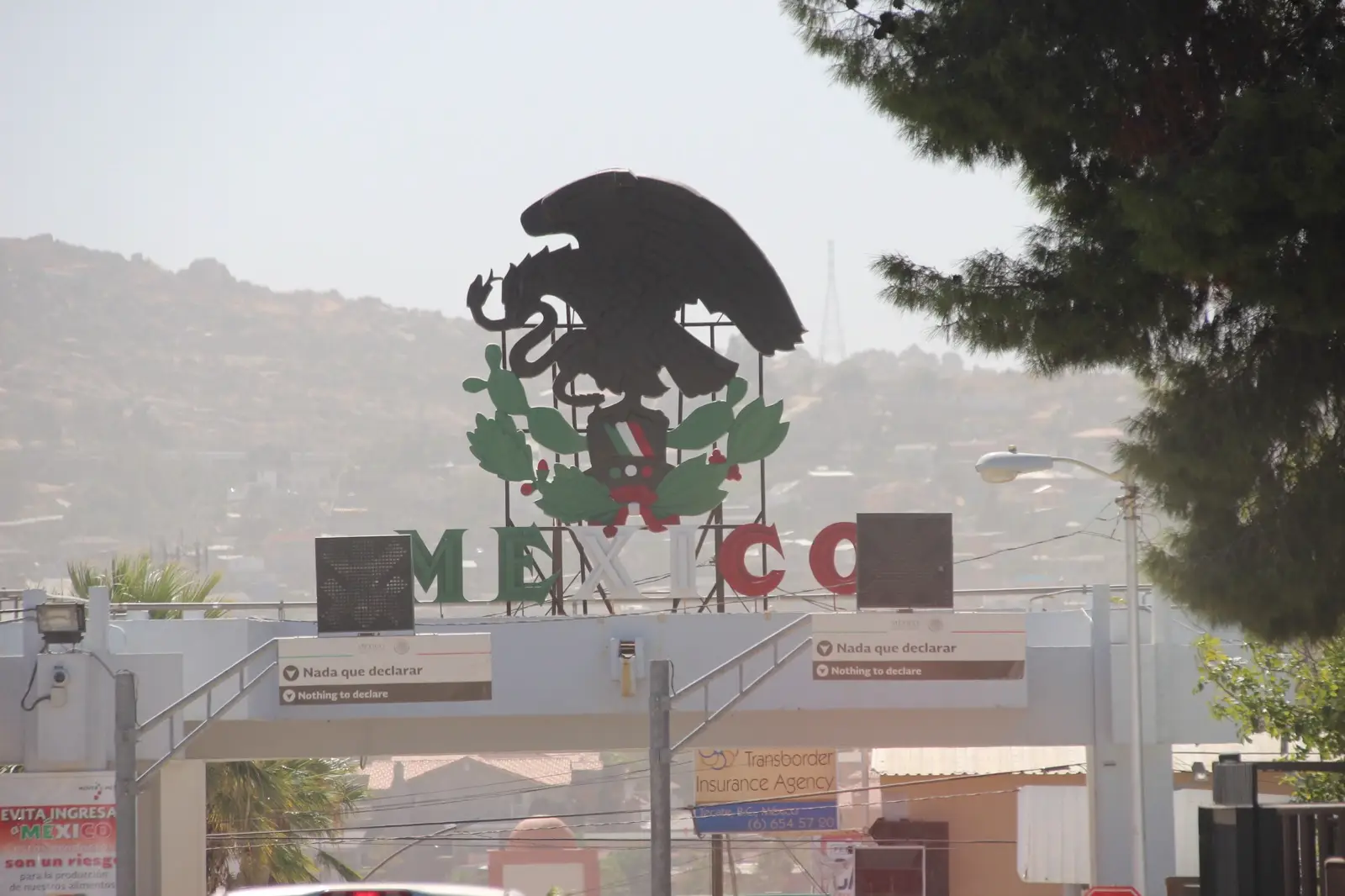
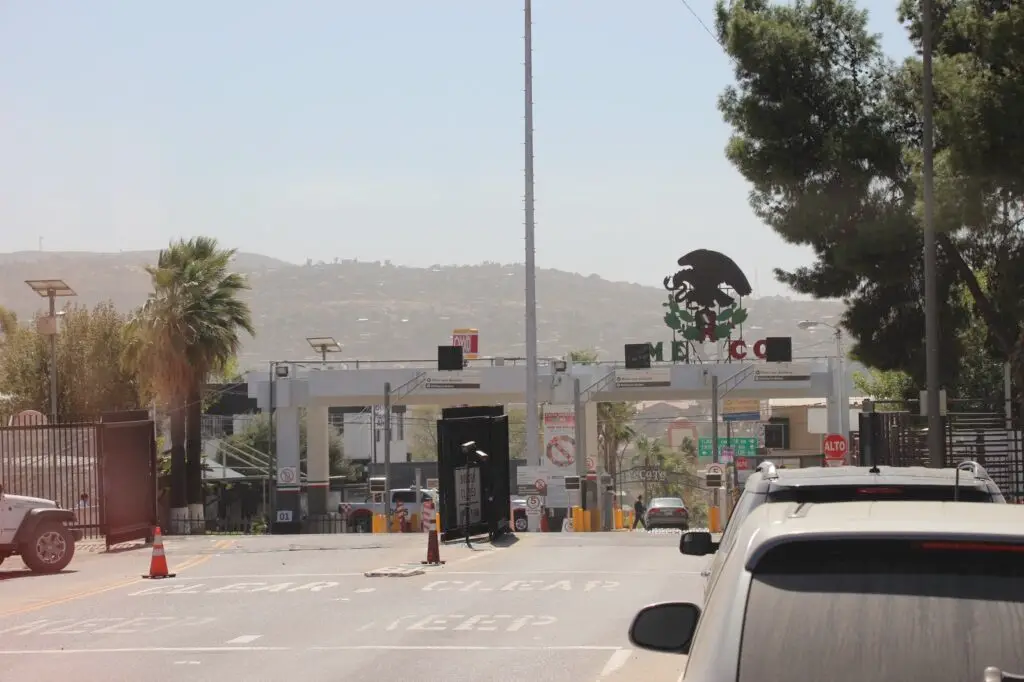
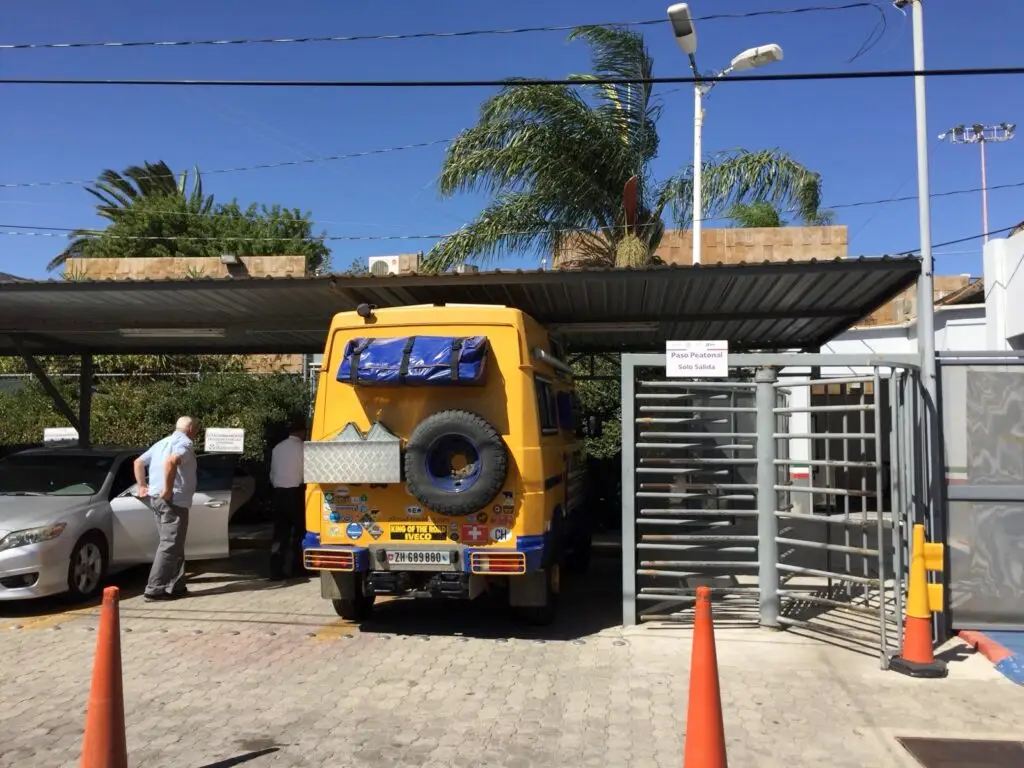
A few minutes later we reach the border. There we check out and have our passports stamped. As we had left Mexico in the meantime and flown to Cuba, we have to pay the tourist fee of 533 pesos per person again. Then we look for the office to check out our camper. But the woman at the counter has no idea what we’re talking about. Within 12 months we have to send a document about the export of our camper to the USA to confirm that we’ve left the NAFTA countries. She can’t issue us a corresponding document.

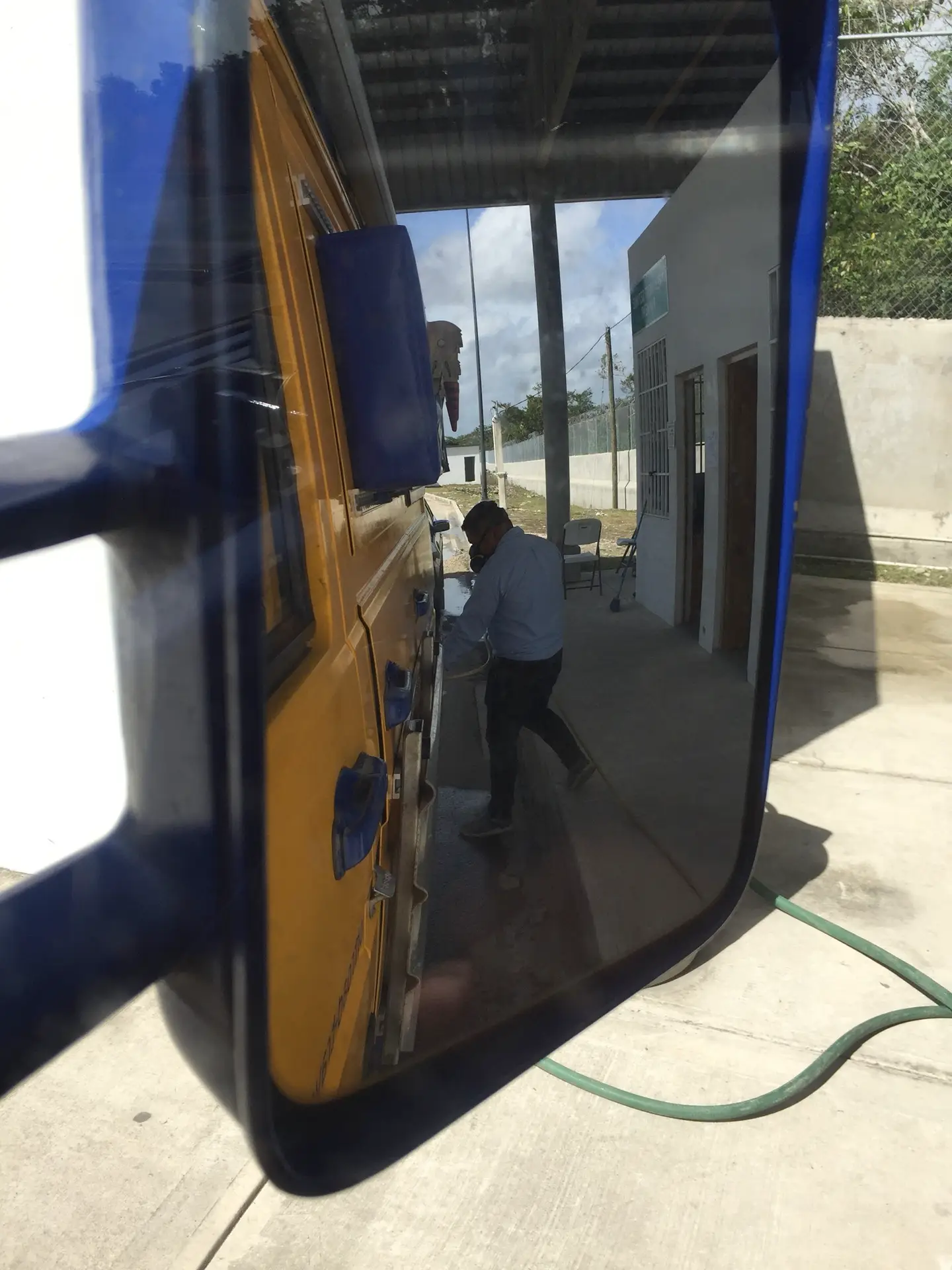
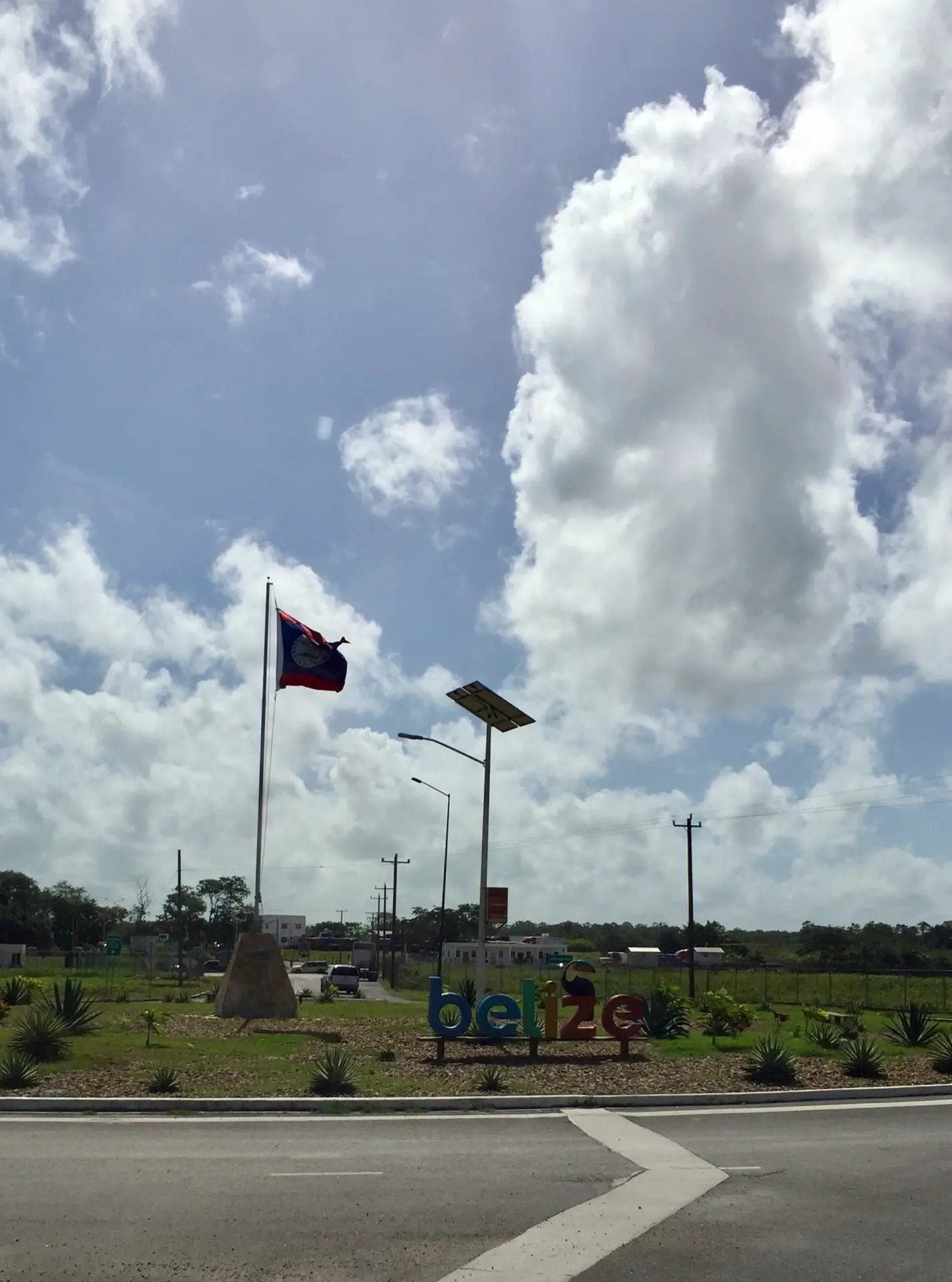
Well, if she doesn’t know what we want, we’ll rely on the Belizeans. On to the disinfection station. Yes, you read that right: we have to close the windows and Muggl is sprayed with disinfectant. The whole thing costs 10 Belize dollars or 5 US dollars or 100 pesos, and we get a receipt that we have to show later. On to immigration, where a very friendly young border official greets us in the car park with a handshake and the words “Welcome to Belize”. He explains that we can leave the car here and should follow him into the immigration office. There he shows us where to fill in the entry form, get our stamp and where Muggl gets his papers. As soon as we enter the building we’re handed a map of Belize with sights, natural highlights and activities. Very friendly people, the Belizeans.
Grenzübertritt von Chetumal Mexiko nach Corazal Belize – Foto 2

The officer at the immigration counter first asks: “Who is this lucky guy?” In such a serious setting it always takes a moment to get the humour. The officer jokes with us and calls Christoph a “lucky guy” because he’s lucky enough to travel with me. Finally someone recognises it! 😉

He asks where we want to go. We say we want to go to Crooked Tree, a village between Orange Walk Town and Belize City. He warns us about the cashew wine in the area – it gets you drunk. Of course, it’s wine. When you wake up the next day thinking you’ve slept it off, the sun reactivates the alcohol and you get drunk again. That sounds wild. Let’s see whether we find cashew wine somewhere.

We don’t have to give fingerprints or look grimly into a camera. The officer asks how long we want to stay and enters 30 days in our passports. How uncomplicated! At the next counter Muggl also gets his “residence permit” in the form of a paper with his details and the length of stay. Like us he gets 30 days, and this document is now his “passport”, says the officer. It costs 30 US dollars, and I hope it’s enough for the Americans to accept Muggl’s entry into Belize as his exit from Mexico.
Grenzübertritt von Chetumal Mexiko nach Corazal Belize – Foto 3

Next they inspect our fridge. Damn! I forgot to hide the eggs. As we hadn’t heard of anyone having their car searched so far, we had dared to stow food in such a way that you’d have to unpack everything to find it. The fifth official explains calmly: “You know, we once had bird flu, and since then no poultry products may be imported. But don’t worry, we have eggs in Belize.” Well, that’s fine then, and I don’t want to be responsible for a mass epidemic. Nobody would have been interested in packaged sausage, travellers who entered Belize at the same border about two weeks before us had told us. Today it’s different. You have to declare it, but since our pack of salami and the ham have the TIF seal, they turn a blind eye. This seal certifies that the food was inspected and approved in Mexico. Luckily he doesn’t see the cheese sausages right at the bottom of the cool box. They don’t have a seal, and losing them would have been really bad for me personally.

The USDA seal from the USA is also recognised, and food with this seal may be imported but must also be declared. Apart from the cool box they didn’t want to see anything – no cupboard, no drawer. They also ask about alcohol. We have a few cans of beer with us, which is no problem. We say nothing about tequila, rum and wine. To rice, fruit and vegetables I say no. We couldn’t find out exactly what and how much you’re allowed to bring into Belize. As far as we know, you definitely mustn’t bring fruit, vegetables, poultry products such as eggs, chicken and turkey meat, fresh meat, grain, flour or rice. One litre of spirits per person is allowed; I don’t know exactly how much beer per person is allowed. Tinned meat is OK. We can live with the loss of the eggs, and it was our own fault anyway.

So, the border formalities are done. Now we just need insurance and we’re good to go. About 200 metres after the border, in a white square building, is the insurance office. Four weeks of liability insurance for our Muggl costs 60 Belize dollars or 30 US dollars, and we get a sticker that we have to put on the windscreen on the driver’s side.

All done! Belize, here we come……

Tips for a Trip to Cuba

Organisation & Planung – Foto 2

A few things we wish we'd known before our trip to Cuba

Here are some tips we wish we’d known before our trip to Cuba, and how best to organise your trip (as of 2018)

  • Bring small soaps and pens to give away. Carry them in your daypack, because you’ll quickly be asked for them.
  • In Cuba cold fronts can last up to five days. So pack warm clothes, sturdy shoes and a rain jacket.
  • A “casa particular” is private accommodation with Cuban families. Prices for a double room range from 15 to 35 CUC.
  • To find a casa particular, use Airbnb or ask at the bus station. Taxi drivers often know someone who offers accommodation. You can also walk the streets and look for the white signs with blue lettering.
  • A “paladar” is a private restaurant where you can eat authentic Cuban food. They’re often cheaper and the service is friendlier than in state restaurants.
  • The cheapest way to get around is the state bus line Viazul. Buy tickets a few days in advance at the counter or online if the internet is working. Alternatively there are shared taxis and private taxis, where you can negotiate.
  • Haggling is common in Cuba. Tourists often pay more, so ask and negotiate.
  • You can buy water at casas particulares or supermarkets. It’s cheaper in supermarkets outside the tourist centres.
  • Cigar factories close for holidays in July and around New Year. Buy cigars in official shops, not on the street.
  • Cuba has two currencies: the CUC for tourists and the CUP for locals. You can pay with CUC everywhere, but get some CUP too.
  • There are ATMs almost everywhere, except in small towns.
  • There’s no departure fee. We invested our 50 CUC in rum.
  • Swiss and German citizens need a tourist card, which you can buy at the airport for 20 US dollars. It’s a simple formality.

These tips will help you experience Cuba better and make your trip go smoothly.

einige Dinge die wir vor unserer Reise nach Kuba gerne gewusst hätten
einige Dinge die wir vor unserer Reise nach Kuba gerne gewusst hätten – Foto 2

Camping in the USA & Canada

Organisation & Planung – Offroad Travelers

Before we left, one question kept us busy: where will we find places to sleep? In the long run it’s expensive and impractical to stay at campsites all the time. Prices vary: state-run sites (National Forest or State Park) cost between 10 and 40 USD, private ones like KOA are more expensive. State-run sites often have no showers or Wi-Fi, while private ones have clean showers and fast Wi-Fi. But campsites aren’t ideal, as you’re parked between huge motorhomes that often have bigger TVs than at home. The atmosphere is like a trailer park or an all-inclusive hotel, which doesn’t suit our travel style. National Forest and State Forest sites offer more privacy and are often nicely wooded. We prefer to look for free spots where we feel comfortable and can stay longer to recover from travelling.

Camping in den USA & Kanada – Offroad Travelers

There are various ways to find such places:

  1. iOverlander app: this free app for Android and iOS shows nearby places to sleep, even offline. Users can rate places and add new ones, so the app keeps improving thanks to the participation of many travellers. [iOverlander](http://ioverlander.com) 

  2. Free Campsites website: this site lists campgrounds and their costs. However, it can’t be used without internet access. [Free Campsites](https://freecampsites.net)
     
  3. Supermarket car parks: overnight stays are allowed in most Walmart car parks, with few exceptions. Safeway and Cabela’s also offer this option. [Walmart](https://www.walmart.com), [Safeway](https://www.safeway.com), [Cabela’s](http://www.cabelas.com) 

  4. Truck stops or travel centres: these are noisy, as lorry engines often run all night. But they offer showers and laundries. Showers usually cost 10 USD, but nobody minds if two of you use one.

  5. KOA (Kampgrounds of America): these luxury campgrounds offer Wi-Fi, showers, often a spa and laundry. Electricity and water are included. [KOA](http://koa.com) 

  6. State Park campgrounds: these state-run sites cost 15–25 USD and often have showers. Wild camping is prohibited, but rangers are sometimes lenient. [State Parks](http://www.camping-usa.com/stateparks/) 

  7. National Forest campgrounds: these offer self-registration and allow dispersed camping if your vehicle is suitable. There are rarely showers, but the toilets are usually clean. [National Forest](https://www.forestcamping.com) 
  8. BLM land (Bureau of Land Management): this land is open to everyone; sometimes a permit is required. Information is available at visitor centres. [BLM](https://www.blm.gov/programs/recreation)
     
  9. Social media: contacts via Instagram and Facebook often lead to invitations to stay in someone’s garden or guest room. The hospitality in the USA and Canada is impressive.

  10. Just ask: if all else fails, it often helps to ask someone for permission to stay on their property. Americans and Canadians are open and helpful.

  11. Another helpful site with information on where you can stay and for how long: [Your RV Lifestyle](https://www.your-rv-lifestyle.com/how-to-find-free-rv-camping-sites/) 
Camping USA & Kanada – Offroad Travelers

Diesel in Canada and the USA

USA & Kanada – Foto 36

Every European traveller with an older diesel vehicle in North America soon wonders why the car is blowing black smoke and cold starts are more sluggish than usual. That’s what happened to us when we picked up the car in Baltimore. At the time everything was still fine, because the tank was full of German diesel. The first few days went smoothly, as temperatures were high – over 30 degrees Celsius – and we were at sea level.

But when we drove higher and temperatures dropped, the problem began. Our Iveco started badly in the mornings. I often had to crank the engine brutally, which was painful. This procedure took 10 to 15 seconds until the engine ran. Then the car smoked black, grey and white for a minute. I was seriously worried that something was broken.

Today I know that this isn’t unusual for older diesel engines. Diesel in North America is of a different, poorer quality than in Germany, Switzerland and other Western European countries. The magic words are “low-sulphur diesel”. This diesel lubricates less and has a lower cetane number, which means lower combustion quality and performance.

Diesel in Kanada und den USA – Offroad Travelers

What you can do

You can’t eliminate the problem completely, but some measures mitigate it. Choose your petrol station carefully; the cheapest isn’t always the best. Here’s a list of petrol stations and their cetane numbers:

Canada:
– Petro-Canada (45–52)
– Sunoco Gold (45–50)
– Shell V-Power Diesel (no figure given, but one of the best)
– Husky Diesel Max (42–45)
– Autogas/Cascadian Biofuels, BC only (45–50)
– Red River Co-op (41–44)

USA:
– BP – Amoco branded (51)
– Chevron (49, with Techron 51)
– ConocoPhillips (48, in California 48–53)
– Petro-Canada (47–51)
– Shell (46)
– Sinclair (46)
– Marathon (45)
– Exxon/Mobil (43–46)
– BP (40–42)
– Hess (40–45)

((All cetane figures without guarantee)

Advantages of diesel with a higher cetane number:
– Lower consumption
– Quieter engine
– Good cold-start behaviour
– High power/torque
– Low emissions

A low cetane number has the opposite effects. In Europe the cetane number starts at 58; in the USA it can drop to 40, which causes problems.

Useful links:
– [Best Diesel Fuel Additive](https://autofella.com/best-diesel-fuel-additive/)
– [Cetane number – Wikipedia](https://de.wikipedia.org/wiki/Cetanzahl)
– [Diesel fuel – Wikipedia](https://de.wikipedia.org/wiki/Dieselkraftstoff)

Avoid filling up in national parks, as the diesel there has often been in the tank for a long time and can have a high water content. Also avoid petrol stations where a tanker is currently parked or has recently been, to avoid sediment from the tank. Fill up before longer stretches to avoid dubious petrol stations. It’s a myth that you won’t see a soul or a petrol station for 500 km on the Alaska Highway, but I’d rather play it safe.

Gib hier deine Überschrift ein – Offroad Travelers

Diesel additive

Many travellers use a diesel additive to combat the problem of poor diesel. The additive is poured into the tank before filling up. It increases lubrication and the cetane number, which is good for the engine.

We use the product from STANADYNE Fuel Systems, Diesel Fuel Additive (blue label). It’s recommended by Bosch Service and many travellers are happy with it. One bottle is enough for about 1,000 litres and costs around 25 US dollars. Alternatively, there’s the Lucas product, available at every Walmart.

STANADYNE is available at:
– NAPA Auto Parts
– AutoZone
– O’Reilly Auto Parts
– Tractor Supply (similar to Landi or BayWa)

In states like Oregon and Montana there’s no sales tax, so you should stock up on STANADYNE there if you have enough space.

Have a good, smoke-free drive! 😉

Diesel Additiv – Offroad Travelers

Border Crossings Between the USA and Canada

USA & Kanada – Foto 37

Border on Route 221 at Lacolle, QC, towards Montréal

The first border we crossed was on Route 221 at Lacolle, QC, towards Montréal. It was Sunday 23 April 2017. This border crossing is small and apparently little used, as the border officer’s surprised reaction showed. He asked in astonishment: “What are you doing here?” Our answer: “We want to go to Canada.” There was great interest in our vehicle; a colleague came over to take a look. Our passports were checked, and we answered questions about how many of us there were and whether we were carrying alcohol, tobacco, weapons, pets or animal products. The officers were curious and also asked about the shipping: cost and duration.

They sent us off with: “Welcome to Canada and enjoy!”

Grenze an der Route 221 in Lacolle QC in Richtung Montréal – Offroad Travelers

Border from Canada to the USA – Port Huron

On 29 April 2017 we returned to the USA via Point Edward into Michigan. We were asked how many of us there were, whether we had weapons, and about our insurance – both car and health insurance. He didn’t want to see the papers. He didn’t ask about food, but about our destination. Finally he asked whether we spoke Spanish and said, reassured, “very good” when I answered “yes”.

After five minutes we were through.

Grenze von Kanada nach USA - Port Huron – Offroad Travelers

Border between Canada's Waterton NP and the USA's Glacier NP

On 22 June we travelled from Glacier National Park to Waterton National Park at Chief Mountain. It’s actually the same park: two-thirds is in the USA and called Glacier, one-third in Canada and called Waterton. The same questions again: how many are we, are we carrying weapons, what are our travel plans? They also asked about firewood. Yes, we had some with us and had to hand it over.

We were through in a few minutes.

Border from Canada to Alaska / Poker Creek

On 10 July 2017, a foggy morning, the border officer greeted us with: “Hello, how are you?” She asked whether there were two of us and whether we had pets, weapons or tobacco with us. She didn’t ask about food. She admired our world map in the cab and asked whether we were travelling “all over the world”. We said, for now just North to South America. She asked about our jobs and disappeared with our passports.

Three minutes later she happily handed back our passports and said she had given us a “special stamp”: “because you made it :-)” A caribou now adorns our passports.

Border from Alaska to Canada / Beaver Creek

At Beaver Creek, done in five minutes: questions about weapons, animal products and the length of our stay. The officer wanted to know how to ask in German: “How long do you want to stay in Canada?” We gave a short language lesson and were sent off with “Willkommen in Kanada”.

Border from Canada (BC) to Alaska / Dalton Cache

At Dalton Cache the officer rolled out of the building into the booth. Apparently not many people come by here on Sundays. “Where are you from?” – “Germany.” “What is this? A Mercedes?” – “No, an Iveco, he is Italian.” “You German guys driving an Italian vehicle? Seriously?!” The officer had a sense of humour. He asked whether we had any food from Canada with us. We said no. As a farewell he said: “Enjoy Canada and Tschüss.” Yes, he really said “Tschüss!”

Through in five minutes again.

Grenze Kanada BC - Alaska /Dalton Cache – Offroad Travelers

Border from Alaska to Canada / Fraser

On 3 August 2017 at Fraser: a young officer and the following conversation:

“Where do you live?” – “Switzerland.” “Vehicle shipped over?” – “Yes.” “Where did you start?” – “Baltimore.” “When do you fly home?” – “Next year August.” “How many days will you stay in Canada?” – “About three weeks.” “Are you working while traveling or just took time off?” – “No work, please! We took time off.” “Have you more than 10,000 cash with you?” – “Unfortunately not!” “Doing everything with credit card?” – “Yes.” “Enjoy your time in Canada!” – “Thank you.”

Grenze Alaska - Kanada /Fraser – Offroad Travelers

Border from Victoria, Vancouver Island, Canada, to the USA / Port Angeles, Washington

On 26 August 2017 from Victoria, Vancouver Island, to Port Angeles, Washington, USA, by ferry: this time the border crossing took a little longer. Time was running short. We were supposed to leave the USA for Mexico on 3 October. As our vehicle had arrived late, our insurance was valid until 10 October. We planned to ask for a two-week extension at the border. Border control took place in Victoria harbour while we were waiting for the ferry. The first questions were: “How many travelers?” “Where do you live?” “What are you doing for work?” “How long do you wanna stay in the US?”

Then it’s our turn. We say that we have to be out by 3 October and still want to travel down the coast to Mexico. Could he extend our visa by two weeks because we spent too much time in Alaska? I add that the summer there was particularly beautiful this year because it was so hot, so there were hardly any black flies and mosquitoes. He briefly lifts his sunglasses, grins and says: “Good to know.” Hesitantly he then asks whether we can confirm our jobs, employers and place of residence, and sends us into the office. We pack papers and laptop and go in. Again they ask us the same questions, and we explain our request again.

The officer sends us outside and makes us wait. I think he wants to deal with the other travellers first because we’re holding up the traffic. When nobody else is queuing, he calls us back in and asks more questions: where we entered the USA, when we were where and for how long. You really have to think about that when you don’t even know what day of the week it is. He wants to know whether we shipped our vehicle here, what vehicle we drive, what the shipping cost and how long it took. He also wants to know how much we saved for the trip, or what our budget is. We wait patiently while he deals with other travellers in between. He says it will cost 6 dollars per person and we can pay by credit card. We’re delighted, and even more so when he says he has now given us another six months. He staples a slip into our passports and says we have to hand it in when we leave for Mexico. He doesn’t know whether we could then immediately get a third six months – that’s at the officer’s discretion. We pack our documents back up; he didn’t look at them.

When we’ve stowed everything away, we look at our passports and notice with astonishment that they say “Germany (West)”… That was 28 years ago now!

Grocery Shopping in the USA & Canada

USA & Kanada – Foto 38

Grocery Shopping in the USA and Canada

Anyone travelling to the USA or Canada will often be given this advice: “Go to Walmart, you’ll find everything you need there, it’s cheap and you can even camp in the car park!” That may be partly true, but as so often, the truth lies somewhere in the middle.

Spending the night in your camper in a Walmart car park can indeed be very practical (more on that in another post). In my opinion, though, the food you get there is often borderline, and the pack sizes simply aren’t made for our fridges!

As you may already have guessed from my first sentences, we’re not big Walmart fans. Please don’t let us influence you; we’re just trying to share our experiences and don’t receive any commission from any shops.

For Germans and Swiss it’s often confusing that vegetables and fruit are more expensive than meat. For example, you can buy a kilogram of beef steak for 10 USD, while a kilogram of strawberries costs 14 USD! Annoyingly, it’s also cheaper to eat at McDonald’s than to buy vegetables and cook them yourself. That’s probably why many people here carry a little more weight.

We’ll now take a closer look at the following shops: Walmart, Safeway, Albertsons, Aldi, Trader Joe’s and Real Canadian Superstore.

Lebensmittel einkaufen in den USA und Kanada – Offroad Travelers

Walmart

As already mentioned, we’re not big fans, but there are differences from Walmart to Walmart. In Dawson Creek, Canada, we found many good, partly European products at affordable prices in the Walmart – we could hardly believe we were in a Walmart! However, that’s probably a Canadian peculiarity, as we didn’t come across this phenomenon in the USA. There all Walmarts look roughly the same. Walmart certainly has the advantage that you can get everything here, from garden chairs to pans to food. I don’t want to badmouth it, but I don’t have a good feeling buying a kilogram of meat for a few dollars – I can’t imagine that this meat comes from a happy cow! Vegetables, as already mentioned, are relatively expensive and quickly become a luxury item. We’ve never seen good bread at Walmart.

You’ll find Walmart everywhere in the USA and Canada.

www.walmart.com

Food USA & Kanada – Offroad Travelers

Safeway

On the whole, Safeway offers a higher-quality range. But let’s say it straight away: without a member card there’s no point even starting, because prices are very high without it. It only becomes affordable if you take advantage of the discounts. On one shop of over 120 USD we saved 30 USD and only paid 90 USD! That’s always worth it, and best of all, you collect points that you can redeem 1:1 when filling up at a Chevron petrol station – so you win twice! Not always, but often, you’ll also find edible bread. There’s always a counter with European sausage and cheese, though they’re relatively expensive.

Albertsons, we believe, is connected to Safeway, as the only difference we could see is the shop colour, which is blue instead of red. Maybe we’re wrong and these two shops don’t belong together. What remains is that the product range is very similar, but prices are a little higher.

You’ll find Safeway almost everywhere in the USA and Canada; Albertsons is far less common.

www.safeway.com

Food USA & Kanada – Foto 2

Aldi

Now it gets interesting 😉 Yes, that’s right, there’s Aldi! We were very surprised too, and after a lot of back and forth we decided to do a shop there. That wasn’t to our disadvantage, as Aldi USA actually surprised us enormously positively. The range is varied, and there are many German products too, such as Nuremberg bratwurst (the real ones!) or Apfelschorle. There’s also a rich selection of cheese and cold cuts that taste quite good. We were particularly surprised by the selection of vegetables and fruit, offered at reasonable prices. Depending on whether the shop is in a state where alcohol may be sold in supermarkets, there’s a decent selection of beer and wine.

But there are a few things we don’t like so much here either, such as a dozen eggs for under a dollar. I can’t imagine that hens can be kept humanely for that price! All in all, Aldi came second in our supermarket ranking!

Aldi is actually only found in the East and Midwest. There’s no Aldi on the West Coast. It’s split up a bit like Aldi Süd and Aldi Nord in Germany – but more on that later.

www.aldi.us

Food USA & Kanada – Foto 3

Trader Joe's

Without doubt our no. 1 for price, quality and range! Trader Joe’s is a subsidiary of Aldi Nord and is found mainly on the West Coast and occasionally in the rest of the USA. TJ’s is a mecca for vegans, vegetarians and people with lactose or gluten intolerance. You can get everything here, a bit like in a health food shop. The selection of vegetables and fruit is also varied and affordable. Meat is relatively expensive, but everything is organic, so you can assume the animals were kept humanely. The selection of cold cuts and cheese is also quite good, and depending on the shop you can get the odd product from home that you miss when you’ve been travelling for a long time. For me, one of the highlights at TJ’s is the very varied selection of wine and beer. You’ll find both US wines and overseas wines from Italy, France and so on. Wine prices are reasonable and the quality very good. Beer costs about the same as in a liquor store. There are always a few locally produced products in the shops, so with luck you can get decent bread (not always).

www.traderjoes.com

Trader Joe`s – Offroad Travelers

Real Canadian Superstore

As the name suggests, this shop only exists in Canada. At first glance it resembles a Walmart a little; at second glance you’ll find lots of great products, such as liver sausage from the Frey company, which presumably has German roots, if the name is anything to go by. You can certainly trust the taste – it’s very German 😉 But there’s more here that’s really pretty good. The selection of vegetables and fruit is rich and good, at affordable prices. I particularly like the cheese and sausage selection, e.g. an oversized Camembert for 7 CAD (approx. 5 USD).

www.realcanadiansuperstore.ca

Canadian superstore – Offroad Travelers

Farmers' Markets

Farmers’ markets can now be found all over the country, and you can shop quite well there, e.g. farm eggs or fresh seasonal vegetables, homemade jam, honey, bread and so on. We love shopping locally at markets. It’s usually not even more expensive than in the supermarket, so it’s certainly a good option if you don’t want to live on chemically produced food. The markets are usually on Wednesdays and Saturdays and are often announced at the entrance to town.

The Good Bread Question

Across the USA and Canada you’ll come across Swiss and German bakeries every now and then, some of which have very good bread. Especially in big cities like Vancouver, Seattle etc. it’s easy to find one. But we’ve also been lucky a few times at farmers’ markets, of which there are now quite a lot, and been able to buy very good bread. As already mentioned, Safeway and Trader Joe’s often have good, crusty bread.

For those of you who bake yourselves and like to use rye or spelt flour: stock up on these flours in Canada, as they’re much harder to get in the USA. Even though they’re generally easier to get in Canada, we mostly only found them in organic markets. In the USA it’s probably easier to get good flour on the West Coast, as people here generally live more consciously.

Forscher Bakery near Zion National Park, USA (our no. 1 bread)
forscherbakery.com

Farmers’ Market St. Jacobs, Canada
stjacobs.com/Farmers-Market-General-Information.htm

Dawson Creek Swiss Bakery
oldfashionedbakery.ca

Vancouver: Breka – a chain, but good bread
breka.ca

Victoria on Vancouver Island: Cobs Bakery
cobsbread.com

Alpine Bakery in Whitehorse (just behind Forscher, no. 2 of our top breads)
alpinebakery.ca

Valemount, Canada: Swiss Bakery
valemountswissbakery.com

Das Thema Gutes Brot – Offroad Travelers

Alcohol

You should find out in advance in which states you can buy alcohol in the supermarket and where you have to go to a liquor store. As a Bavarian I really shouldn’t say this publicly, as I’ll probably no longer be allowed back into Bavaria, but I like the microbrewery culture in Canada and especially in the USA. There are so incredibly many small breweries, some of which brew excellent IPAs and pale ales that you absolutely have to try! The selection is so huge that you could drink a different one every day and would probably need 1,000 years to taste them all. There’s also plenty for our better halves, such as grapefruit-flavoured IPA etc., which, I admit, I quite like too 😉 There are also an incredible number of brewpubs, simply called “breweries”. They usually serve burgers, salads etc. – good quality at reasonable prices – and best of all, each of these microbreweries brews its own beer, which in most cases tastes very good. Our personal favourites so far are in Oregon and Washington.

Border Crossing from the USA to Tecate, Mexico

Informationen zu Mexiko – Foto 24

On 9 October we’re finally off to Mexico! We cross the border at Tecate, as many travellers recommend this crossing as easy and uncomplicated. At the border we drive until someone stops us. A young official asks whether we speak Spanish. Christoph says: “No.” I answer: “Un poco.” He asks us to open the sliding door, takes a quick look inside and asks for the vehicle registration and chassis number. Christoph searches, the official waits patiently, but when Christoph finds the papers, he doesn’t even want to see them. At least we now know where they are. The official says goodbye with “Adiós” and leaves.

Grenzübertritt von USA nach Tecate Mexiko – Foto 2

But where do we get our visa, and how do we get rid of the white slip they stapled into our passports when we entered Washington? I ask him, and he sends us back to the USA. He explains where we have to park and walk. We drive around the corner and park under a corrugated-iron roof that our vehicle only just fits under. Another official directs us in and says we may only park for 20 minutes. We had no idea it would take 1.5 hours. We walk back into the USA, where they remove the slip, then back towards Mexico into an office in front of the station where the official had asked about the chassis number. We fill in a form with our name, date of birth, passport number, reason for travel and destination in Mexico. The official sends us to the bank and kindly explains where we have to go next. The “bank” is two counters where we pay for the visa. Then back to the official, who gives us the stamp with a residence permit for 180 days.

At the same time he offers us honey and salsa. It takes me a moment to understand, as I hadn’t expected anyone to try to sell us something. I translate it for Christoph, and we have to stifle our laughter. The situation is so funny that we actually buy honey and salsa. Then he sends us to the pharmacy to make copies, because we need a copy of the visa to import the car. So off to the pharmacy right next to the border jungle. Then back to the “bank” to pay for our vehicle’s permit. The form has to be filled in twice because the clerk made a typo. Check carefully so that an O instead of a 0 doesn’t become your undoing! Our vehicle may now stay for 10 years. We’re jealous!

Grenzübertritt von USA nach Tecate Mexiko – Offroad Travelers

Now we just need car insurance. The agencies are in town, and we leave the border jungle. In the insurance agent’s office we feel as if we’re at a bazaar. We need insurance for a motorhome. She writes 379 US dollars on a piece of paper. If we hadn’t known from other travellers what they had paid, we wouldn’t have been surprised. We only need liability, not comprehensive. The price drops to 279 US dollars. Still too much! We say that friends paid less. She keeps searching and finally offers us insurance for 227 US dollars for six months. A bargain compared with the US insurance at 1,270 US dollars.

How Does Muggl Get Across the Pond?

USA & Kanada – Foto 25

Shipping from Hamburg to Baltimore

Our Muggl found his place on the Grande Dakar, a container ship with a roll-on/roll-off deck. Five months before departure we booked the transport with Seabridge in Düsseldorf. On their website you can enter your vehicle’s dimensions and weight and get a free quote immediately. More at: https://www.seabridge-tours.de. To save costs we chose the cheaper roll-on/roll-off option, where the car is driven straight onto the ship. In the hold, the decks can be adjusted to the size of the vehicle, similar to a car transporter. We were told not to leave any food, spices or drinks in the vehicle. So we brought two bottles of Brunello, honey and olive oil in our checked luggage. But neither in Hamburg nor in Baltimore was the vehicle inspected, and nobody asked. We could have spared ourselves the stress, but there’s still the risk of having to hand these things over or pay a fine if it is inspected. We were also told to disconnect the leisure battery, which we dutifully did. But the port worker in Hamburg said that wasn’t necessary.

Verschiffung von Hamburg nach Baltimore – Offroad Travelers

On 15 March we dropped Muggl off at the port of Hamburg. Only one person was allowed onto the site, so I waited in the waiting room among lorry drivers while Christoph handed Muggl over to the harbour master. Nothing was checked; that would happen in Baltimore, if at all, said the port worker. On 18 March Muggl went on board and was scheduled to arrive in Baltimore on 6 April. Seabridge sent us a link to track the route. But the ship was delayed because of icebergs that had broken off in Greenland. Over 600 icebergs were drifting in the sea, causing great difficulties for ships and immense costs for shipping companies. Muggl arrived in Baltimore a week later. Before that he circled off New York waiting for a berth. There was also a backlog in Baltimore, as many ships from Europe were delayed because of the icebergs.

Verschiffung von Hamburg nach Baltimore – Foto 5
Verschiffung von Hamburg nach Baltimore – Foto 2

To pick up Muggl in Baltimore we needed an agent, as private individuals aren’t allowed onto the port site. On Seabridge’s recommendation we hired Heinz Müller. Müller, who is over 80, came to the USA 53 years ago for a job that was only supposed to last five years. To collect Muggl he needed the number plates, proof of insurance and the vehicle registration. He also had to know where the battery is, as many motorhomes arrive with a flat battery. After two hours of waiting we got Muggl back at 4 pm. The seals on the doors, hatches and boxes were intact, and everything was fine. Muggl started straight away. A tip: buy an adapter for American gas bottles in Europe. It costs 30 euros and lets you buy a filled gas bottle in the USA for 50 USD. The adapter is also available from Seabridge.

Costs:
– Shipping: 1,800 euros
– Underbody wash in Hamburg: 60 euros
– Port fee Baltimore: 225 USD
– Port agent (Heinz Müller): 180 USD
– Total cost: 2,220 euros

Verschiffung von Hamburg nach Baltimore – Foto 3
Verschiffung von Hamburg nach Baltimore – Foto 4

Insurance for a Long-Term Trip

Versicherungen für eine Langzeitreise – Offroad Travelers

Health insurance for long-term trips to the USA and Canada

For long-term trips to the USA and Canada you need special health insurance, as normal health insurance doesn’t cover such stays. Swiss residents who deregister in Switzerland for a longer stay abroad are no longer obliged to keep the compulsory health insurance. The EGK wrongly claimed that the compulsory health insurance had to be kept.

We chose long-term travel health insurance from the ADAC, as we’re travelling for less than two years and the ADAC doesn’t treat the NAFTA countries differently. The NAFTA countries (Canada, USA and Mexico) are often more expensive than other countries in insurance policies. We pay about 52 euros a month for health insurance. An alternative would be Care Concept, which is suitable for longer trips. With Care Concept you can put together an individual package if you’re travelling for at least six months and at most five years. However, changing tariffs during the contract isn’t possible. It’s advisable to take out two contracts before departure to stay flexible. Overpaid premiums are refunded for whole months if you can prove it with a plane ticket or other evidence. Care Concept works with Hanse Merkur.

Krankenversicherung für Langzeitreisen in die USA und Kanada

Accident insurance

We also took out accident insurance with the ADAC, available from 55.50 euros a year. Membership of the ADAC or TCS is worthwhile, as many motels and campsites in the USA recognise these automobile clubs as partners of the AAA (American Automobile Association) and give up to 10% discount.

Vehicle insurance for the USA and Canada

Vehicle insurance for the USA and Canada is complicated. Our vehicle, an older camper called Muggl, is over 19 years old, which makes insurance more difficult. Seabridge, who shipped our vehicle, only arrange insurance for vehicles under 19 years old. They referred us to Tourinsure in Hamburg, who insure older vehicles. However, Tourinsure could no longer offer contracts due to problems with their American insurer.

We turned to Lionsgroup and received a quote. Shortly before the start of the contract, however, the conditions changed and Muggl was no longer classified as a motorhome but as a normal car, which increased the costs considerably. We kept looking and contacted about ten insurers in the USA, but mostly got rejections or no answer. On the Facebook page of the Pan-American Travelers Association we received lots of tips and finally a quote from Thum Insurance. This too was more expensive than the original quote.

In the meantime Lionsgroup could no longer insure European motorhomes, as some agencies had insured European motorhomes at low prices by giving the policyholders American addresses. As a result, insurers became stricter.

In the end we were able to insure Muggl through Sue Blood at Thum Insurance. We pay 1,237 dollars for six months. By the time we received the insurance certificate, we had already been in New York for three days.

Conclusion

Preparing for a long-term trip to the USA and Canada requires careful planning and research, especially regarding health and vehicle insurance. It’s advisable to find out early and compare different offers.

(All information as of 2017)