The Police, Your Friend and Helper

Berichte Nordamerika & Mexiko – Foto 5

We get stopped at a police check for the first time in southern Mexico – of all days, on the day we want to leave for Belize! On Baja California there were a few military checkpoints and on the mainland some police checkpoints too. Mostly we were waved through, occasionally asked where we were coming from and where we were going. Sometimes a particularly curious police officer wanted to take a look inside our camper, Muggl. But we only experienced a real police check after about 40,000 kilometres. Nothing in the USA, nothing in Canada!

They've got a new toy

It’s Tuesday morning, 20 February. In Chetumal we’ve prepared for today’s border crossing into Belize and are driving south on Avenida Insurgentes when a policewoman stops us. “Great”, we think, “that’s all we needed.” On the very last day they get us, and I brace myself for negotiations with corrupt police officers. The young officer says we were going too fast, grinning as she says it. I ask how fast we were going, but get no answer. I can’t imagine we were speeding, unless this wide avenue were absurdly a 30 zone. I’d believe anything of the Mexicans. We’ve only driven about four kilometres, and Christoph always warms Muggl up very slowly. So I ask again how much over the limit we were. Again no answer. The policewoman seems very amused, and somehow I had imagined a Mexican police check differently.

A police officer steps out from behind her, also grinning, and says we were driving too fast – but he doesn’t tell us how fast either. It all seems very strange to me. When the officer steps aside, I see the policewoman again, holding a laser gun that she’s aiming at the next vehicle. Now it all makes sense: they’ve just been given new laser guns and think the new toy is great fun. We’re handed a slip of paper asking us to please respect the speed limits in built-up areas, and they wish us a good journey and a nice day. We’re speechless but happy at the same time, and leave Mexico without having met a single one of the infamous corrupt police officers.

They do exist after all

In Belize, Guatemala, El Salvador and Honduras the police leave us completely alone. Although there was a lot of police presence and many checks in Guatemala, tourists are of no interest whatsoever. We actually meet the first corrupt police in Nicaragua, and I’m a little surprised that despite the unrest in the country they still have time to rip off tourists! It’s Wednesday morning, 16 May, and we’re leaving León heading south. At the edge of town two police officers stop us. One comes to the window and says we drove over a solid line. Of course, I say, you have to here, otherwise you can’t change lanes – and we want to go to Granada, not León, because that’s where we’ve just come from. A short back-and-forth discussion; he wants 20 US dollars from us and waves a yellow slip of paper meant to make the whole thing look official. I say we have no cash and ask for a bank payment slip, then of course we’d pay our fine properly. He walks away and briefly discusses with his colleague, then we’re waved on. Nice try.


We immediately warn the other overlanders we met in León, because they want to head the same way the next morning – and sure enough, one of them gets caught too. They tried it with 100 US dollars. Must be the Sprinter. Muggl’s age and the fact that he’s already so scratched and dented work in our favour here, lowering the bribe somewhat. But the two of them do as we did, ask for a payment slip and are sent on their way. When we drive back through Nicaragua six weeks later, with the crisis further advanced, not a single police officer is to be seen anywhere. The police are under the total control of the dictatorial government and therefore enemies of the population, so the police no longer dare to go out on the streets.

The next time the police pay us a visit is on 23 May, on a rainy night at Playa Coyote on the Nicoya Peninsula in Costa Rica. We had a lovely sunny day at the beach, and when it starts to rain around half past seven and it’s already dark, we go to bed. Shortly after nine – it feels like the middle of the night to us because we’ve already been asleep – a police siren with additional disco lighting wakes us up. It feels a little frightening when the police visit you with the full programme. I get out, and Christoph first says to me: “You’ll handle it.” “Are you crazy? You’re coming out with me,” I reply.

The younger of the two officers is very nice and asks whether everything is OK, who we are, what we’re doing and how long we plan to stay. Another, rather grim-looking older officer asks for our passports and disappears with them. We stand under Muggl’s awning and chat with the young officer, who tells us that he has been to Hamburg before – but in autumn, which must have been quite a temperature shock for him! The grim one comes back and lectures us on how dangerous it is here and that robberies and robbery-murders keep happening all over the country. I refrain from saying that we’ve already survived five months in Mexico and almost two in Guatemala. The young officer has already questioned us thoroughly and explains to him that we’ll be leaving tomorrow morning. The grim one asks whether we have any weapons or drugs. We say no, and apparently he believes us, because we’re not searched. He gives us back our passports and mumbles a goodbye before disappearing behind Muggl. The young officer says goodbye with a handshake and wishes us a good night and a good onward journey.

And the next one follows right away in Costa Rica. On 4 June we’re camping with other overlanders in the middle of San José, at the end of a road behind a Walmart surrounded by green meadows. We’ve only been parked for an hour, it’s already dark, when five police officers arrive on three motorbikes. And I say: “Good that they’re coming now and not knocking us out of bed in the middle of the night.” They ask where we’re from and want to see our IDs. It isn’t good that we’re parked here, they say; we should rather move over to the Walmart car park, where there’s a security guard – that would be safer. We had already decided the Walmart wasn’t an option for us, and I reply that we’d rather stay here because it’s much quieter and not as brightly lit as the Walmart car park. Besides, there are two of us. They’re not thrilled, but they let us park here and disappear again. We actually have a very quiet night, and in the morning around seven a new team comes by, this time four officers on two motorbikes, to check that we’re still alive and all present. “Is everything OK?” they ask. “Yes, everything’s great,” we answer. One of the officers even says goodbye with “Auf Wiedersehen” and “Gute Reise” in German!

The next and last time it’s our turn in Panama, just a few kilometres after the border. Panama is very strict about speed limits, and strangely, many roads outside towns have a maximum speed of only 40 km/h! That almost became our undoing about 15 minutes after the border. We were “lasered” at 67 km/h. Yes, you read that right, the traffic police in Panama use laser guns! That was supposed to cost 50 US dollars. The officer sees in Christoph’s passport that we only entered today and asks how long we’ve been here. “20 minutes at most,” we say. “Ohhh,” he replies, says he has to write us a ticket and explains that we have until we leave the country to pay it – and starts writing. We’re disappointed in ourselves for not paying attention, and about the pointlessness of a 40 km/h limit on this dead-straight, well-built road. The officer disappears briefly, and I think at that moment he got the OK from his colleagues – there were three or four officers in total – to let us go, because when he comes back he explains that he won’t issue us a ticket, but we should watch the speed limits! We can hardly believe it, are speechless at first and thank the friendly officer profusely for treating us so kindly on our first day in Panama.

On the way back through Costa Rica, Nicaragua, Honduras and Guatemala there are no police or military checks. Only in Mexico does it get fun again. On the drive from La Mesilla to San Cristóbal de las Casas in Chiapas – that’s 176 km – we pass three military checkpoints, one police check and a very modern police checkpoint. The three military checks are, as we’re used to from Baja California, curious young men who simply want to see what a camper looks like inside. The police check just looks us over from outside and waves us through without asking anything. At the modern, still very new-looking checkpoint that everyone has to pass through, we feel as if we’re at a toll station. You drive up to the barrier, where you have to press a buzzer that randomly decides whether you’ll be checked or can drive on. A green or red light shows whether you’ll be checked or not. Ours lights up red, of course. “Great,” we think, and an above-average-sized Mexican (probably the tallest Mexican of all time) asks us to open the sliding door. But there are only the usual routine questions we always get: where from? Where to? Pets? Tobacco? … etc. From such a professional, even almost threatening-looking checkpoint, I had almost expected them to make us empty half the car, but nothing. Here too we’re sent off with “Buen viaje”.

Our conclusion

Apart from the situation in Nicaragua, we’ve had only positive experiences with the police and military. People treated us in a friendly and polite way, which may also have had something to do with our camper. I can imagine it being different with a newer and/or larger vehicle, as the experience of our travel friends in the Sprinter showed – 100 US dollars were demanded from them for the same “offence”. All the same, we’d recommend always going into the vehicle with anyone who wants to get in. In theory you don’t have to let them in at all, but we just think it could make us look suspicious if we said no. Police officers and soldiers ALWAYS asked whether they could look inside or come in, though no police officer ever came in – only soldiers. We also always showed laminated copies of our IDs and driving licences. Only once did a police officer in Mexico notice and want to see the original. Seeing it was enough for him; he didn’t take it. That was our experience. But we’ve also heard stories of travellers who had to “buy back” their original documents or had something planted on them during a check. You should be careful in general, but in our experience there’s no need to be afraid. I always start every encounter with a little joke, which usually lightens the mood right from the start. By the way, that also helps at border crossings – and of course it’s easier if you speak a bit of Spanish.

Maya – How a Little Dog Won Our Hearts

Berichte Zentralamerika – Offroad Travelers

It’s Saturday evening, 10 March 2018, when we see this little creature for the first time. She belongs to the family on whose neighbouring plot we want to camp. “We have puppies,” they say. “Oh, let’s have a quick look,” we reply. There are nine puppies in total: eight females and one male. Four are already spoken for, five are still waiting. They look different, which suggests different fathers – typical of street dogs. They’re about two months old, but one is smaller and much thinner than the others. This little female won’t leave our minds all night. She looks so sad.

The next morning we just want to quickly thank the family and say goodbye. But the little dog is sitting there sadly again and seems absent. “She keeps throwing up,” says Lauren. “Something’s wrong with her.” The mother no longer lets the puppies drink. Now and then one manages to grab a few drops of milk, but the little female has no chance. We fetch dog food from the car and feed her. But soon she vomits again, whimpers and suffers. We wonder what to do. We offer to take her to a vet and pay for the treatment. But because it’s Sunday, we can’t find an open veterinary clinic. Monday is a public holiday, so nothing then either. We offer to take her with us for a few days, go to the vet on Tuesday and then bring her back. But the family makes clear that they don’t want her back and even say they’d wait until she dies and then throw her in the rubbish. That shocks us. So leaving her behind is no longer an option for us. She’s coming with us!

Maya – Wie eine kleine Hündin unsere Herzen eroberte – Offroad Travelers

I ask Lauren for a bucket of water, and Christoph fetches washing-up liquid, a towel and tweezers from the car. We remove a few ticks from her ears, one as big as a chickpea, and wash the little one. At first she protests, but when she notices that the fleas don’t like it either, she’s all for it. We put her on the cool box in Muggl and give her fresh water. She stays calm and looks at us expectantly. She seems relieved, as if she were thinking: whatever you do with me, it can only get better.

We’ve heard of the Humane Society, which is active in Belize and looks after animals, especially street dogs. Hoping to meet someone there, we drive to Placencia. But nobody is there. We keep thinking about what to do. We want to get away as quickly as possible, so we drive to Hopkins to find internet and think further. I remember that dogs who can’t eat are fed finely chopped chicken with soft-boiled rice and carrots in small portions several times a day. So in Hopkins I cook. I mash everything finely with a fork. The little dog eats greedily and then lies down to sleep with a full belly. We do this all Sunday and Monday. On Monday evening we finally meet someone from the Humane Society in Hopkins. Kelly takes a look at our little one and says encouragingly that she doesn’t look bad at all. She has seen puppies in worse condition. That reassures us. She gives her a worming treatment, a collar, a lead, a green squeaky duck, a bag of dog food and a bag of dog biscuits. Now we’re all set.

Maya – Wie eine kleine Hündin unsere Herzen eroberte – Foto 2

On Tuesday we can finally go to the vet, Dr Mia. She estimates the dog to be seven weeks old and weighs her: only 2.5 kg. It’s hard to say how much she should weigh, as we don’t know what breeds she is. The vet thinks she could be a shepherd mix. I remember Lauren saying the mother was a shepherd mix. The mum is a beautiful dog: long legs, slim and elegant, with huge ears. The little one takes after her mum; they have the same markings on their faces. Unfortunately I missed taking a photo of her. The little one has swollen lymph nodes and fistulas in her mouth. She’s given antibiotics for two weeks. When the lymph nodes go down, hopefully she’ll be able to eat and swallow better. It’s also possible that her stomach has shrunk or the entrance to her stomach has narrowed, which happens in dogs that have been malnourished for a long time. So she needs very small portions of food several times a day. She also gets her first puppy treatment against worms.


The vet asks us what we want to do with her: give her away or keep her? Good question. We hadn’t really thought about it. All that mattered to us was that she didn’t have to stay with those people. In the two days with us the little one has won our hearts. Christoph in particular is so smitten that “giving her away” is out of the question. So now we have a dog!

Maya – Wie eine kleine Hündin unsere Herzen eroberte – Foto 4

Some people wonder why you would “bring” a dog from abroad when there are so many shelter dogs in Germany or Switzerland. That may be true, and I feel sorry for all of them. But for me there’s a crucial difference: most dogs in German and Swiss shelters end up there because their owners no longer want them. They realise that a dog means work and costs. There are hardly any street dogs, and breeding goes on as if a purebred dog were better than a mixed breed, or because Chihuahuas happen to be in fashion.


In many countries street dogs live because nobody looks after them. They multiply, but they are often the sweetest dogs in the world, because they know they’re at the very bottom of the pecking order. We met lovely street dogs who didn’t even want food, just a little love, some cuddles or a safe place to sleep under a roof. We never planned to adopt a dog, but we looked after many street dogs and puppies. We thought of them for a long time after we moved on. Maya, however, we couldn’t leave behind. A chain of different circumstances made her stay with us.

Maya – Wie eine kleine Hündin unsere Herzen eroberte – Foto 5

So we feed her soft chicken, rice and carrots several times a day. It works well; she vomits less and becomes livelier. In the first few days she slept a lot, now she plays and gets cheeky. She steals our socks and tries to carry shoes that are still too heavy for her. It’s time to train her, and we find that she learns quickly. In the first two weeks she teaches us “sit” and “give paw”. We’re thrilled!

After a week we go back to the vet. Maya can now have a name entered in her passport: Maya. She needs the passport to travel with us. Her vaccinations are recorded there, and no more than ten days before crossing a border we have to take her to the vet to get a health certificate. We find out about border crossings in Central America. As all the countries south of Mexico are high-risk countries for rabies and have the same regulations, we shouldn’t have any problems. Maya can’t be vaccinated against rabies yet, as that’s only possible from 12 weeks at the earliest. Puppies under 12 weeks may enter Guatemala without vaccination. However, if you want to travel from a high-risk rabies country to a rabies-controlled country like Mexico, there can be problems, as these countries strictly require a rabies vaccination.

Maya – Wie eine kleine Hündin unsere Herzen eroberte – Foto 3

Maya has gained almost a pound, and the vet is pleased. As she seems much more alert, it looks like it’s only uphill from here. On 19 March we enter Guatemala from Belize with Maya. We have her papers with us, but nobody is interested. Nobody asks about “mascotas” and nobody wants to look in the car. That was easy! In Guatemala I finally find proper supermarkets again. In a pet department I’m happy. Maya gets a bowl, a blanket, three different toys, a bag of puppy food and a bag of treats. You can’t get any of that in Belize. Compared with Guatemala, Belize is a true dog paradise, even though dogs have a hard time there too.

We spend the next week and a half feeding, cuddling and training our little rascal. She quickly responds to her name and has made Muggl her home base. She likes to lie in the shade under him or squeaks when she wants to come in. At Lago Petén Itzá we meet a French-Canadian couple who are also travelling with a dog. We camp at the same spot for a few days, and with Chuleta Maya has someone to play with. She also learns to bark from her and from now on defends her home when other dogs come near. The puppy bark doesn’t sound frightening yet, but it works. The strays give Muggl a wide berth.

She makes progress every day. By now she climbs onto the bed or the passenger seat on her own, where she now sleeps. At night she wakes us when she needs to pee, and in the morning she sneaks into bed with us. Sometimes she dozes a little longer with us, sometimes she does her morning grooming straight away and cleans herself like a cat. Feeding goes better at some times than others. Every time I try to switch from chicken to normal dog food or add some, it gets worse. Soaking doesn’t help either. I suspect that the swollen lymph nodes and/or the shrunken stomach aren’t the only problem. In forums I search for “dog can’t swallow” or “food gets stuck in dog’s throat”, but find nothing. Heartburn, reflux – everything goes through my head. I google symptoms and possible solutions, but nothing is clear.

Maya – Wie eine kleine Hündin unsere Herzen eroberte – Foto 8

Early on Easter Saturday we reach Antigua, where we’ve booked an Airbnb for two weeks. Muggl is going to the garage, we’re taking a Spanish course and going to the dentist. I’ve looked up vets, and when I get talking on Sunday afternoon in the park in front of our accommodation with Kathy, who has also adopted two street dogs, she gives me more recommendations. We exchange numbers, and if I have questions I can get in touch.

On Monday afternoon Maya is unwell again. She vomits and looks miserable. I immediately run with her to the vet Kathy recommended. Luckily he’s nearby and Easter Monday isn’t a public holiday. In the old practice with old equipment and instruments, Dr Sican examines her. He looks at her closely, feels her throat and listens to her heart. Then he says: “That’s very interesting.” A brief hesitation, then: “She has a heart defect!” I’m left breathless. However calm and experienced the vet is, my world collapses. A heart defect! What does that mean? He draws everything out for me in detail, including the exact name: “Persistencia del 4. arco aórtico” in Spanish, “persistent right fourth aortic arch” in English. I should google it, there are good articles and explanations.

In tears I carry Maya back. She seems to know that it’s not good and looks at me as if she wants to comfort me. With a persistent fourth aortic arch, the aorta coming directly from the heart presses on the oesophagus. It has grown attached where it shouldn’t be. As a result the oesophagus is constricted and no food, or only very little, gets through. It’s a rare heart defect in dogs that occurs most often in German Shepherds. So there must be more shepherd in her than we thought – and than we’d like. The symptoms I find in the articles online match Maya’s exactly. On the one hand we’re relieved because we finally know what’s wrong with her, on the other hand we’re shocked that it’s so serious.

Maya – Wie eine kleine Hündin unsere Herzen eroberte – Foto 10

From now on Maya gets blended chicken with rice and carrots, completely liquid and from a raised position, so that gravity helps the food go down. On Tuesday we have an appointment for X-rays with Dr Sican. The full extent becomes clear: the blockage of the oesophagus has caused a megaoesophagus, a dilation of the oesophagus – and really mega! The little one’s oesophagus is extremely dilated, which is unusual for such a small dog at such a young age. She needs surgery as soon as possible so that the dilated oesophagus can shrink back a little.

I still want other opinions and email Dr Mia, Maya’s first vet in Belize, with photos. I also go to another veterinary clinic in Antigua. Dr Rosales, whom I speak to there, is very helpful. He doesn’t perform this kind of operation, but knows a specialist in Guatemala City and books us in with him for the very next day. Dr Mia replies immediately, is shocked by Maya’s X-rays, but says we’re lucky to have found a specialist who was able to diagnose this heart defect at all. Usually it goes undetected. It could be corrected well surgically, and the megaoesophagus can be managed well with the right diet and feeding from a raised position. That gives us hope.

On Wednesday afternoon, 4 April, we take an Uber with Maya’s X-rays to Dr Viau’s veterinary clinic in Guatemala City. He too is a very old vet. He looks at Maya’s X-ray and doesn’t look optimistic. He also wants to see the photos of Maya’s siblings to assess the extent. He gives us little hope. He says we should have her put to sleep; even with surgery she would never become a healthy dog. I ask what would happen if we didn’t have Maya operated on but always fed her blended food. He says the heart would enlarge over time, as the oesophagus presses on the aorta and the heart has to work harder than in a healthy dog. She would always be quickly out of breath, her heart constantly under heavy strain, and she wouldn’t have a long life. So that’s not an option either!

Maya – Wie eine kleine Hündin unsere Herzen eroberte – Foto 11

He sees our disappointment and says he could operate on her. But to do so he would feed her through a tube for at least two weeks; she’d be too weak for an operation for him. Frustrated, we drive back to Antigua and keep thinking about what to do. We had decided that we would have her put to sleep immediately if she had to suffer constantly. But since she’s been getting liquid food she hasn’t vomited a single time and is getting livelier, fitter and more playful, so the decision is hard for us. The next morning we agree: we’ll have Dr Sican operate on her. That same afternoon we ask about her chances and risks, how long recovery will take and whether she isn’t too thin and weak for an operation. The latter is no problem for him. He has operated on smaller and younger dogs. Her chances of surviving the operation are 70%. The stitches are to be removed ten days after the operation, and we should stay in Antigua at least that long.

The operation is scheduled for the following Tuesday afternoon, 10 April. Until then we slowly increase Maya’s portions. The liquid chicken works so well that you can watch her grow. In between she’s also spoiled with bananas and peanut butter. She doesn’t have to throw up a single time and is the happiest dog in the world. Every day we notice how she has more energy, runs home because she knows the way to our accommodation, and plays there with the other residents, who have also taken her to their hearts. Only at school does she sleep quietly on my lap. Spanish lessons are just boring for a little dog.

Maya – Wie eine kleine Hündin unsere Herzen eroberte – Foto 6

On the day of the operation we take her to Dr Sican first thing in the morning. That way I don’t have a hungry little pest on my hands, as she’s not allowed to eat. She’s operated on at 5 pm. Hard hours for us. Only the next morning do we go back to Dr Sican to see her. She’s doing as well as can be expected! Thank God! She seems so thin to me again and has a huge scar behind her left front leg. Her ears, which she always used to hold up happily, hang down sadly and fearfully. I feel so sorry for her and would love to take her with me straight away. But we’re only allowed to collect her in the afternoon after school. That afternoon Maya doesn’t move an inch from me. She seeks physical contact and even sleeps on me at night, which means I hardly sleep, because I don’t want to accidentally press on the wound. I’ve moved my Spanish lessons to the afternoon so that Maya can stay at home and one of us is always with her. We feed her every three hours and carry her outside in between so she can do her business. She still seems a little groggy from the anaesthetic, which is normal. But she still has an enormous appetite and is gaining weight steadily. She’s back on her feet so quickly after the operation that I even say her recovery is almost too fast for me. She has so much energy, plays and really starts to wrestle with us. She also tries to drag shoes onto the bed and to hop down and up the stairs. We occasionally have to slow her down a bit.

On Friday 13 April her wound is weeping a little. I have the vet look at it before the weekend. All fine, he says, it’s just fluid coming out of the tissue. He examines her more closely, checks how she’s breathing and is satisfied. I’m to come back in the middle of next week to have her checked. He documents this case meticulously because it’s so rare. So that she can’t lick the wound she’s been given a cone collar, and so that she can’t scratch, I buy her a T-shirt as well.

Maya – Wie eine kleine Hündin unsere Herzen eroberte – Foto 7

At this point we have no idea that the next few days will be dramatic. On Saturday everything is still fine. She plays, lies in the sun and is overjoyed whenever I so much as walk towards her food bowl. Late on Sunday evening she’s restless. She doesn’t want to lie down and I have the feeling something isn’t right for her. She just can’t find the right position, so she hardly sleeps. I take her to the vet first thing on Monday morning. X-ray – pneumonia! Oh no, not that too! What else does the poor little thing have to go through?! Now it’s getting really difficult, says Dr Sican. For now he increases the antibiotics. There’s nothing more that can be done but wait. These will be three hard days, he says, and I should come to him first thing tomorrow morning. Then she’ll get oxygen. But it never comes to that.

I’ll spare you the details. Maya dies in our arms on Monday evening, 16 April, at 10:25 pm. I know that so precisely because minutes before I had tried to call the vet. Within two hours she became so ill and simply gave up. We’re shocked and can’t believe it. It takes a few days for us to realise what has happened. We tried everything and never gave up, were so lucky to find a vet who correctly recognised the situation and was then even able to operate on her. You really do wonder what it was all for when it ends like this.

Maya – Wie eine kleine Hündin unsere Herzen eroberte – Foto 9

The next morning we take her to the practice. We’re there even before the vet arrives. He too is astonished and shocked. Nobody really expected this. A dog doesn’t die that quickly from pneumonia. A pulmonary embolism is suspected. We think about where to bury Maya. On the edge of town there’s a viewpoint Kathy recommended. The nearest pet cemetery is some distance away, and we don’t want to simply leave her at the vet’s. One of Dr Sican’s assistants offers to ask his brother-in-law, who has a finca on the other side of town where they also bury their own dogs. Without looking at the place, we accept the offer. They wrap Maya up for us. We’re to come back to the practice at 4 pm and the assistant will accompany us to his brother-in-law’s finca. There we can bury her. In the meantime we buy flowers and a candle. Gladys, the cleaner from our Airbnb, and Rachel, our room neighbour, also buy her flowers. The two of them were completely smitten with Maya. When we arrive at Francisco’s, he has even dug a grave already. We’re glad we don’t have to do it ourselves. It takes so much strength just to fill it in. It’s not the most beautiful place. The finca is next to a road and a car repair shop. But Francisco’s family is so warm-hearted. They have seven street dogs and four cats. So firstly she isn’t alone, and secondly she’s with people who love animals as much as we do. We can visit her any time.

Border Crossing from El Salvador to Honduras at El Amatillo

Berichte Zentralamerika – Foto 2

On Sunday 13 May 2018 we crossed the border from El Salvador into Honduras at El Amatillo. The border stretches over several kilometres. First we passed a long queue of lorries and parked in front of a small hut. There an official signed off the TIP form for Muggl. We had to get a copy made right next door. He didn’t want to see our passports.

Grenzübertritt von El Salvador nach Honduras bei El Amatillo – Foto 2

About three kilometres further on, the road split: tourist traffic and heavy traffic were separated. We crossed a small bridge, where a Salvadoran official asked us where we were from and where we were going and checked our passports. He also asked whether Vladimir Putin and Mesut Özil were German – whether he was serious remained unclear. At the last window we checked out of El Salvador. The official needed our passports as well as the vehicle registration and driving licence. Leaving cost nothing. We received a small slip of paper that we had to hand in at a checkpoint 50 metres further on.

After about 300 metres over a bridge we reached Honduras. We parked on the road next to a large building and joined a queue the wrong way round. Even before it was our turn, we were directed to a window where we handed over our driving licence, vehicle registration and passports. Here they processed the TIP for Muggl, and we were to come back once we had finished at immigration.

Grenzübertritt von El Salvador nach Honduras bei El Amatillo

At immigration they stamped our passports, took fingerprints and photos. We paid 3 US dollars per person for entry and received a receipt. Then we returned to the TIP window. In the meantime the official had prepared the TIP, or in Spanish “permiso de entrada y salida temporal de vehículo”. He sent us to the kiosk in front of the building to make the following copies: three of the permiso de entrada, two of the passport photo page, two of the exit stamp in the passport, two of the driving licence and two of the vehicle registration.

We returned with the copies. The official sorted the papers into two piles and stapled them together. We paid 35 US dollars for Muggl and received the original permiso and a stamped copy as a receipt. We had to hand this in at a checkpoint about 500 metres after the border.

The whole procedure took 1 hour and 15 minutes. Both border posts seemed confusing at first, but things went quickly.

Border Crossing from Honduras to Guatemala at El Florido

Berichte Zentralamerika – Foto 3

On 2 July 2018 we choose this border because at first glance it seems the least complicated. At 9:45 am we park in front of the white and blue building where the immigration and customs of Honduras and Guatemala are housed in one and the same building – we’d never seen that before! They call themselves the Unión Aduanera Guatemala Honduras, and we’re delighted by the merger. Within barely 15 minutes we’ve checked out of Honduras and into Guatemala. The customs counter is the same for both countries, and it really could have been quick and easy if you didn’t once again need copies in between – namely of the exit and entry stamps of the vehicle owner, i.e. Christoph. For that you have to walk 200 m into Guatemala, where a young woman has set up a small copy shop in her living room. You can equip yourself with piles of copies of the vehicle registration, passport photo page and driving licence, but you’ll definitely need at least one copy of the stamp you’ve just received, and usually several of the TIP.

When we get back to the customs counter we first have to queue and hope that the man in front of us will soon be sent off to make copies too. As we already have the TIP for Guatemala, we hope to be through quickly. We had suspended it when we left back then, because otherwise you can’t re-enter Guatemala for three months. The young woman goes outside with us briefly and compares Muggl’s number plate and chassis number, and we apologise to her because Muggl is already terribly dirty. When we’ve finished at the joint border post, we’re sent to a small office next to immigration after all, where we have to close our TIP for Honduras. So the joint border isn’t quite so well thought out after all. But here too things go quickly, and the man – how progressive – makes the copies he needs himself. The man who then opens the barrier to Guatemala for us wants another copy of our reactivated SAT (that’s the TIP, it’s just called differently in Guatemala), and then we’re “already” through. In Guatemala you’re not obliged to have car insurance, and since we don’t want to look for an insurance office that doesn’t exist anyway, we drive straight on. Total time: 1 hr 17 min, of which about 25 minutes were waiting. We don’t have to pay anything except 20 quetzales for the copies.

Border Crossing from Panama to Costa Rica at Paso Canoas

Berichte Zentralamerika – Foto 6

The fastest border of our trip so far

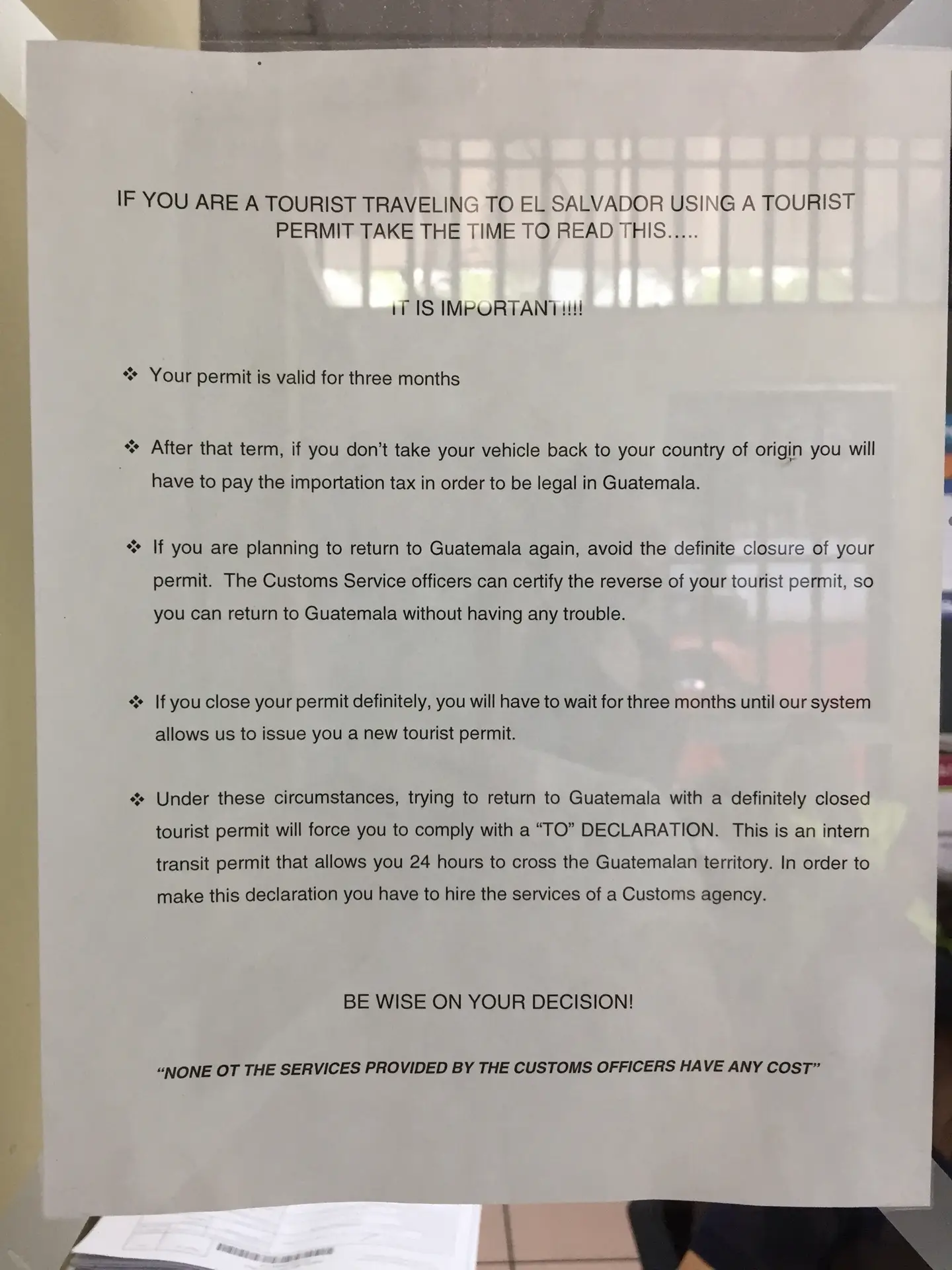
On 15 June 2018 we drive up under the arch and park in the left lane as the front vehicle at the red line. A friendly and helpful official border helper explains what to do. I ask whether there’s a waiting period if we export the vehicle now and want to come back, as we don’t yet know whether Nicaragua will let us in. He makes enquiries for us so that we definitely won’t have any problems and says that the TIP then simply starts again from scratch and there’s no waiting period. So at this time Guatemala is the only country in Central America where you mustn’t close the TIP if you want to return within three months; you have to suspend it and reactivate it on re-entry.


He sends us to the customs counter, where we get a stamp on the TIP. Then he and a colleague take a look at Muggl, sign the stamp and send us to immigration, where we have to check out. A photo is taken of us and our fingerprints are taken. With the exit stamp we have to go back to customs; the official checks Christoph’s passport and keeps the stamped TIP form. That was quick, even though we went to the toilet in between.

On to Costa Rica. Between the borders there’s a fumigation station, and although nobody signals us to drive there, we do it anyway. We don’t want anyone running or shouting after us. The man notes our number plate, signals that we should close the windows, and Muggl is deloused once again. It costs nothing. Right after that there’s a green building on the right – it doesn’t look like it, but it’s the border. All around are no-parking signs, and we’re wondering what to do when a volunteer border helper signals that we should park in the no-parking zone. There’s no point even trying to understand it.

It’s not easy to tell the volunteer border helpers from the official ones. The volunteers, if they’re fair, identify themselves beforehand by saying they’ll help us for a tip or a regalo (gift). After almost 20 border crossings on this trip we no longer need help. At first it was a bit tedious, but that’s the only way to learn and remember how it works. We march to immigration and check in. On our last entry Costa Rica asked for a return flight ticket, but it’s enough to say you’re travelling in your own vehicle. This time the official didn’t even want to see the vehicle registration. We get our stamps and have to go round the corner, somewhat hidden, to customs to reactivate the TIP. Because even though we wouldn’t have had to suspend the TIP when leaving Costa Rica, we did it anyway and are therefore faster now. For that we have to fill in the application form and an import slip. He wants to see the insurance certificate, which we still have from last time. He checks the VIN and takes a quick look inside Muggl. A quick look in the fridge – nobody had looked in it for a long time, and because we hadn’t even thought about it any more, we had gone shopping the day before. But apparently we didn’t have anything forbidden with us. A short “listo” and the official has disappeared again. Total: 50 minutes including a toilet break! But that’s also because we only had to reactivate the TIP and already had the insurance.

Border Crossing from Nicaragua to Honduras at Guasaule

Berichte Zentralamerika – Foto 4

Nicaragua to Honduras at Guasaule

On Saturday 23 June 2018 we actually didn’t want to cross here again – entering Nicaragua had taken so long back then, and the good 3.5 hours are still all too fresh in our memory. But it’s now the shortest route out of the country, and since we’re still travelling with Aiden and Joanna, we decide to take the shortest and least complicated route. As so often, we drive past a long queue of lorries and join the line just before the faded light-blue “Bienvenidos” (welcome) arch. Lorry drivers are very patient people, and in Central America they have to be. An inspector at a small hut wants to see our passports and the TIP. We park on the right, once again in front of the light-blue building that houses immigration and customs – let the ordeal begin!

Of course we first get the wrong queue and are sent to the other end of the room, just like at the supermarket, where you always pick the slowest line. Fortunately the queues aren’t long and things move quickly. Somehow everything seems better organised today, and more booths are staffed. We pay $4 and are checked out in the system – unfortunately there’s no stamp. Next we have to find a vehicle inspector again, which turns out to be easy this time, because like last time he’s wearing a light-blue polo shirt with an orange high-vis vest. As we get closer, we recognise him as the nice man from back then who inspected Muggl when we entered. A police officer comes along, and they take a look inside the car, including the cool box. The police officer takes notes, and in a few minutes we’re done.

As always, the last stop – customs, where we stamp Muggl out – is back in the building. The woman this time is very friendly, and we’re done quickly here too. We can hardly believe it and wonder whether we’ve forgotten something, but after 45 minutes everything is done. On the bridge between the borders, a young woman from the tourist office briefly asks us about our travel plans: which regions we want to visit, what activities we’ve planned, where we intend to stay overnight, how long we want to stay and finally how old we are.


The Honduran side of this border is very run-down. A huge gravel area with potholes so big that a mid-size car could disappear in them lies opposite the immigration building. Everything is crammed with lorries, so we have to park there too. As soon as we drove in we were besieged by border helpers who want to help us with the paperwork, and young lads who probably want to become one some day offer to watch our cars – all for a propina (tip), of course. We politely decline, say we have a dog who keeps watch, and join the long queue in front of the officials’ booths. It goes quickly; a young official deals with us, and after about 20 minutes we’re done here.

Customs, where we get the papers for Muggl, is at the back of the row of booths. Without us noticing, Aiden has already wangled something, and we don’t have to queue there but are waved into an office behind the booths. A woman sits at a desk there and greets us kindly. Here we all do the TIP for our vehicles. She needs two copies each of the vehicle registration, Christoph’s passport and driving licence, and fills in a form. Finally she stamps Christoph’s passport. We also have to pay $35 for the three months (there’s nothing shorter). We’re back in the land of copies. Next I have to make copies of the form she issued (1x) and of the stamp in Christoph’s passport (2x) in a small hut opposite the building. Getting there is like running the gauntlet, as I have to pass through three rows of lorries queuing towards Nicaragua, cross the car park and dodge countless puddles. When I get back, she takes the copies and hands us our TIP. Oh, it would often be so much easier if they just put a photocopier in there. In Honduras car insurance isn’t compulsory, so we don’t even bother looking for an insurance office – that would be a waste of time, we’ve learned that much. Total time: surprisingly only about 1 hr 40 min.

Border Crossing from Costa Rica to Nicaragua at Peñas Blancas

Berichte Zentralamerika – Foto 5

Costa Rica – Nicaragua at Peñas Blancas

On 21 June 2018 at midday we meet Joanna and Aidan, our compañeros with whom we want to travel through Nicaragua, in La Cruz, 20 km before the Nicaraguan border. At 12:15 pm we arrive at the border and first have to pay our $8 tourist tax at a small kiosk to the right of it. Then we pass the queue of lorries that has formed on the right past the border and park opposite the immigration building, where we check out of Costa Rica. There we can also make a copy of the TIP straight away and then – how could it be otherwise – have to go 300 m back to the building where we got the insurance and the TIP when we entered. At the same counter the reactivated TIP is suspended again, as we don’t yet know whether Nicaragua will let us in and out again to the north, or whether in the worst case we’ll have to come back. But that’s all no problem; the woman at the counter is very nice and quick, so we’re back outside after a few minutes.

Costa Rica - Nicaragua bei Peñas Blancas – Foto 2

Off to Nicaragua – but first, as always, we have to pass the last Costa Rican, who is usually positioned a few metres from the border and checks that we really have done everything and have every stamp. We get closer to the Nicaraguan border; a man wants to see our passports and explains that we now have to drive through the fumigation, then park on the left and pay for the fumigation in the building next to customs. All clear! It’s not so confusing for us here because we’ve been here before. By chance we park exactly where we parked last time and go to immigration first. A more or less friendly, plump young woman first has to plug in her mobile phone and then rummages around under the desk. She asks for our passports, asks (mumbling heavily) what we do for a living and at which border crossing we want to leave. We don’t know the latter yet, because we don’t yet know how and where we’ll get through the country. We pay $24 and are now officially in crisis-hit Nicaragua.

Costa Rica - Nicaragua bei Peñas Blancas – Offroad Travelers

Now it’s Muggl’s turn. Behind the building we stop at the seguro (insurance) counter. A woman is interrupted in her crocheting, and the insurance certificate for 30 days and $12 is quickly issued. As we’re already on the other side of the building and there was no vehicle inspector in sight at the front, we immediately look for the person we have to pay the fumigation to, but the counter is empty. We ask the woman next door, who sits at customs, and she says he should actually be there. She comes out from behind her desk, goes to the fumigation counter and knocks hard on the glass. A man in the glass booth jumps up, and all four of us are very amused, as we’ve already walked past it three times. The fumigation costs $3, and the sleepy man issues the corresponding document.

Now comes the hardest part: we have to find the vehicle inspector, but once again there’s nobody there. People are very helpful; someone says he’ll look for him for us, someone else says he’s on his lunch break. Well, those are the best conditions! But after about 15 minutes someone actually comes to us with the vehicle inspector in tow. He first hands us a piece of paper and turns around again. I just think: “Nooo, please don’t go away!” I fill in the form, and luckily the inspector is back. He takes a quick look at Muggl from outside and then asks if he can get in. Sure, we have nothing to hide. A brief look is enough for him; he asks whether we have a drone, which we deny, and we’re sent off with a “Buen viaje”. Now just customs, where we have to show the insurance, passport and driving licence and finally get Muggl’s TIP. Total: 2 hrs 15 min. Totally relaxed, and no sign at all of the unrest in the country.

Border Crossing from Honduras to Nicaragua at Guasaule

Organisation & Planung – Foto 4

Checking out of Honduras goes smoothly. We park our vehicle in front of a blue building where it is checked out. On the other side of the road we get our exit stamp at immigration. After just 15 minutes everything is done, and we continue towards the bridge. A lorry driver waiting in the queue advises us to simply drive past. That means we first have to cross a small hill and switch to the oncoming lane so we don’t have to wait. An official in front of the bridge checks that we’ve completed all the formalities and that our documents have the exit stamp for us and our vehicle, Muggl.

The Nicaraguan side seems chaotic – and it is! First a gatekeeper gives us a declaration document, which is important so that you don’t have to go back to the very start of the queue. An official checks our passports, followed by a female official who asks whether we applied for anything beforehand. We say no, as we didn’t know about anything. Next we go to fumigation, where we pay three dollars and Muggl gets sprayed a little.

Now it gets really exhausting: at immigration we’re dealt with straight away, but need various copies: two of the passport photo page, two of the page with the Honduran stamps, one of the vehicle registration and one of Christoph’s driving licence. We get the copies quickly in a small copy shop opposite. We bring our papers back, hand over our passports and wait. After half an hour another official comes back with our documents and complains that the copies are too small. We had copied both passports on one sheet and cut the pages apart to save paper. In the end he accepts it, but we copied the wrong stamp page of Christoph’s passport, so back to the copy shop.

When I come back, the official is still sorting the papers and staples Christoph’s and mine together separately. Then the questioning begins: occupation, marital status, age, vehicle make and type, colour and number plate, how much cash we have on us (after deducting the immigration fee, 26 dollars), how long we want to stay, where we’re going in Nicaragua and where afterwards. He even wants to know when we left Germany, when we entered the USA and how long we were there. He notes everything on the copies of our passports – now I understand why he wanted so many pages!

After the interrogation he disappears behind a glass door with all the documents, including our passports. He points out our passports to a colleague, who just shrugs. We feel like the first Germans ever to enter Nicaragua – there’s no recognisable system! At some point he comes back with a new form, sits down in an empty customs booth and fills it in. I suspect he’s transferring the answers he first scribbled on the copies of our passports onto the form.

15 minutes later he leads us outside and points to an elderly gentleman in an orange high-vis vest who will inspect our vehicle together with a police officer. He says we’re almost done – I don’t believe him! We wait another 10 minutes until the gentleman is free. At least he has a sense of humour – the first person with a sense of humour we’ve met today. He doesn’t want to check the chassis number; he and a young police officer who has joined us in the meantime are curious. I open the sliding door, the elderly gentleman looks around and asks: “What’s that lying in the hammock?” We have a little pink pig in a hammock above the bed. I say: “Oh dear, it doesn’t have a passport.” He laughs. They want to know whether we have a drone and look at my camera. They ask what Christoph does for a living and whether we’re reporters. The police officer looks in the cool box and the wardrobe and wants to look in the bag under the seat where the Dutch oven is stowed.

Inspection done, but far from finished. 1.5 hours have passed since we first went to make copies. During the waiting times, when the official kept disappearing with our documents, I wrote this report. We went to get money twice, once córdobas and once US dollars – better not tell him that, it would mess up all his notes. We wait another 20 minutes until the official we first saw finally processes our immigration. We pay 24 dollars (12 dollars per person) and after 3 hours we’re done! Wait, no, we still have to go to customs to check Muggl in and to the station where luggage is normally scanned, and explain that we have no luggage.

Grenzübertritt Honduras nach Nicaragua bei Guasaule – Offroad Travelers

Done? No, because for Nicaragua, unlike Guatemala, El Salvador and Honduras, car insurance is compulsory again. So off to the neighbouring building, where the bank is. There the insurance clerk has simply moved her office outdoors and sits at a small table in the shade. It takes 5 minutes to issue the insurance certificate, and for 12 US dollars it’s valid for 30 days.

Total time: 4 hours and 15 minutes, 3.5 of them at the Nicaraguan border.

Border Crossing from Guatemala to Mexico at La Mesilla

Berichte Nordamerika & Mexiko – Foto 6

The most adventurous border crossing awaits us: narrow and getting narrower towards the immigration building. La Mesilla is like a huge marketplace. We arrive at 12:36 pm. A friendly official in a blue polo shirt with an embroidered SAT emblem greets us. He tells us to go to customs first and asks whether we want to return to Guatemala. We say no and remove the sticker from our windscreen, where it had been stuck until today. We stick it on the back of the SAT form, which is stamped and kept at customs. He isn’t interested in Christoph’s passport. Then it’s off to immigration, where our passports are stamped. At the check, the official asks about whisky and tobacco. I say we don’t like whisky and we don’t smoke. That’s not even a lie, and Christoph only smokes now and then. Still, he wants to look in the car, checks the cool box and looks in the cupboards. He doesn’t get in; it’s enough for him that I open the cupboards and explain what’s inside. Then, as always, there’s fumigation right in the middle of the market bustle. This time Muggl is only sprinkled with a pressure-washer-like device, for which we pay 50 quetzales.

Grenzübertritt von Guatemala nach Mexiko bei La Mesilla – Offroad Travelers

At 12:56 pm, after 20 minutes, we leave town and drive the 3 kilometres to the Mexican border. But there the official sends us back first. The exit stamp has the wrong date: today is 10 July, not 10 June! Damn! Not paying attention once – but it was bound to happen at some point.

So back into the hustle and bustle. We look for a parking space, but we’re refused the half-empty taxi car park. No amount of explaining helps. In the time spent negotiating we could easily have walked to immigration and got a new stamp. I walk down the street to the friendly old traffic guide who had waved us towards the edge of town earlier. He understands immediately. We park at the back entrance of a supermarket, which is presumably a loading zone otherwise.

At immigration the clerk is very embarrassed. He apologises several times for his mishap. The wrong stamp is declared invalid and a new one goes in. Well, that was easy. Now it’s time for a taco break!

Grenzübertritt von Guatemala nach Mexiko bei La Mesilla – Foto 2

At 2:45 pm we’re back at the Mexican immigration, and with us a minibus. Of course. I wonder how many people fit in a minibus. We wait a good 35 minutes until it’s finally our turn and then get the classic customs form to fill in. At least afterwards we don’t have to go to the back of the queue again, but are waved in between. Then a quick trip to customs to ask whether anyone wants to see Muggl’s import permit. The official explains that he can simply drive in and out for 10 years, as often and whenever he likes. For that he got a sticker on the windscreen when he first entered. Well, he has it easy!

At 3:26 pm we’re finally done and set off for San Cristóbal de las Casas. Almost, anyway, because we don’t get far. The first military checkpoint is waiting for us just three kilometres after the border. Oh, how we’ve missed that. “Revisión del vehículo,” they say, and I patiently open the sliding door. It’s broken, I say, and the curious Mexican helps me lift it. Yes, they’re curious, the young soldiers, but also very polite. His colleague gets in and looks around. He carefully opens the wardrobe and carefully closes it again afterwards. Still, this military check seems more serious than the ones we had on Baja so far. Two soldiers walk around the checkpoint with dogs, and as we drive on we see a stinger lying at the end of the barrier.

Total time without the military check: 2 hours 45 minutes, but including a taco break. If the official on the Guatemalan side hadn’t set his stamp wrong, this could have been our fastest border crossing.

Border Crossing from Guatemala to El Salvador at La Hachadura

Organisation & Planung – Foto 5

On 8 May 2018 we reached the La Hachadura border crossing from Guatemala to El Salvador. Even from afar we could see the chaos that awaited us. We had read that you should simply drive past the lorries. So we passed the roughly three-kilometre-long queue of lorries and reached the Guatemalan border. There we checked out and made copies of the stamp in Christoph’s passport and of Muggl’s Guatemalan temporary import permit (TIP). Luckily the copy shop was right opposite.

In the office of the SAT, which is responsible for the temporary import of vehicles, I explained that we wanted to suspend Muggl’s permit, as we would be travelling through Guatemala again on the way back. Cancelling the permit or letting it expire would have meant a three-month ban on re-entry. At the counter an employee checked our documents and asked us to wait. As all the seats were taken, we stood for half an hour. With no recognisable system, we were finally called. A female official, who seemed grim at first, dealt with us, checked Muggl’s number plate and chassis number and suspended the permit.

Grenzübertritt von La Hachadura Guatemala nach El Salvador – Offroad Travelers

On we went to check in to El Salvador. The barely one kilometre between the border offices was full of lorries squeezing across a two-lane bridge. As there was oncoming traffic from El Salvador, we had to slot in between the lorries. Meanwhile we chatted with the drivers and learned that a crossing further north would have been faster. We were surprised, as we were the only car.

When we finally arrived, we passed a barrier that represented the official immigration, as there are no more stamps. The CA-4 countries Guatemala, El Salvador, Honduras and Nicaragua issue a joint 90-day visa, which speeds up border processing – except for vehicles. Because of Muggl we had to go to customs and fill in a form that was only available in Spanish. Fortunately we were given a sample form that helped us understand the questions. Here too the official wanted to see Muggl and checked the details on the form, including number plates and chassis number. He even looked for the model designation, which wasn’t recorded, but showed a will to check thoroughly. Then he entered everything into the system, which took another 15 minutes.

Finally we checked the details, and after a good three hours in total we were finally done.