The Police, Your Friend and Helper

Berichte Nordamerika & Mexiko – Foto 5

We get stopped at a police check for the first time in southern Mexico – of all days, on the day we want to leave for Belize! On Baja California there were a few military checkpoints and on the mainland some police checkpoints too. Mostly we were waved through, occasionally asked where we were coming from and where we were going. Sometimes a particularly curious police officer wanted to take a look inside our camper, Muggl. But we only experienced a real police check after about 40,000 kilometres. Nothing in the USA, nothing in Canada!

They've got a new toy

It’s Tuesday morning, 20 February. In Chetumal we’ve prepared for today’s border crossing into Belize and are driving south on Avenida Insurgentes when a policewoman stops us. “Great”, we think, “that’s all we needed.” On the very last day they get us, and I brace myself for negotiations with corrupt police officers. The young officer says we were going too fast, grinning as she says it. I ask how fast we were going, but get no answer. I can’t imagine we were speeding, unless this wide avenue were absurdly a 30 zone. I’d believe anything of the Mexicans. We’ve only driven about four kilometres, and Christoph always warms Muggl up very slowly. So I ask again how much over the limit we were. Again no answer. The policewoman seems very amused, and somehow I had imagined a Mexican police check differently.

A police officer steps out from behind her, also grinning, and says we were driving too fast – but he doesn’t tell us how fast either. It all seems very strange to me. When the officer steps aside, I see the policewoman again, holding a laser gun that she’s aiming at the next vehicle. Now it all makes sense: they’ve just been given new laser guns and think the new toy is great fun. We’re handed a slip of paper asking us to please respect the speed limits in built-up areas, and they wish us a good journey and a nice day. We’re speechless but happy at the same time, and leave Mexico without having met a single one of the infamous corrupt police officers.

They do exist after all

In Belize, Guatemala, El Salvador and Honduras the police leave us completely alone. Although there was a lot of police presence and many checks in Guatemala, tourists are of no interest whatsoever. We actually meet the first corrupt police in Nicaragua, and I’m a little surprised that despite the unrest in the country they still have time to rip off tourists! It’s Wednesday morning, 16 May, and we’re leaving León heading south. At the edge of town two police officers stop us. One comes to the window and says we drove over a solid line. Of course, I say, you have to here, otherwise you can’t change lanes – and we want to go to Granada, not León, because that’s where we’ve just come from. A short back-and-forth discussion; he wants 20 US dollars from us and waves a yellow slip of paper meant to make the whole thing look official. I say we have no cash and ask for a bank payment slip, then of course we’d pay our fine properly. He walks away and briefly discusses with his colleague, then we’re waved on. Nice try.


We immediately warn the other overlanders we met in León, because they want to head the same way the next morning – and sure enough, one of them gets caught too. They tried it with 100 US dollars. Must be the Sprinter. Muggl’s age and the fact that he’s already so scratched and dented work in our favour here, lowering the bribe somewhat. But the two of them do as we did, ask for a payment slip and are sent on their way. When we drive back through Nicaragua six weeks later, with the crisis further advanced, not a single police officer is to be seen anywhere. The police are under the total control of the dictatorial government and therefore enemies of the population, so the police no longer dare to go out on the streets.

The next time the police pay us a visit is on 23 May, on a rainy night at Playa Coyote on the Nicoya Peninsula in Costa Rica. We had a lovely sunny day at the beach, and when it starts to rain around half past seven and it’s already dark, we go to bed. Shortly after nine – it feels like the middle of the night to us because we’ve already been asleep – a police siren with additional disco lighting wakes us up. It feels a little frightening when the police visit you with the full programme. I get out, and Christoph first says to me: “You’ll handle it.” “Are you crazy? You’re coming out with me,” I reply.

The younger of the two officers is very nice and asks whether everything is OK, who we are, what we’re doing and how long we plan to stay. Another, rather grim-looking older officer asks for our passports and disappears with them. We stand under Muggl’s awning and chat with the young officer, who tells us that he has been to Hamburg before – but in autumn, which must have been quite a temperature shock for him! The grim one comes back and lectures us on how dangerous it is here and that robberies and robbery-murders keep happening all over the country. I refrain from saying that we’ve already survived five months in Mexico and almost two in Guatemala. The young officer has already questioned us thoroughly and explains to him that we’ll be leaving tomorrow morning. The grim one asks whether we have any weapons or drugs. We say no, and apparently he believes us, because we’re not searched. He gives us back our passports and mumbles a goodbye before disappearing behind Muggl. The young officer says goodbye with a handshake and wishes us a good night and a good onward journey.

And the next one follows right away in Costa Rica. On 4 June we’re camping with other overlanders in the middle of San José, at the end of a road behind a Walmart surrounded by green meadows. We’ve only been parked for an hour, it’s already dark, when five police officers arrive on three motorbikes. And I say: “Good that they’re coming now and not knocking us out of bed in the middle of the night.” They ask where we’re from and want to see our IDs. It isn’t good that we’re parked here, they say; we should rather move over to the Walmart car park, where there’s a security guard – that would be safer. We had already decided the Walmart wasn’t an option for us, and I reply that we’d rather stay here because it’s much quieter and not as brightly lit as the Walmart car park. Besides, there are two of us. They’re not thrilled, but they let us park here and disappear again. We actually have a very quiet night, and in the morning around seven a new team comes by, this time four officers on two motorbikes, to check that we’re still alive and all present. “Is everything OK?” they ask. “Yes, everything’s great,” we answer. One of the officers even says goodbye with “Auf Wiedersehen” and “Gute Reise” in German!

The next and last time it’s our turn in Panama, just a few kilometres after the border. Panama is very strict about speed limits, and strangely, many roads outside towns have a maximum speed of only 40 km/h! That almost became our undoing about 15 minutes after the border. We were “lasered” at 67 km/h. Yes, you read that right, the traffic police in Panama use laser guns! That was supposed to cost 50 US dollars. The officer sees in Christoph’s passport that we only entered today and asks how long we’ve been here. “20 minutes at most,” we say. “Ohhh,” he replies, says he has to write us a ticket and explains that we have until we leave the country to pay it – and starts writing. We’re disappointed in ourselves for not paying attention, and about the pointlessness of a 40 km/h limit on this dead-straight, well-built road. The officer disappears briefly, and I think at that moment he got the OK from his colleagues – there were three or four officers in total – to let us go, because when he comes back he explains that he won’t issue us a ticket, but we should watch the speed limits! We can hardly believe it, are speechless at first and thank the friendly officer profusely for treating us so kindly on our first day in Panama.

On the way back through Costa Rica, Nicaragua, Honduras and Guatemala there are no police or military checks. Only in Mexico does it get fun again. On the drive from La Mesilla to San Cristóbal de las Casas in Chiapas – that’s 176 km – we pass three military checkpoints, one police check and a very modern police checkpoint. The three military checks are, as we’re used to from Baja California, curious young men who simply want to see what a camper looks like inside. The police check just looks us over from outside and waves us through without asking anything. At the modern, still very new-looking checkpoint that everyone has to pass through, we feel as if we’re at a toll station. You drive up to the barrier, where you have to press a buzzer that randomly decides whether you’ll be checked or can drive on. A green or red light shows whether you’ll be checked or not. Ours lights up red, of course. “Great,” we think, and an above-average-sized Mexican (probably the tallest Mexican of all time) asks us to open the sliding door. But there are only the usual routine questions we always get: where from? Where to? Pets? Tobacco? … etc. From such a professional, even almost threatening-looking checkpoint, I had almost expected them to make us empty half the car, but nothing. Here too we’re sent off with “Buen viaje”.

Our conclusion

Apart from the situation in Nicaragua, we’ve had only positive experiences with the police and military. People treated us in a friendly and polite way, which may also have had something to do with our camper. I can imagine it being different with a newer and/or larger vehicle, as the experience of our travel friends in the Sprinter showed – 100 US dollars were demanded from them for the same “offence”. All the same, we’d recommend always going into the vehicle with anyone who wants to get in. In theory you don’t have to let them in at all, but we just think it could make us look suspicious if we said no. Police officers and soldiers ALWAYS asked whether they could look inside or come in, though no police officer ever came in – only soldiers. We also always showed laminated copies of our IDs and driving licences. Only once did a police officer in Mexico notice and want to see the original. Seeing it was enough for him; he didn’t take it. That was our experience. But we’ve also heard stories of travellers who had to “buy back” their original documents or had something planted on them during a check. You should be careful in general, but in our experience there’s no need to be afraid. I always start every encounter with a little joke, which usually lightens the mood right from the start. By the way, that also helps at border crossings – and of course it’s easier if you speak a bit of Spanish.

Border Crossing from Guatemala to Mexico at La Mesilla

Berichte Nordamerika & Mexiko – Foto 6

The most adventurous border crossing awaits us: narrow and getting narrower towards the immigration building. La Mesilla is like a huge marketplace. We arrive at 12:36 pm. A friendly official in a blue polo shirt with an embroidered SAT emblem greets us. He tells us to go to customs first and asks whether we want to return to Guatemala. We say no and remove the sticker from our windscreen, where it had been stuck until today. We stick it on the back of the SAT form, which is stamped and kept at customs. He isn’t interested in Christoph’s passport. Then it’s off to immigration, where our passports are stamped. At the check, the official asks about whisky and tobacco. I say we don’t like whisky and we don’t smoke. That’s not even a lie, and Christoph only smokes now and then. Still, he wants to look in the car, checks the cool box and looks in the cupboards. He doesn’t get in; it’s enough for him that I open the cupboards and explain what’s inside. Then, as always, there’s fumigation right in the middle of the market bustle. This time Muggl is only sprinkled with a pressure-washer-like device, for which we pay 50 quetzales.

Grenzübertritt von Guatemala nach Mexiko bei La Mesilla – Offroad Travelers

At 12:56 pm, after 20 minutes, we leave town and drive the 3 kilometres to the Mexican border. But there the official sends us back first. The exit stamp has the wrong date: today is 10 July, not 10 June! Damn! Not paying attention once – but it was bound to happen at some point.

So back into the hustle and bustle. We look for a parking space, but we’re refused the half-empty taxi car park. No amount of explaining helps. In the time spent negotiating we could easily have walked to immigration and got a new stamp. I walk down the street to the friendly old traffic guide who had waved us towards the edge of town earlier. He understands immediately. We park at the back entrance of a supermarket, which is presumably a loading zone otherwise.

At immigration the clerk is very embarrassed. He apologises several times for his mishap. The wrong stamp is declared invalid and a new one goes in. Well, that was easy. Now it’s time for a taco break!

Grenzübertritt von Guatemala nach Mexiko bei La Mesilla – Foto 2

At 2:45 pm we’re back at the Mexican immigration, and with us a minibus. Of course. I wonder how many people fit in a minibus. We wait a good 35 minutes until it’s finally our turn and then get the classic customs form to fill in. At least afterwards we don’t have to go to the back of the queue again, but are waved in between. Then a quick trip to customs to ask whether anyone wants to see Muggl’s import permit. The official explains that he can simply drive in and out for 10 years, as often and whenever he likes. For that he got a sticker on the windscreen when he first entered. Well, he has it easy!

At 3:26 pm we’re finally done and set off for San Cristóbal de las Casas. Almost, anyway, because we don’t get far. The first military checkpoint is waiting for us just three kilometres after the border. Oh, how we’ve missed that. “Revisión del vehículo,” they say, and I patiently open the sliding door. It’s broken, I say, and the curious Mexican helps me lift it. Yes, they’re curious, the young soldiers, but also very polite. His colleague gets in and looks around. He carefully opens the wardrobe and carefully closes it again afterwards. Still, this military check seems more serious than the ones we had on Baja so far. Two soldiers walk around the checkpoint with dogs, and as we drive on we see a stinger lying at the end of the barrier.

Total time without the military check: 2 hours 45 minutes, but including a taco break. If the official on the Guatemalan side hadn’t set his stamp wrong, this could have been our fastest border crossing.

Border Crossing from Chetumal, Mexico, to Corozal, Belize

Berichte Nordamerika & Mexiko – Foto 4

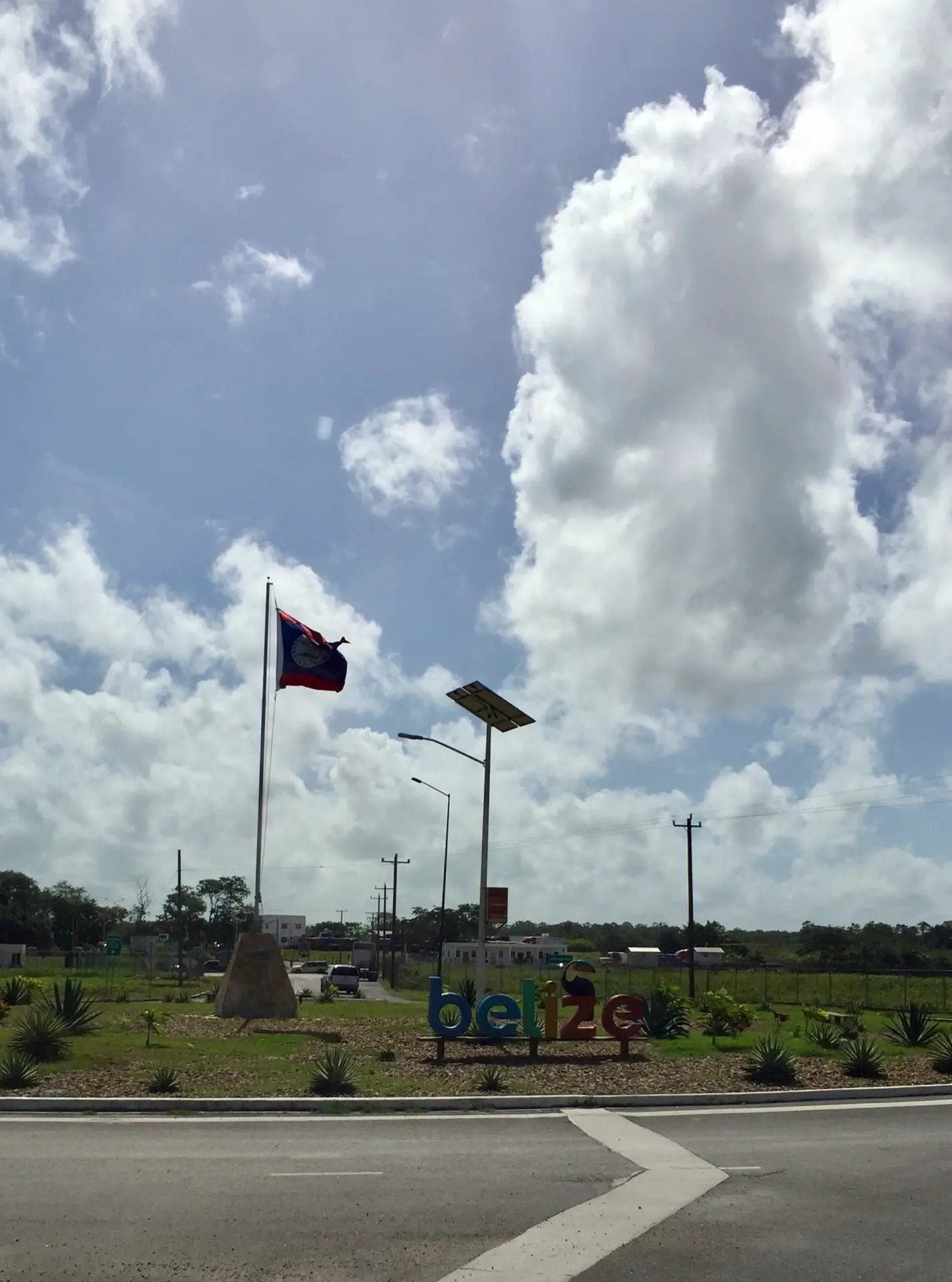
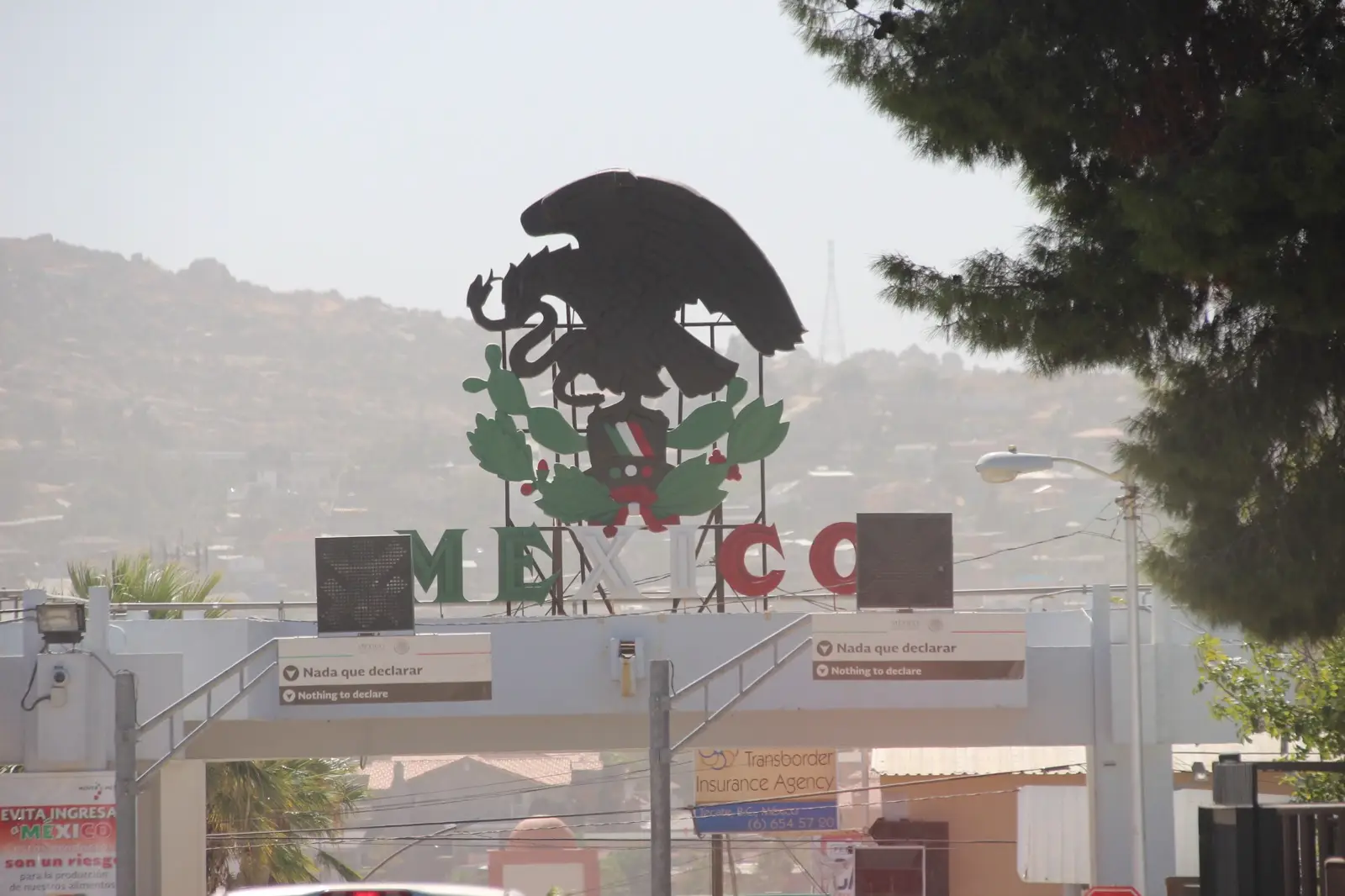
20.02.2018 Adiós Mexico, welcome Belize. On Tuesday morning we set off from Chetumal for the border. Hardly out of town, we run into a police check. The policewoman explains, laughing, that we were driving too fast. Only 40 km/h applies in town, she says in Spanish. I ask how fast we were going, but get no answer. Great, we think, that’s all we needed on our last day! A colleague joins her and asks whether we speak English. Yes, we answer, and he too explains that we were too fast. He doesn’t tell us our speed either. Somehow they all find it funny, and soon we’re laughing along. Nobody wants money from us; they just tell us to drive more slowly. Then they send us on our way. We suspect they’ve just been given the new laser guns and are therefore having so much fun with them. Mexicans are a bit like big kids.
Grenzübertritt von Chetumal Mexiko nach Corazal Belize – Offroad Travelers

A few minutes later we reach the border. There we check out and have our passports stamped. As we had left Mexico in the meantime and flown to Cuba, we have to pay the tourist fee of 533 pesos per person again. Then we look for the office to check out our camper. But the woman at the counter has no idea what we’re talking about. Within 12 months we have to send a document about the export of our camper to the USA to confirm that we’ve left the NAFTA countries. She can’t issue us a corresponding document.

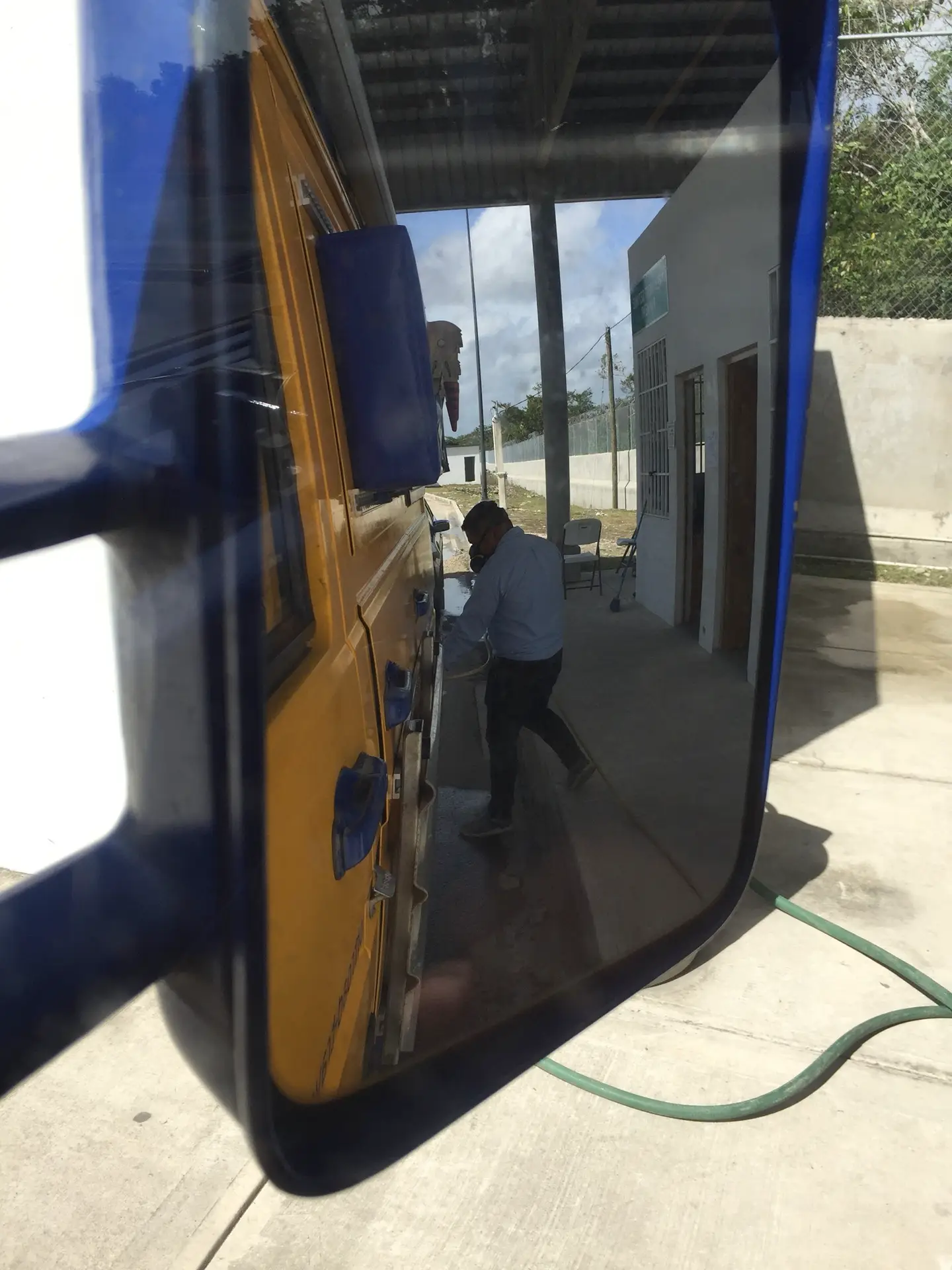
Well, if she doesn’t know what we want, we’ll rely on the Belizeans. On to the disinfection station. Yes, you read that right: we have to close the windows and Muggl is sprayed with disinfectant. The whole thing costs 10 Belize dollars or 5 US dollars or 100 pesos, and we get a receipt that we have to show later. On to immigration, where a very friendly young border official greets us in the car park with a handshake and the words “Welcome to Belize”. He explains that we can leave the car here and should follow him into the immigration office. There he shows us where to fill in the entry form, get our stamp and where Muggl gets his papers. As soon as we enter the building we’re handed a map of Belize with sights, natural highlights and activities. Very friendly people, the Belizeans.

Grenzübertritt von Chetumal Mexiko nach Corazal Belize – Foto 2

The officer at the immigration counter first asks: “Who is this lucky guy?” In such a serious setting it always takes a moment to get the humour. The officer jokes with us and calls Christoph a “lucky guy” because he’s lucky enough to travel with me. Finally someone recognises it! 😉

He asks where we want to go. We say we want to go to Crooked Tree, a village between Orange Walk Town and Belize City. He warns us about the cashew wine in the area – it gets you drunk. Of course, it’s wine. When you wake up the next day thinking you’ve slept it off, the sun reactivates the alcohol and you get drunk again. That sounds wild. Let’s see whether we find cashew wine somewhere.

We don’t have to give fingerprints or look grimly into a camera. The officer asks how long we want to stay and enters 30 days in our passports. How uncomplicated! At the next counter Muggl also gets his “residence permit” in the form of a paper with his details and the length of stay. Like us he gets 30 days, and this document is now his “passport”, says the officer. It costs 30 US dollars, and I hope it’s enough for the Americans to accept Muggl’s entry into Belize as his exit from Mexico.

Grenzübertritt von Chetumal Mexiko nach Corazal Belize – Foto 3

Next they inspect our fridge. Damn! I forgot to hide the eggs. As we hadn’t heard of anyone having their car searched so far, we had dared to stow food in such a way that you’d have to unpack everything to find it. The fifth official explains calmly: “You know, we once had bird flu, and since then no poultry products may be imported. But don’t worry, we have eggs in Belize.” Well, that’s fine then, and I don’t want to be responsible for a mass epidemic. Nobody would have been interested in packaged sausage, travellers who entered Belize at the same border about two weeks before us had told us. Today it’s different. You have to declare it, but since our pack of salami and the ham have the TIF seal, they turn a blind eye. This seal certifies that the food was inspected and approved in Mexico. Luckily he doesn’t see the cheese sausages right at the bottom of the cool box. They don’t have a seal, and losing them would have been really bad for me personally.

The USDA seal from the USA is also recognised, and food with this seal may be imported but must also be declared. Apart from the cool box they didn’t want to see anything – no cupboard, no drawer. They also ask about alcohol. We have a few cans of beer with us, which is no problem. We say nothing about tequila, rum and wine. To rice, fruit and vegetables I say no. We couldn’t find out exactly what and how much you’re allowed to bring into Belize. As far as we know, you definitely mustn’t bring fruit, vegetables, poultry products such as eggs, chicken and turkey meat, fresh meat, grain, flour or rice. One litre of spirits per person is allowed; I don’t know exactly how much beer per person is allowed. Tinned meat is OK. We can live with the loss of the eggs, and it was our own fault anyway.

So, the border formalities are done. Now we just need insurance and we’re good to go. About 200 metres after the border, in a white square building, is the insurance office. Four weeks of liability insurance for our Muggl costs 60 Belize dollars or 30 US dollars, and we get a sticker that we have to put on the windscreen on the driver’s side.

All done! Belize, here we come……

The Story of Our Brake Discs – an Incredible Ordeal

Berichte Nordamerika & Mexiko – Offroad Travelers

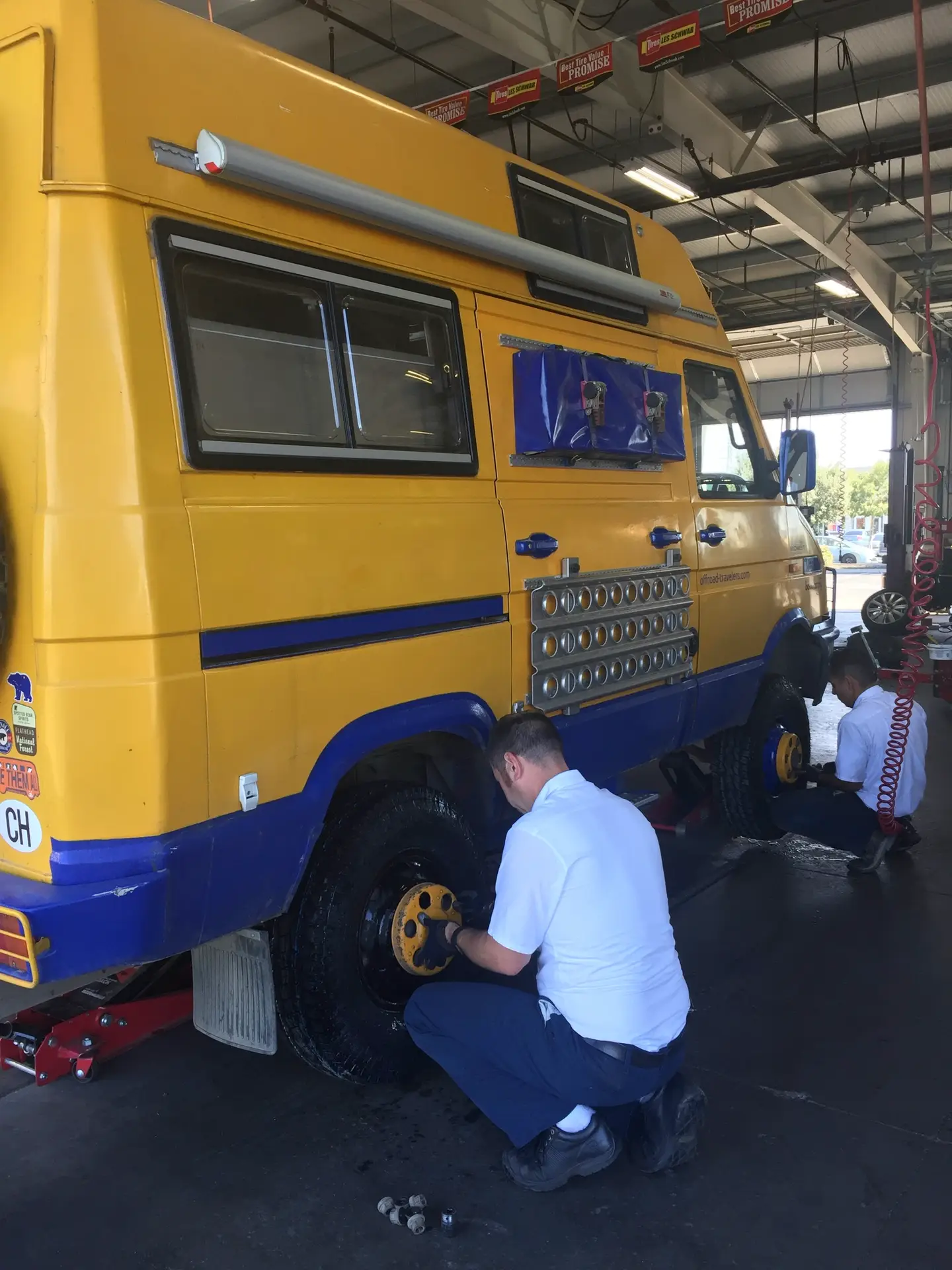
To understand the story, we have to go back in time. Shortly after setting off from San Francisco towards Lake Tahoe, we had another flat tyre. We changed the tyre on the hard shoulder of Interstate 580 heading east, in the middle of rush hour. You can’t choose when you get a flat! With the spare wheel fitted we drove to Manteca and decided to go to a garage the next morning to fix the broken tyre and perhaps fit new tyres straight away. Our mud-terrain tyres had now done 50,000 kilometres, which isn’t much for tyres. But the tread was unevenly worn, as we had mostly driven on paved roads with tyres meant for mud and unpaved tracks.

Die Geschichte unserer Bremsscheiben – eine unglaubliche Tortur

In the USA it’s not easy to find a garage that repairs tyres with inner tubes and split-ring rims. So we ended up at the big chain Les Schwab. There we got good advice and chose the Toyo Open Country tyres. The BF Goodrich All-Terrain is more expensive, has a delivery time and isn’t necessarily better. As we had to change all four tyres, we had the rims balanced at the same time. While the garage fitted the new tyres, we went for breakfast. A good hour later we were able to pick up Muggl again. On we went to Lake Tahoe. After a few kilometres we noticed that the brakes juddered when braking. Christoph suspected that this had to do with the tyre change. In Tahoe we drove to another Les Schwab branch and explained our problem. They turned us away; the shaking had nothing to do with the tyres but was due to the brakes.

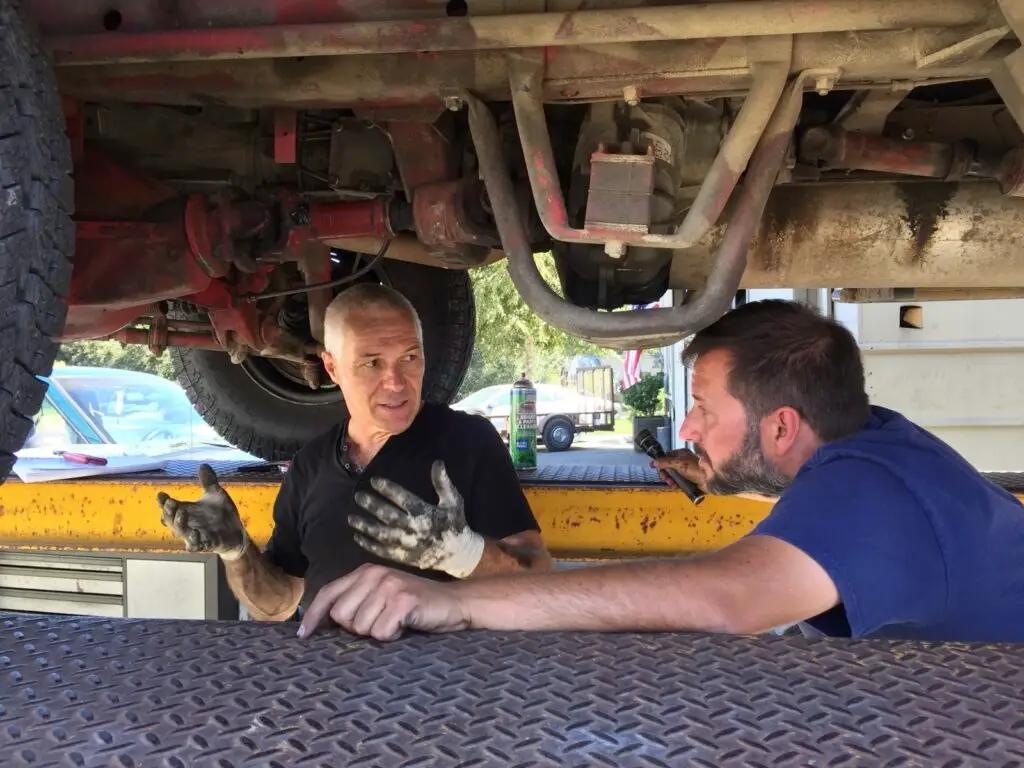
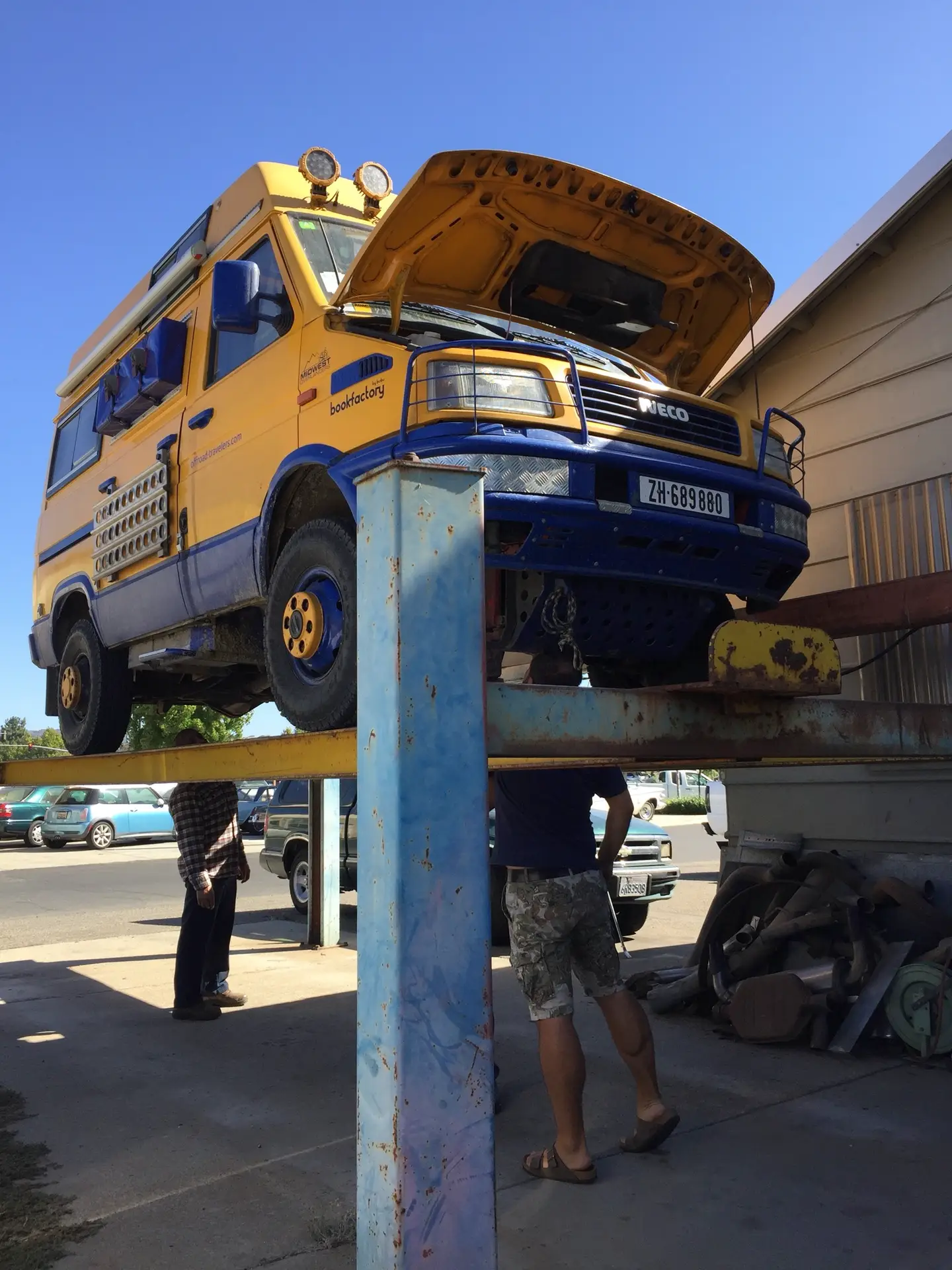
We drove on to Yosemite National Park and then towards Los Angeles. The shaking was with us constantly. As long as the vehicle was cold it wasn’t bad, but when it warmed up it shook badly and you didn’t want to brake too hard. Shortly before Santa Barbara we had an appointment at a garage anyway. Werner, a German, had been recommended to us by Daniel, whom we had met at the Overland Expo in Flagstaff. North American diesel had badly clogged our injection pump, and we had already had a new one sent by our mechanics in Germany. Werner looked at the brake discs and found that they were badly worn. Damn! If we’d known, we’d have ordered new brake discs at the same time. Time was pressing, as our car insurance was about to expire and we had to leave the USA in a few days. The agency wouldn’t extend our policy, and a new six-month policy for 1,700 US dollars was out of the question. We decided to have the brake discs sent to Mexico. We had no idea yet how complicated that would get.

Die Geschichte unserer Bremsscheiben – eine unglaubliche Tortur – Foto 3

We asked the ADAC for support and wanted the discs sent to a cargo office at one of the five international airports in Baja California, where we could pick them up. For days, even weeks, we were in contact with the ADAC. They didn’t give us much encouragement, as it was difficult to send parcels to Mexico and get them through customs. We would need an international customs agent, and even that would be no guarantee. If Mexican customs didn’t accept the delivery, the goods might even be destroyed. We didn’t want to risk that, because it had already been difficult to get brake discs for our Iveco. They’re only produced sporadically and were sold out at the time. Our garage had removed a set from a used Iveco that had only done 5,000 kilometres and was practically as good as new.

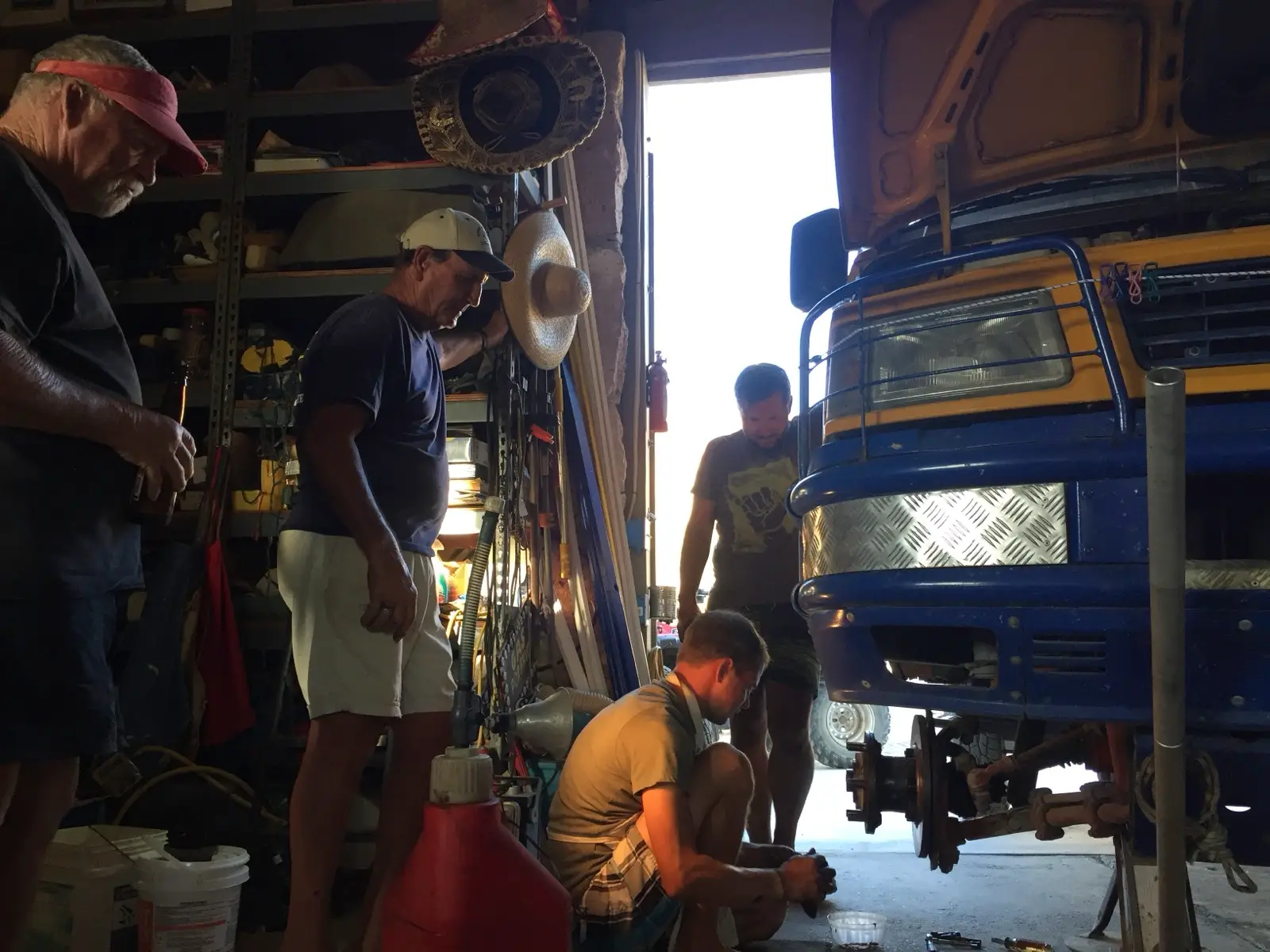
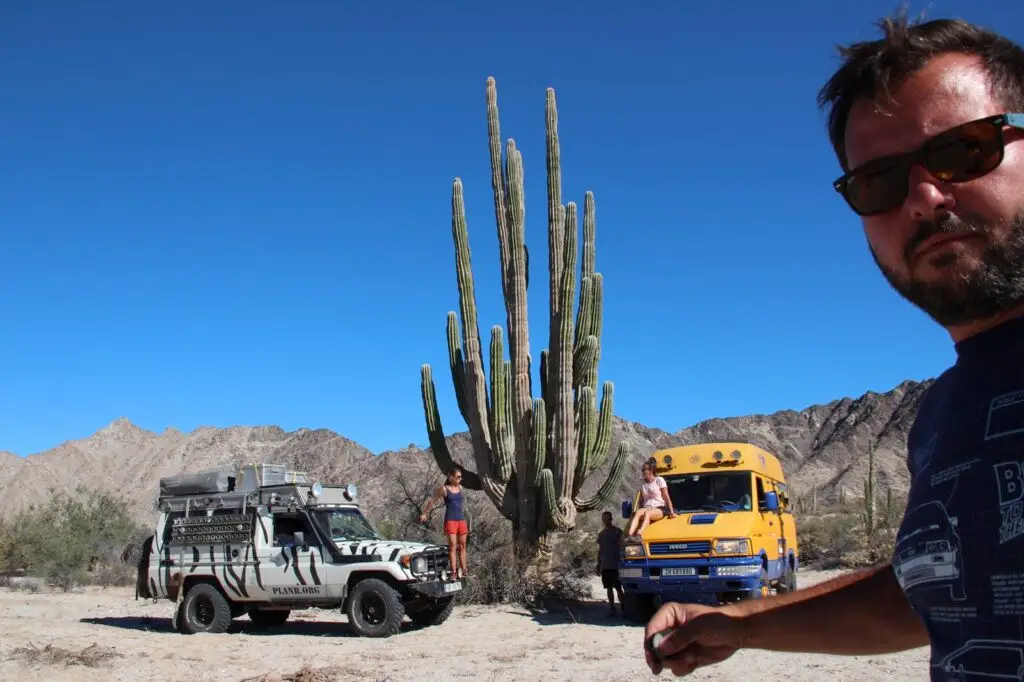
The parcel was ready to ship and waiting at the ADAC for further instructions. In Mexico we met Yasmin and Stefan in their Toyota Land Cruiser (Zebra). We decided to travel Baja together so we could do more off-road driving. The area is sparsely populated, and if you break down you’d have to wait a long time for someone to come by. In Bahía de los Ángeles we came across an American community living in a small bay, where they had their holiday homes and were enjoying retirement. They invited us to camp there and use the internet to solve our problem. I could go into detail, but that would go beyond the scope. In short, we had the ADAC send the brake discs to San Diego, to a friend who came to visit a week later. That was the least complicated way, and we were allowed to stay in paradise all that time, where we snorkelled with whale sharks, used the kayaks and paddled with dolphins, giant turtles and sea lions. Everyone looked after us wonderfully, and we were often invited to dinner in the evening. In the end we were even allowed to use the workshop, where Christoph and Stefan changed the brake discs and pads themselves with the men’s help.

Die Geschichte unserer Bremsscheiben – eine unglaubliche Tortur – Foto 2

Finally it’s done. After two weeks we continue south with mixed feelings. 280 kilometres of gravel track along the Baja 1000 route take us to San Francisquito, where we spend the night, and then on to Guerrero Negro. The last 30 kilometres are paved. But when we brake for the first time, it still judders. So it isn’t the brake discs after all? Did something go wrong during fitting? We want to go into town to buy food and do laundry. The men leave the women at the laundry and look for a garage. But without any Spanish they quickly come back and fetch me. Surprise: a flat tyre! Again! When it rains, it pours. We’re out of luck. Fortunately there are lots of garages in Mexico, and they fix tyres routinely. Our system with inner tubes is impractical, but this time we picked up a rusty nail at the taco stand. The tyre is quickly repaired, and we ask them to check the brakes. Right wheel bearing broken, the mechanic finds. Luckily we have a spare part with us, and it’s changed immediately. The Mexicans work patiently and meticulously, which reassures us. After three hours it’s late afternoon and we haven’t done our shopping yet. We decide to spend the night outside Guerrero Negro at the old shipyard. Relieved that the problem is solved.

The next morning we do our shopping before moving on. Back on tarmac and at higher speed, it shakes when braking just like before. At a loss, we contact our garage in Germany and other travellers with the same Iveco, and even send a video. Everyone suspects the brake discs. Our mechanic thinks they might be sticking slightly; rust or dirt in between could be causing the rattling. In El Marasal we go to the next garage. Christoph and Stefan want to take the brakes apart and clean them thoroughly. I ask whether we can use a space and tools. The boss agrees. The mechanics are helpful, watch us and hand us tools. They suspect it could be the new brake discs. There’s someone in town who can skim them. The apprentice takes the discs to the metal workshop by bike. Five hours later everything is reassembled. Christoph goes for a test drive and comes back dejected. Still the same problem! A mechanic rides along and says it must be the brake discs. We’re in despair. Still dirt in the system? Is something else broken?

Die Geschichte unserer Bremsscheiben – eine unglaubliche Tortur – Foto 4

Christoph is still wondering whether something went wrong during the tyre change. But what? The problem has plagued us ever since. A stupid coincidence or the real reason? Everyone claims it’s the brake discs; we’ve checked everything else three times. No screws or bolts are broken, no bearings defective. The mechanics at the garage are at a loss. We discuss spare parts and repairs to find a solution. They suggest checking everything again tomorrow. What else can we do? The boss asks: “You were at a garage in Guerrero Negro yesterday?” “Yes,” I answer. “That was my brother’s,” he says. We’re known far and wide. We’re to come back at 8 am. In the evening we go to our camp outside town among the cacti and keep discussing. Stefan knows about cars, but even he has no explanation. Christoph insists that the tyre change is to blame, and we want to swap the tyres from front to back. But that fails because the Mexicans tightened the nuts so hard that Stefan breaks a wrench. So tomorrow morning at the garage! The next morning I explain that we’d like to swap the tyres. The mechanic isn’t surprised and gets going. I suggest to the boss that he talk on the phone with our mechanic in Germany, who also speaks Spanish. At some point it had all become too complicated for me, and my Spanish was no longer enough. After the tyre swap Christoph takes a long test drive, and the problem has disappeared! Everyone is so perplexed that nobody can say anything. The workshop foreman drives himself and confirms that everything is fine and the braking performance is right. What still isn’t running true are the rims. Christoph was right: the tyre change at Les Schwab had consequences. We had the rims balanced there, and it went wrong. What an ordeal – we need to digest that first!
How We Almost Ended Up with a Dog

Berichte Nordamerika & Mexiko – Foto 3

At midday on Monday 22 January we set off from Mérida heading south-east, with Tulum as our destination for the next few days. In Mérida we had met an American-Colombian couple: Mariana from Colombia and Eric from Boston, USA. They were accompanied by their dog Marbel, a husky mix. As they were taking the same route as us, we decided to travel together for the next few days.

Wie wir fast auf den Hund gekommen wären – Offroad Travelers

There was a lot to discover on the way to Tulum, above all the many cenotes – sinkholes connected underground by a cave system, some of which reach impressive depths. We started our exploration at the cenotes around Cuzamá. About 200 years ago “green gold” was grown and harvested in this area – a plant whose tough fibres were used to make rope. Today most of the plantations have gone wild, but part of the rail system once used to transport the harvest still exists. Horses now pull visitors from cenote to cenote. At the start of the week it wasn’t particularly busy, and the car park, a large meadow, was almost empty. At the entrance there were toilets and even a shower, and we didn’t have to pay anything to stay overnight.

We parked at the far end of the car park at the edge of the forest, set up camp and decided to visit the cenotes early the next morning. It didn’t take long for the first visitor to turn up – a lady dog, whom we fed straight away even though she didn’t seem to be starving. For a short while now we had always carried a sack of dog food with us. Word got around quickly, and gradually two more lady dogs joined us, one of them a mother who brought her three puppies along too. The little ones were shy at first but curious, and inched closer and closer to us. By the end of the day they still wouldn’t let themselves be caught, but at least they were already lying on our straw mat in front of Muggl. Two of the puppies were white, which quickly looks unattractive on street dogs. The third was black and brown with light-brown paws – all girls. We planned to wash the little ones the next afternoon.

Wie wir fast auf den Hund gekommen wären – Foto 2

The next morning all six dogs got breakfast first. Of course they were awake before us and waiting with wagging tails. They had spent the night in front of, under or behind our campers. We went on our cenote tour and let a horse pull us in a little cart along the rails from sinkhole to sinkhole. When we came back, the mother dog was there with only one puppy, and we wondered where the other two had gone. After almost two hours they still hadn’t turned up, and we began to worry. We started with the remaining puppy, inspected it and found that it had fleas and a few ticks. We removed the ticks by hand or with tweezers, and Mariana skilfully treated a festering inflammation between its toes. She had volunteered at an animal shelter for a few months and was very experienced with dogs. Besides, they had their Marbel with them and therefore medicines and flea treatment too. Then we bathed the puppy in washing-up liquid, which fleas really don’t like, and simply washed the dead pests away. The toilet attendant turned on the water hose nearby for us and watched happily. The little puppy was brave and put up with everything. The mother had watched us at first but had since disappeared. When we were almost finished and I was just drying the puppy – it was shivering quite a bit and I don’t think it had ever been completely wet before – the mother came back with the other two. It almost seemed as if she was bringing them to us so we would look after them too. So we carried on.

Wie wir fast auf den Hund gekommen wären – Foto 3

Hours later all three puppies and their mum were lying in front of our door, totally exhausted from the ordeal but gleaming white – at least two of them. They didn’t leave our side all evening and by now let themselves simply be picked up and stroked. They even fell asleep in our laps, and even when we put them with their mum because we wanted to go to bed, they didn’t wake up. We guessed they were just under two months old, and I asked the toilet attendant whether there were only three and who they belonged to. He said there had been six and they belonged to nobody. If we wanted to adopt one, we were welcome to. The other three had already been taken. The dogs “belonged” to the community – the people who worked at the cenote entrance, the cart drivers, the car park attendant, the people running the food stalls and, of course, the toilet attendant. They looked after them a bit and fed them too. The little ones and their mum were very grateful and really sweet. Unfortunately we couldn’t take one with us. Adopting a street dog isn’t actually that hard. First you have to go to the vet, then the puppies get a vaccination – strong stuff, because they say if they survive the following seven days, everything is fine. Then, shortly before each border crossing (different for every country), you have to go to the vet and have the required vaccinations refreshed or given. That’s all. Still, we didn’t take one, but it was close. Knowing that they have a mum and won’t starve there helped us with our decision. If they had been alone or close to starving, the story would have ended differently.

How We Ended Up at the Party Finca of the Mexican Patrones

Berichte Nordamerika & Mexiko – Foto 2

There are travellers who plan everything down to the last detail: when they should be where, where they’ll sleep and eat. And then there are travellers who plan nothing at all and just set off. We’re somewhere in between.

This Thursday we want to drive from Cabo San Lucas along the Camino Cabo Este, north-east along the coast, and then look for a nice spot on the beach to spend the night. We’re running late before we’ve even properly set off, because we still have to fill up with diesel and water. Diesel is no problem, as there are petrol stations everywhere. Water is trickier, especially when the attendant quickly goes off to get cigarettes. We don’t know where he wanted to get them, but he didn’t show his face for the half hour we waited in front of his shop. That’s Mexico! Then someone else gets the business. Finally we’re on the Camino Cabo Este. Here you can drive the first stretch on the gravel track right along the coast or on the graded route a little further inland. We choose the first option, let some air out of the tyres, lock the free-wheeling hubs and off we go. Five months ago a hurricane hit the southern tip of the Baja peninsula hard. The extent is still clearly visible here: a washed-out gravel track repeatedly cut through by dry riverbeds.

Wie wir in der Party Finca der Mexikanischen Patrones gelandet sind

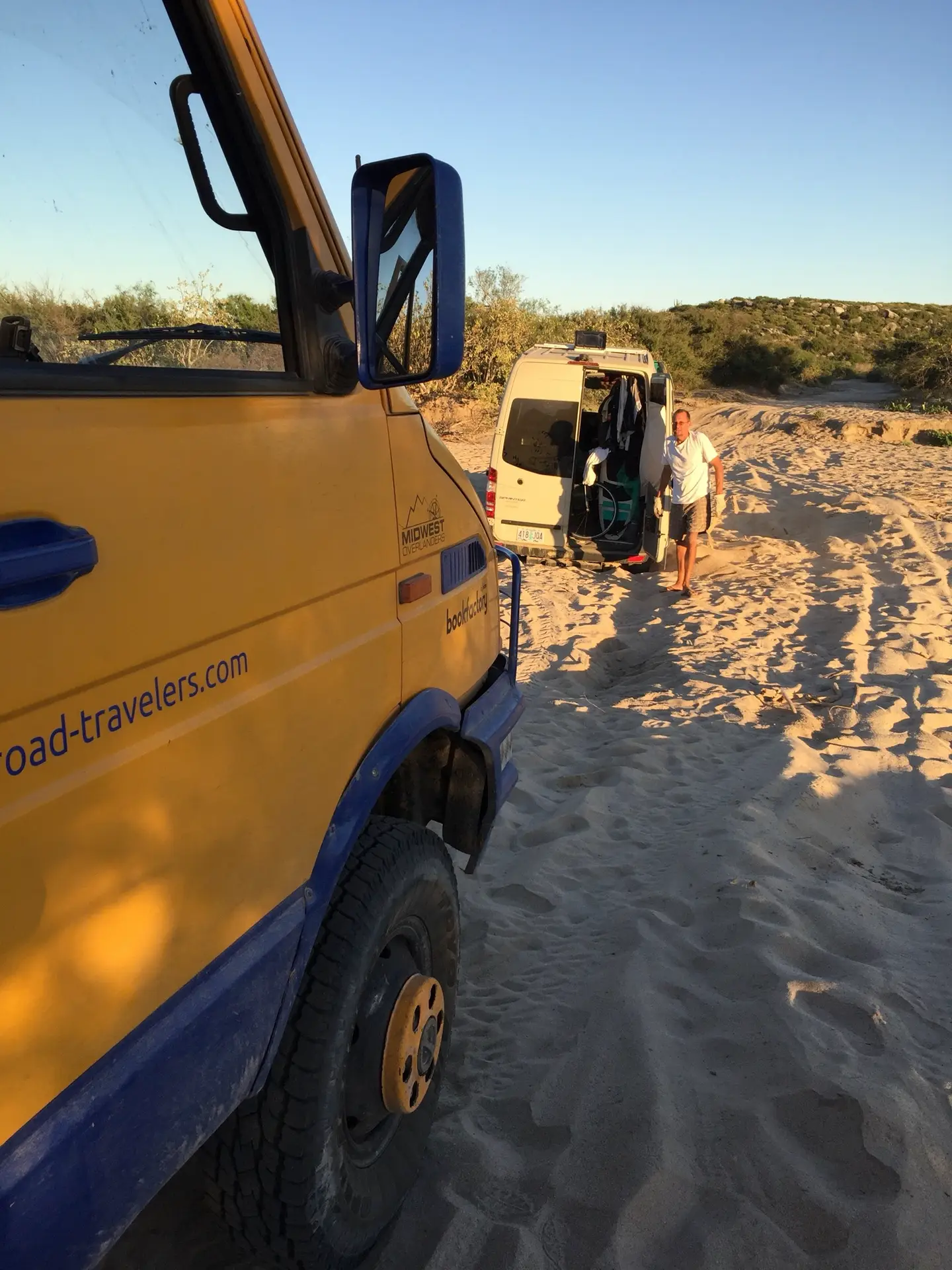
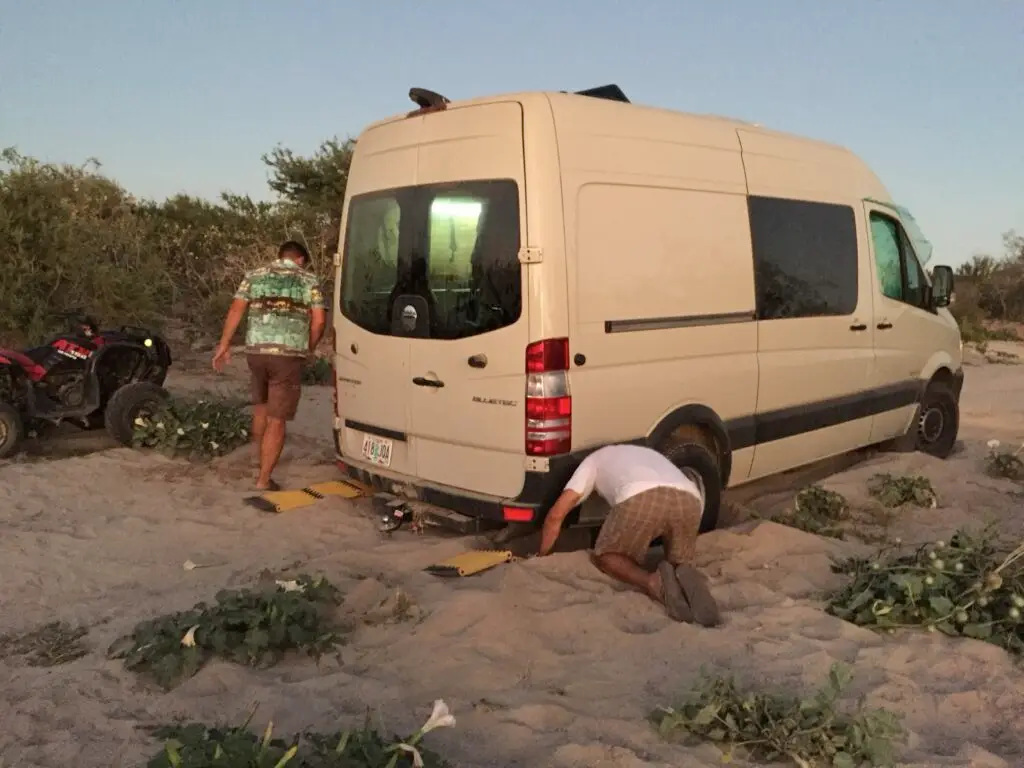
Someone is stuck in one of these riverbeds! Greg from Oregon is desperately trying to dig out his Sprinter with a cooking pot. He’s been digging for quite a while and in the meantime has even walked three kilometres in the scorching heat to the next village to get help – all without success. Fine, then we’ll pull him out. Greg’s Sprinter doesn’t have four-wheel drive, only rear-wheel drive, and he hasn’t let his tyres down. So, hitch up the Sprinter and pull it out. That was quick! But Greg doesn’t have much experience driving on sand yet and immediately buries himself again. So all over again: unpack the tow rope and sand ladders again. Meanwhile it’s getting dark, and I imagine the beautiful sunset on the beach we’re missing. So spotlights on and pull again! Fermín, a Mexican who lives two kilometres further on in a small caravan, comes by. He helps dig and knows all about the sandy ground. Going any further is out of the question for Greg anyway, as the road keeps getting worse. We walk ahead a bit and decide to turn the Sprinter around. The road is narrow, single-track, bumpy and sandy. Fermín finds a spot where the Sprinter can be turned safely, and in the end Christoph reverses Greg’s Sprinter and turns it so that Greg can safely drive back to Los Cabos.

Wie wir in der Party Finca der Mexikanischen Patrones gelandet sind – Foto 2

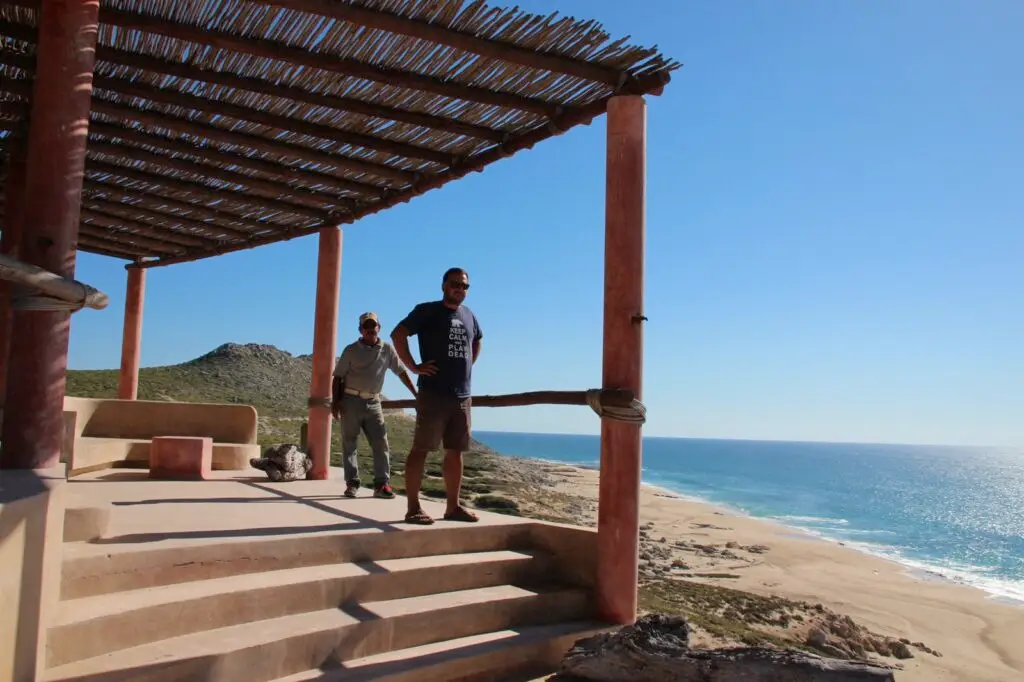
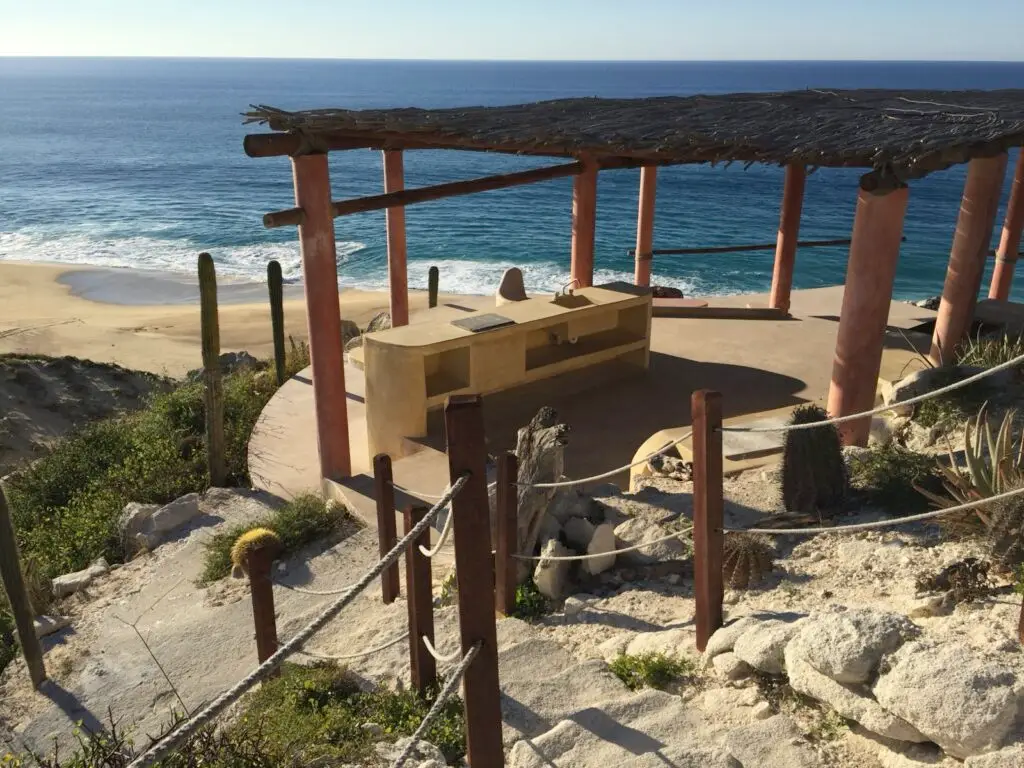
We wonder where to go. We won’t find a beach in the dark anyway, so we’ll set up camp here off the track. Fermín invites us to camp at his place and have a shower. A shower! After that action, absolutely! We follow Fermín on his quad along the bumpy road. He shows us his caravan, but then jumps back on his quad and drives on. We’re briefly puzzled and follow him. He takes us behind a barrier about 300 metres from his caravan. We’re to park here, and then he leads us up a narrow concrete path between giant cacti onto a hill. It’s very dark, the moon is only just waxing again, the night is clear and starry, and with our torches we can only partly see where we are. In front of us the coast; below we hear the waves breaking. This is the fiesta residence of the Mexican patrones, says Fermín. Now I really want to know what he means by patrones! They’re local politicians, not drug lords. There’s a toilet and a shower here – we don’t need more today. We cook for all of us, and Fermín is thrilled with the cold beer. Picture the shining eyes of a child who’s just been handed an ice cream – and I’m not exaggerating!

Wie wir in der Party Finca der Mexikanischen Patrones gelandet sind – Foto 4

The next morning we take a closer look at our night-time residence. It’s simple, but beautiful and practical. A terrace on two levels, an outdoor kitchen, two showers – one outside and one inside – a toilet and stairs down to the beach. The view is breathtaking, but see for yourself in the photos.

Wie wir in der Party Finca der Mexikanischen Patrones gelandet sind – Foto 3

Bienvenido a México: Off-Road Tracks, White Beaches and Starry Skies

Informationen zu Mexiko – Foto 25

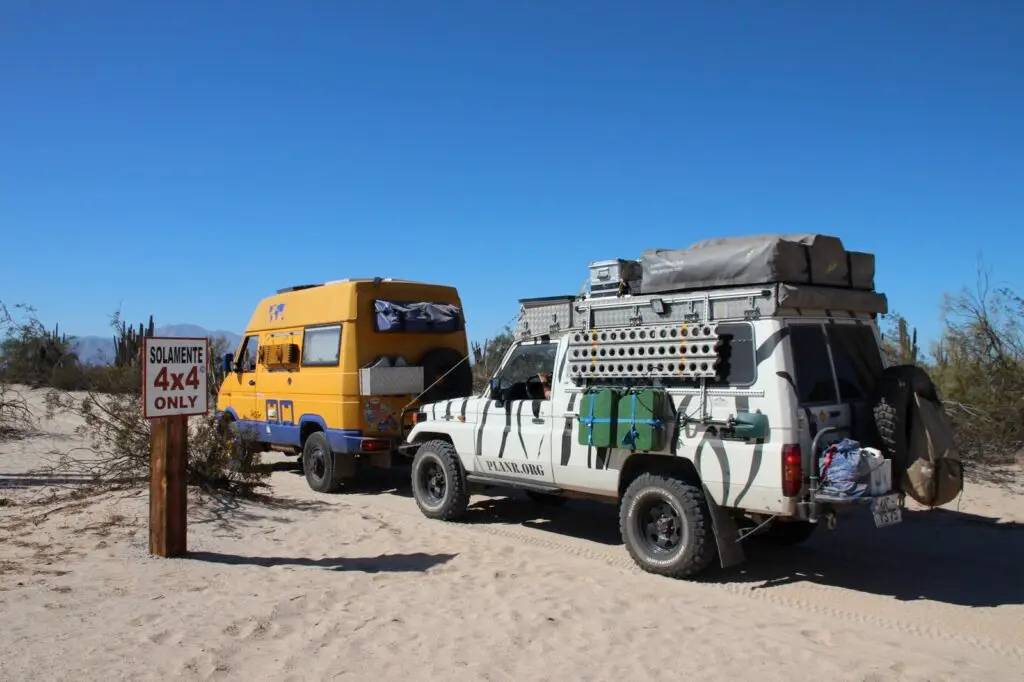
It’s time to leave the USA! We’ve covered 35,000 kilometres so far, and now we’re ready to discover something new. On 9 October 2017 we cross the border into Baja California, Mexico, at Tecate. Our first stop is Ensenada, where we meet Yasmin and Stefan. They’re travelling in the Zebra, a 1992 Toyota Land Cruiser, and have similar plans to ours. They started in Halifax and have two years in total. Christoph and Stefan had already been in contact via Facebook, as our travel plans matched. Until now our paths hadn’t crossed, but now the time has come, as our car insurance policies expire at the same time. We decide to travel together for a while, which is an advantage on sparsely populated Baja with its poor road conditions.

In Ensenada we stock up on food and move on south. Shortly after Ensenada we turn onto a gravel road to look for a place to sleep and come across the route of the Baja 1000 rally, which runs 1,000 miles (1,600 km) from Ensenada to the tip at La Paz. Since we’re already there, we let some air out of the tyres and stay on this route. We find a spot for the night in the middle of nowhere, under a sparkling starry sky and in the company of wild horses.

Bienvenido a Mexico: Offroad-Pisten, weiße Strände und Sternenhimmel

The next day we head for San Felipe, where we land in the middle of filming for a BF Goodrich commercial. Dune buggies race across the terrain, and we position ourselves behind a crest to watch the action and wait until filming is finished. After all, we don’t want to get in the way, as we’re not exactly fast – we’ve got our house with us. The route is well marked with green and orange signs, but we still take a wrong turn once and pass a somewhat run-down rancho. Suddenly two pick-ups follow us determinedly. “You can’t go any further here!” the men say firmly. “The road ends!” We turn around, and one of the men drives ahead and the other behind to escort us back onto the right track. What might we have found? We’ll leave that to your imagination.

Having arrived in San Felipe, we look for a place to spend the night on the beach. That’s not so easy, as there are no detailed maps and the GPS doesn’t know any route. The tracks leading in the right direction are either fenced off or filled in. Just as we’re about to give up, a fisherman on a bicycle crosses our path and says: “Follow me!” We follow him, curious where he’ll lead us. As fast as he’s pedalling, he must know the way, and he skilfully navigates us through the maze of tracks. We would never have recognised the right way. He leads us to a small cove, where the last part of the track is steep and rocky. When we’re almost at the bottom, he asks whether we have 4×4 – better late than never. His name is Daniel, and he fishes here illegally. Sometimes the police come and he has to hide quickly, but we shouldn’t worry, they leave tourists alone. He helps us collect firewood, and we invite him for a beer.

Bienvenido a Mexico: Offroad-Pisten, weiße Strände und Sternenhimmel – Foto 2

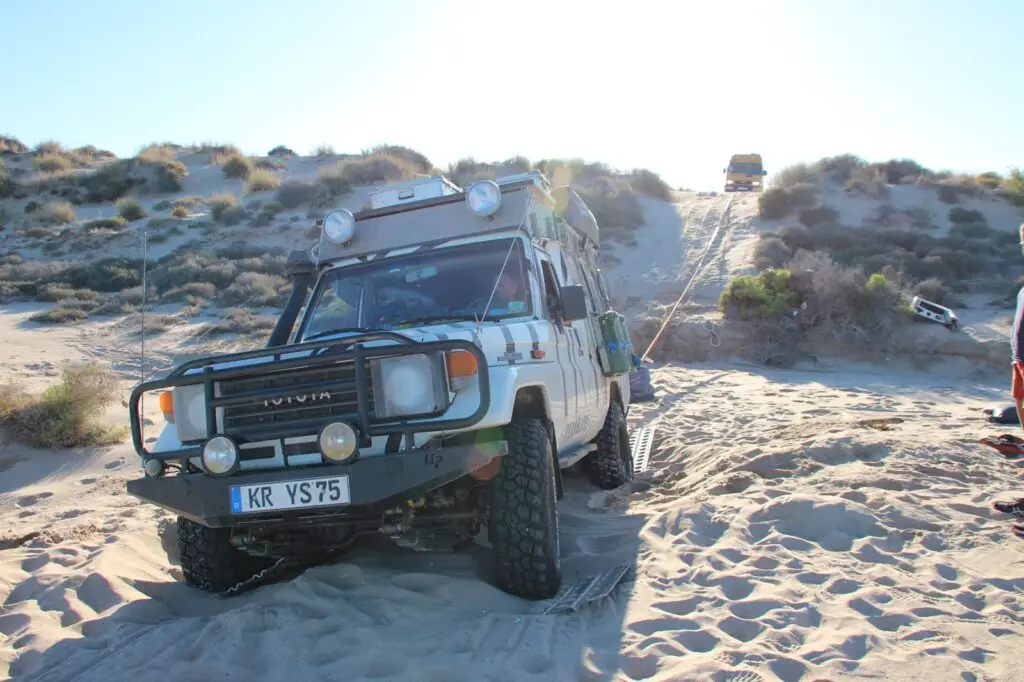
The first beach spot wasn’t easy to find, and the second attempt was to fail. A little south of San Felipe we look for our next spot for the night. Muggl was actually supposed to lead that day, but as the Zebra is closer to the turn-off, it drives down the narrow track towards the sea first. The track is sandy, and suddenly the Zebra disappears in front of us, sinking down behind the dune. There it sits, sunk in the sand. We walk around to see whether there’s a way out over the beach, but it doesn’t look good. The Zebra has to go back up in reverse! We shovel and dig to free the tyres and first try to pull it up with Muggl. But as Muggl also has sand under his feet up on the hill and threatens to dig himself in, we stop. In the end we dig even more and lay all six sand ladders we have one after the other, again and again, to create firm ground so the Zebra can free itself under its own power. Two hours of sweaty work, it’s slowly getting dark, and we still don’t have a place to spend the night. The next campsite is closed, the one after that pretty expensive, so we simply park in the desert and sleep among the cacti in the middle of nowhere – also nice.

The Baja 1000 route runs partly on tarmac, but mostly through the backcountry. The road and track conditions are varied: sometimes sand, sometimes stones, sometimes rock, through the desert with cacti (I didn’t know there were so many different kinds!) and through dry riverbeds – there’s everything. Above all, you keep finding beautiful places to spend the night, sometimes on the beach, sometimes under giant cacti or in the Calamajué Canyon, where we wake up in the morning with a flat tyre! How did that happen? Everything was fine the day before?! First we pump it up again and wait. It only seems to be losing air slowly, so we carry on with an “injured foot”. The route gets demanding, and we check the tyre pressure regularly. Strange, hardly any air is escaping – but all the better! We make the 54 kilometres to Bahía de los Ángeles and only have to pump in a little air twice.

Bienvenido a Mexico: Offroad-Pisten, weiße Strände und Sternenhimmel – Foto 3

Having arrived in Bahía de los Ángeles, it’s tacos first. With Gina’s taco stand we’ve found the best one in town straight away, and there’s no point looking for a garage when you’re hungry. Then it’s off to the supermarket – and how handy, right opposite is a garage that seems to do everything. We put our name down but first restock our supplies at the supermarket. In the supermarket Dennis and Rainy speak to us; they had been sitting at the table next to us at the taco stand. They ask what we’re doing and whether we’re looking for a campsite. Yes, in fact, for once we actually wanted to go to a campsite because we need internet to contact the ADAC. Our brake discs seem to be worn out, and the car shakes badly when braking. Dennis says: “Come with us – you can camp on the beach, shower at our place, use the kayaks and sort things out with the ADAC.” They’re expecting more visitors in the late afternoon anyway, because they’re planning a quadruple birthday party for the coming week. Then we won’t stand out. He explains where we have to go, and the directions are adventurous. Finally he places an arrow in the middle of nowhere on the map on my phone. “That’s where we live,” he says. I’m curious whether we’ll find it.

Once our tyre is patched and we’ve done everything, we head south. We have to turn off twice; somewhere a tyre lies at a fork, where we have to go left, and suddenly there’s a Sprinter in front of us. When it stops, we ask whether they’re going to Dennis and Rainy’s. “Yes!” say Don and Susy, “we’re just waiting for friends who’ve never been there and don’t know the way.” How handy – we don’t know the way either and probably would never have found it if we hadn’t met them. So we drive into the bay in a convoy of four, where Dennis and Rainy and a few others have their holiday homes. We’re welcomed very warmly, shown the way to our camping spot and the way to Jeff and Susan’s, where there’s dinner in the evening. We can’t believe it – we’ve landed in paradise! The people are so helpful and open, all of retirement age but still so young at heart and full of joie de vivre. In the end we stay there for two weeks. Alan, a friend of Jeff’s, picks up our brake discs at the international airport in San Diego and brings them with him. He comes to Bahía de los Ángeles with his wife Jen a good week after we arrive. There’s a separate report about the brake discs!

Bienvenido a Mexico: Offroad-Pisten, weiße Strände und Sternenhimmel – Foto 4

In those two weeks we experience so much that I can only summarise it briefly. We snorkel with whale sharks, paddle with dolphins and see tarantulas for the first time. Every day someone different comes to us and asks whether we need anything from town. Jeff and Susan take us to the laundry, the supermarket and to collect firewood. We spend many evenings at Dennis and Rainy’s over delicious food, cooked by someone different each time. We make a small contribution too, and Christoph and Stefan cook Käsespätzle. When the day of the big party arrives, we offer to help. We set up tables and chairs, decorate and hand out cake. But there’s still time to join in the celebrations and dance. The Mexicans from the village are invited too and turn up in large numbers. Gina makes tacos, a Mexican band plays, and a piñata is hung up for the village children to knock down. A lovely party where we met many interesting people, such as Dave and Debbie, with whose help we later buy a solar panel in La Paz.

On the second-to-last evening we’re invited to dinner at Jeff and Susan’s. Alan and Jen have arrived with our brake discs, and Alan tells us how the customs officer questioned him about the vehicle and he didn’t really know what an Iveco was. He then steered the conversation to his classic car. On our last day, a Sunday, Christoph and Stefan fit the new brake discs. Dennis has a superbly equipped garage with all kinds of tools that we’re allowed to use. Dennis’s workshop and his house are somehow the centre of this community and a meeting point at any time of day. So the boys are in the best company, accompanied by the technically savvy retirees who help out with advice and a hand – cerveza in hand. We leave the following Monday with mixed feelings. On the one hand we’re happy to have new brake discs and finally be able to move on; on the other hand we’re sad to have to leave these lovely people.

Bienvenido a Mexico: Offroad-Pisten, weiße Strände und Sternenhimmel – Foto 8

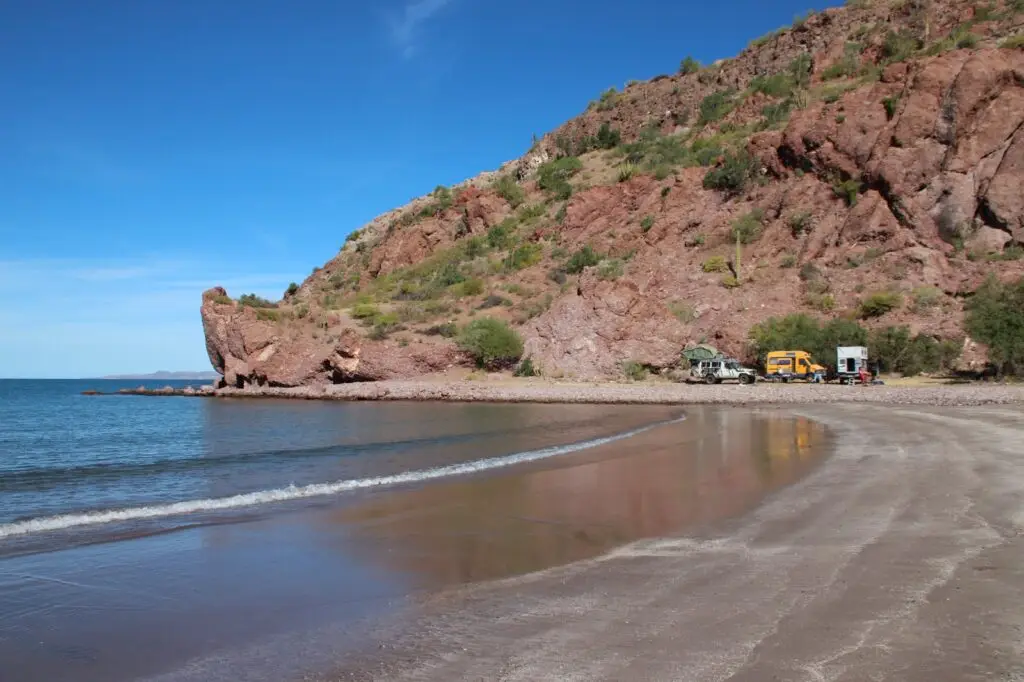
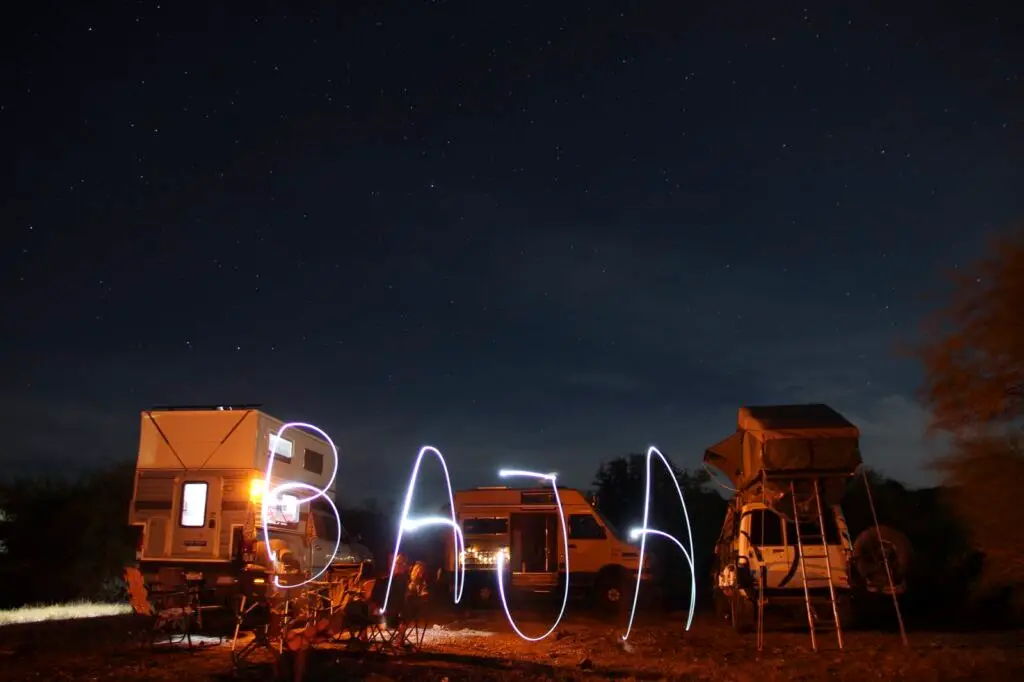
We continue south, literally over hill and dale along the Baja 1000 rally route. In Santa Rosalía we meet Shay and Monika from Vancouver, Canada, who are on a five-week holiday on Baja. As we’re taking the same route, they spontaneously join us and we travel on as three couples. The further south we get, the more beautiful the beaches we find to spend the night, and the roads there often lead over gravel, sand, dry and not-so-dry riverbeds. However, when we look for a beautiful beach on the opposite side of Bahía Concepción, it turns out to be a bit difficult. All three couples have information about this spot from different sources. The Zebras read about it in a blog, the Canadians got the info from locals, and we got the tip from other travellers who were there the year before. So, as explained in the directions, we open the gate that goes off left onto the gravel road after the bay and drive into the rancho. Horses and cows look at us in disbelief, a road is hard to make out, and we remember Jeff’s words: “On Baja you have to keep this in mind: follow the most travelled road!” So that’s what we do, but progress is very slow, as it’s one of the worst trails we’ve ever driven. It gets dark, the beach isn’t particularly nice and is stony, but we settle down and set up camp anyway. We spend a lovely evening, cook a vegetable stir-fry with chorizo, bake cinnamon rolls in the Dutch oven and take photos of an incredible starry sky above us. We’re so far off the beaten track that there’s practically no light pollution here. Because we’re on a roll, we also start writing in the air with torches. The results – “Baja” and “Mexico” – are pretty impressive.

The next morning we see how far we can get and suddenly find ourselves facing a rock face. Well, if there ever was a beautiful beach somewhere here, it has disappeared, or a landslide has buried the access so that it can’t even be recognised any more. So we turn around! We decide to meet at the exit, i.e. where you get back onto the highway. Somehow, though, we come out at a different place from where we went in. The Zebra and Muggl arrive at the same time, but the Canadians have fallen behind. We start pumping air back into the tyres and discuss how to find them when they finally arrive too – apparently they, like us, took a wrong turn somewhere. Great joy – all the greater when Monika comes towards us with our roof hatch! Yes, you read that right, we lost our roof hatch, turned Muggl into a convertible and didn’t even notice! Apparently a branch brushed us somewhere and ripped the poor hatch off the roof!

Bienvenido a Mexico: Offroad-Pisten, weiße Strände und Sternenhimmel – Foto 6

The next beach spot is already waiting, and we find a snorkelling paradise with fine white sand. Here we first remove the bush from our wardrobe and fix the roof hatch so that it holds for a while. After two days of relaxing on the beach, where we can snorkel brilliantly and have lots of fun playing UNO, we move on to Loreto. A sweet little town with a beautiful historic centre that we really liked. From there it’s back onto the track to Agua Verde – and “track” isn’t an exaggeration here. A very narrow gravel road winds steeply down in hairpin bends. At the bottom, though, a quiet bay with a small rocky island in the middle awaits us – another snorkelling paradise with great coral.

The next morning it’s time to say goodbye to the Canadians. They need to get a move on – after all, they only have five weeks and have to go all the way back too! We, the Zebra and Muggl, start a little later. But it doesn’t take long before we find the Canadians at the roadside with their camper jacked up. A nut had come loose on the right front wheel, and the bolt had worked so far out that the wheel had come away from the suspension and simply buckled! It happened on an incline, but on tarmac and just a few kilometres after the steep, winding gravel track. The nut was gone, of course, and we searched Muggl and the Zebra for a spare nut – nothing! Stefan patches up the damage temporarily, and we can send the two of them to the next garage like that.

Bienvenido a Mexico: Offroad-Pisten, weiße Strände und Sternenhimmel – Foto 7

We continue towards La Paz, where after almost five weeks we also say goodbye to the Zebra. We’ve decided not to travel all the way down to Argentina, but only to Panama. There’s so much to see and discover, and we don’t want any stress. A year and a half seemed a lot at the beginning, but once you’ve been on the road for a while, you realise it’s not enough. So now we have more time and can dawdle a bit on Baja. First we get ourselves a new solar panel, as the old ones aren’t as efficient any more. Then we have Muggl checked by a diesel specialist, because the new injection pump is already causing problems again. “He has rust in the tank, and the single-filter system can’t cope with that,” the Mexican explains. He cleans our tank quite thoroughly, and we’re curious whether it’ll help. My technical Spanish for car repairs is getting better and better.

We enjoy the “lower loop” of Baja, as we call it, to the full. Todos Santos is one of our favourite little towns on Baja. In Cabo San Lucas we treat ourselves to a hotel for two nights. You can read about the consequences in the next report. Nothing bad – that much I can say already. We have a delicious meal at “Mi Casa”, a somewhat touristy but very tasty restaurant with a mix of modern and traditional Mexican cuisine and a huge collection of Catrinas. These are the skeleton figures you can buy in Mexico mainly for the Día de los Muertos (Day of the Dead) or All Saints’ Day. There’s also a boat tour around the tip of Baja California off Cabo San Lucas, where we look at the rock formations, beaches and sea lions. A bit of tourist programme is allowed too – after all, we’re on holiday, and besides, it’s the low season. It’s best to get price information from locals and then ask tour operators for the local price. That actually always works.

Bienvenido a Mexico: Offroad-Pisten, weiße Strände und Sternenhimmel – Foto 5

Via the Camino Cabo Este we head back up the other side towards Cabo Pulmo and Los Barriles. There we were held up for a while, and there’s a separate report about that: “The days that take an unexpected turn.” From Los Barriles we try our off-road luck one last time on Baja and want to drive along the coast to La Paz. The road is marked on the map and Google knows it too, so off we go. The first few kilometres are even paved, then only gravel, and finally it gets quite bumpy and narrow. After almost 40 kilometres a cyclist from England comes towards us and doesn’t know what to make of us at this spot. His face is a mixture of astonishment and delight. “If you want to keep going that way, you’re crazy. The track gets even worse, narrower and steeper.”

Border Crossing from the USA to Tecate, Mexico

Informationen zu Mexiko – Foto 24

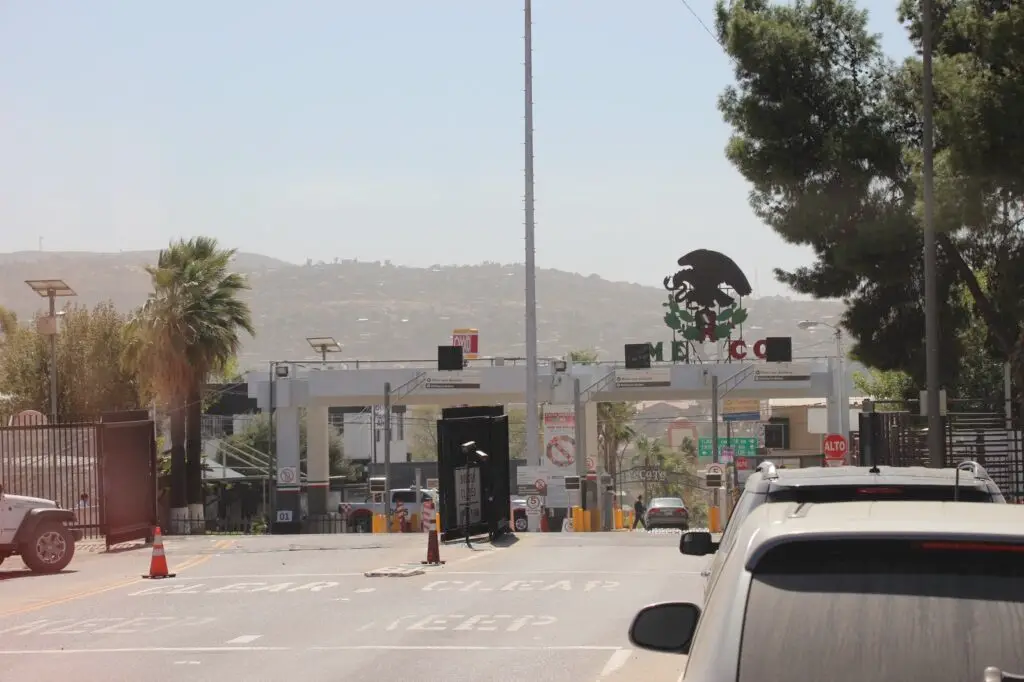
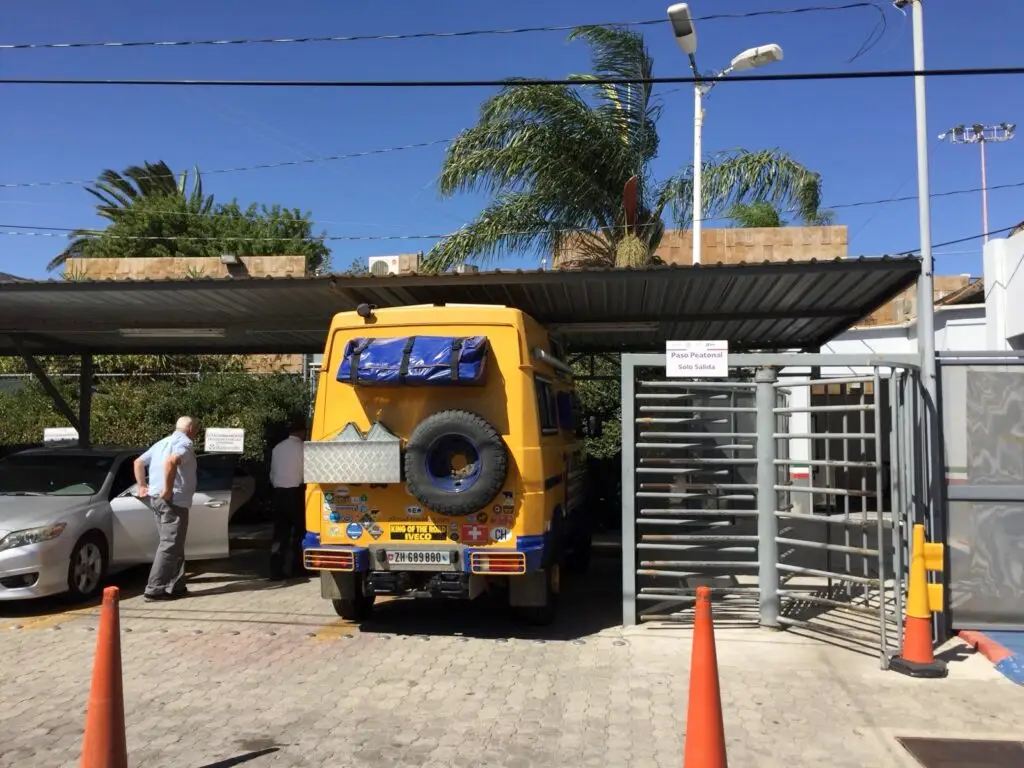
On 9 October we’re finally off to Mexico! We cross the border at Tecate, as many travellers recommend this crossing as easy and uncomplicated. At the border we drive until someone stops us. A young official asks whether we speak Spanish. Christoph says: “No.” I answer: “Un poco.” He asks us to open the sliding door, takes a quick look inside and asks for the vehicle registration and chassis number. Christoph searches, the official waits patiently, but when Christoph finds the papers, he doesn’t even want to see them. At least we now know where they are. The official says goodbye with “Adiós” and leaves.
Grenzübertritt von USA nach Tecate Mexiko – Foto 2

But where do we get our visa, and how do we get rid of the white slip they stapled into our passports when we entered Washington? I ask him, and he sends us back to the USA. He explains where we have to park and walk. We drive around the corner and park under a corrugated-iron roof that our vehicle only just fits under. Another official directs us in and says we may only park for 20 minutes. We had no idea it would take 1.5 hours. We walk back into the USA, where they remove the slip, then back towards Mexico into an office in front of the station where the official had asked about the chassis number. We fill in a form with our name, date of birth, passport number, reason for travel and destination in Mexico. The official sends us to the bank and kindly explains where we have to go next. The “bank” is two counters where we pay for the visa. Then back to the official, who gives us the stamp with a residence permit for 180 days.

At the same time he offers us honey and salsa. It takes me a moment to understand, as I hadn’t expected anyone to try to sell us something. I translate it for Christoph, and we have to stifle our laughter. The situation is so funny that we actually buy honey and salsa. Then he sends us to the pharmacy to make copies, because we need a copy of the visa to import the car. So off to the pharmacy right next to the border jungle. Then back to the “bank” to pay for our vehicle’s permit. The form has to be filled in twice because the clerk made a typo. Check carefully so that an O instead of a 0 doesn’t become your undoing! Our vehicle may now stay for 10 years. We’re jealous!

Grenzübertritt von USA nach Tecate Mexiko – Offroad Travelers

Now we just need car insurance. The agencies are in town, and we leave the border jungle. In the insurance agent’s office we feel as if we’re at a bazaar. We need insurance for a motorhome. She writes 379 US dollars on a piece of paper. If we hadn’t known from other travellers what they had paid, we wouldn’t have been surprised. We only need liability, not comprehensive. The price drops to 279 US dollars. Still too much! We say that friends paid less. She keeps searching and finally offers us insurance for 227 US dollars for six months. A bargain compared with the US insurance at 1,270 US dollars.