Border Crossing from El Salvador to Honduras at El Amatillo

Berichte Zentralamerika – Foto 2

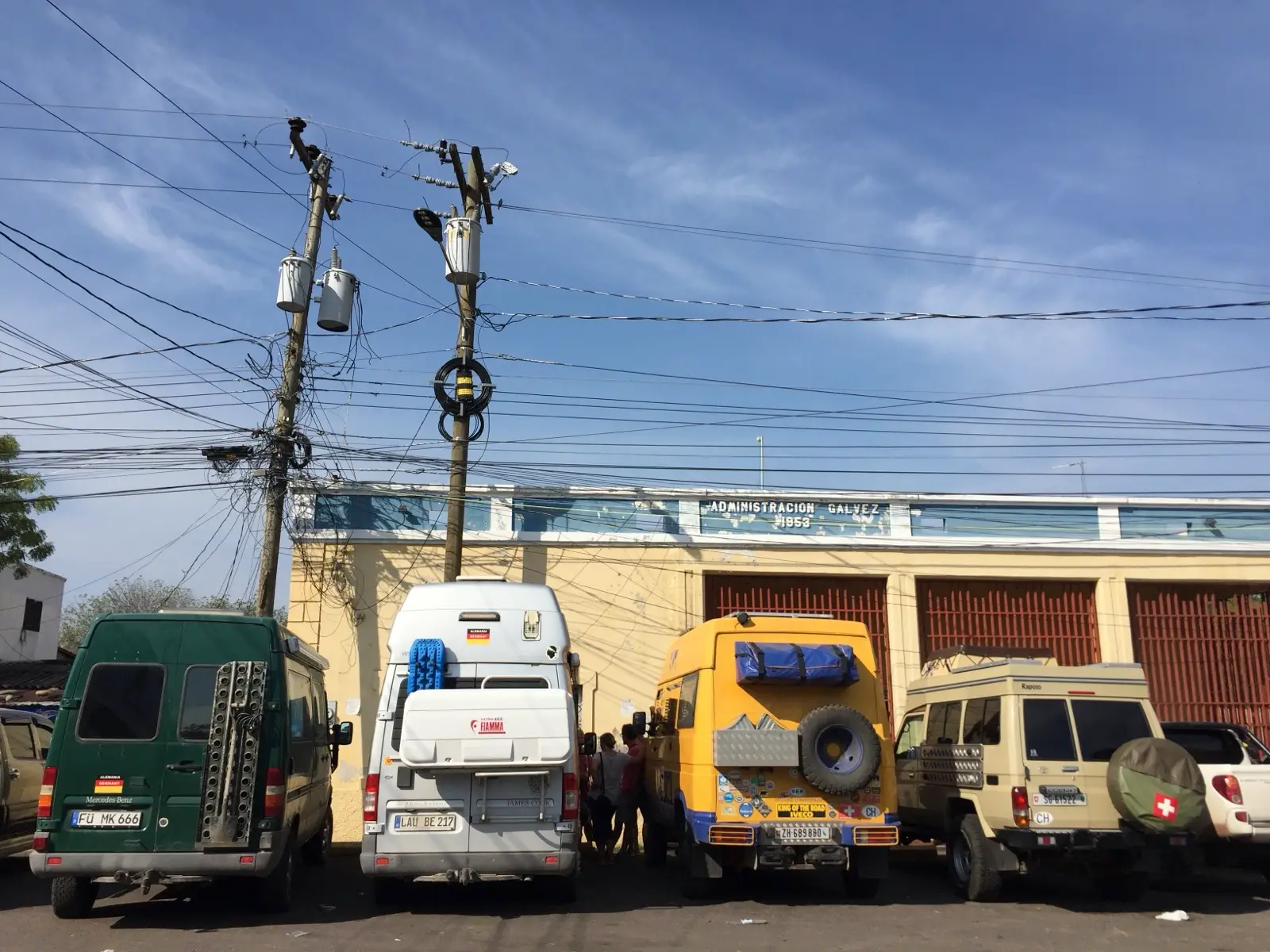
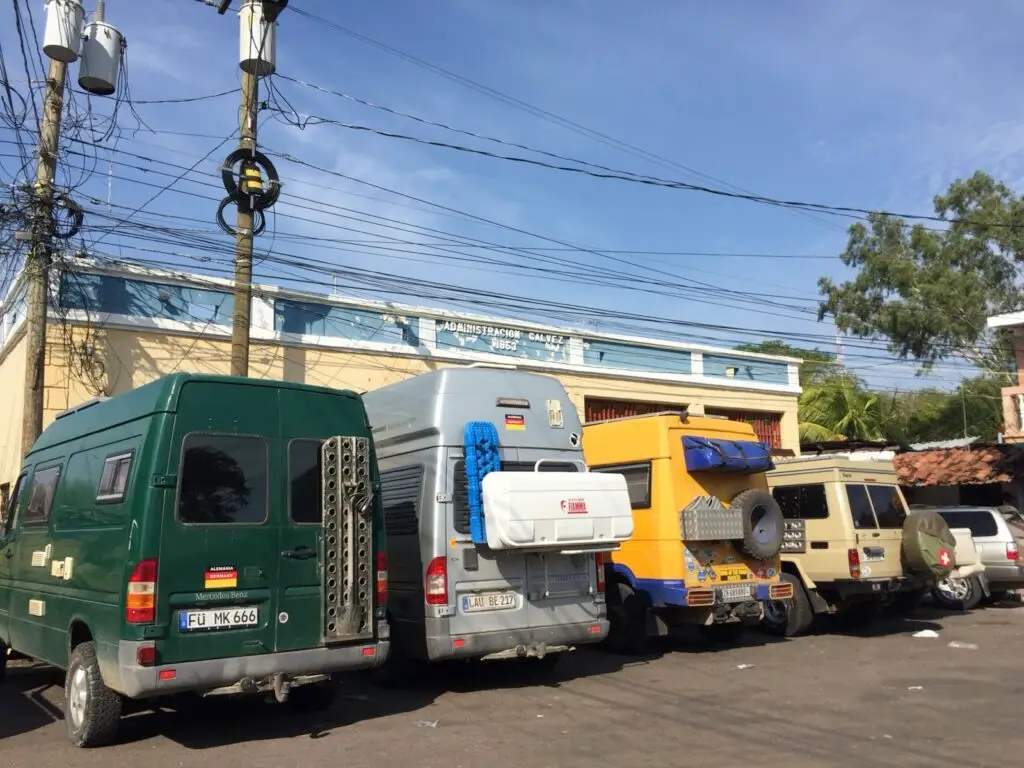
On Sunday 13 May 2018 we crossed the border from El Salvador into Honduras at El Amatillo. The border stretches over several kilometres. First we passed a long queue of lorries and parked in front of a small hut. There an official signed off the TIP form for Muggl. We had to get a copy made right next door. He didn’t want to see our passports.
Grenzübertritt von El Salvador nach Honduras bei El Amatillo – Foto 2

About three kilometres further on, the road split: tourist traffic and heavy traffic were separated. We crossed a small bridge, where a Salvadoran official asked us where we were from and where we were going and checked our passports. He also asked whether Vladimir Putin and Mesut Özil were German – whether he was serious remained unclear. At the last window we checked out of El Salvador. The official needed our passports as well as the vehicle registration and driving licence. Leaving cost nothing. We received a small slip of paper that we had to hand in at a checkpoint 50 metres further on.

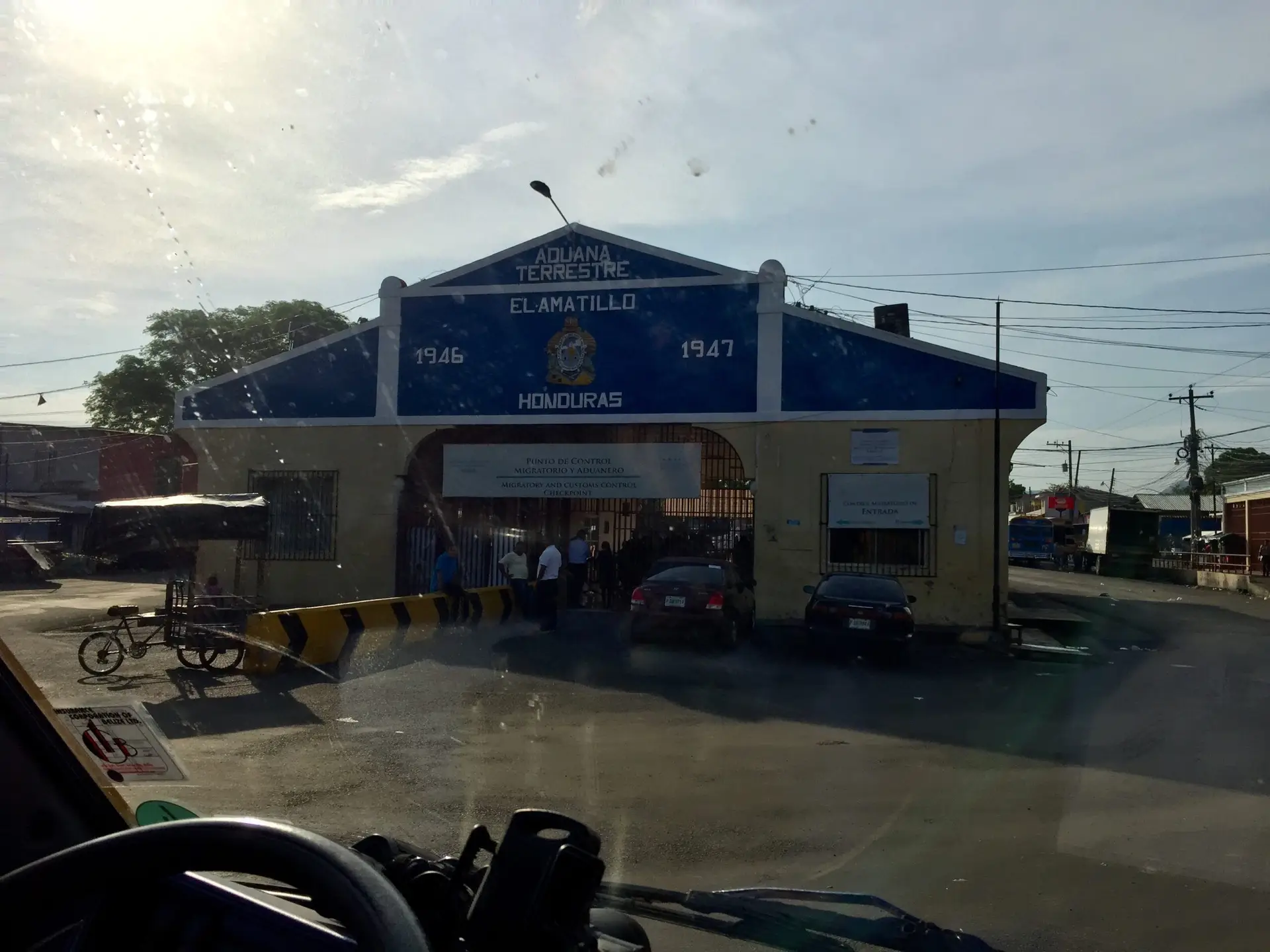
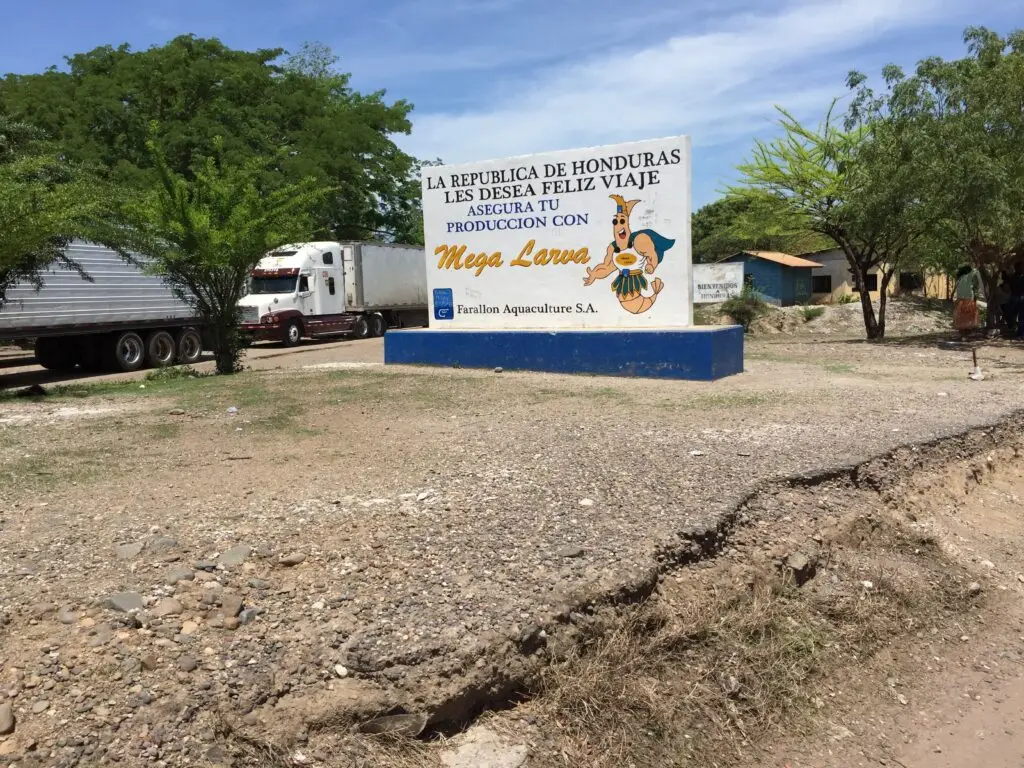
After about 300 metres over a bridge we reached Honduras. We parked on the road next to a large building and joined a queue the wrong way round. Even before it was our turn, we were directed to a window where we handed over our driving licence, vehicle registration and passports. Here they processed the TIP for Muggl, and we were to come back once we had finished at immigration.
Grenzübertritt von El Salvador nach Honduras bei El Amatillo

At immigration they stamped our passports, took fingerprints and photos. We paid 3 US dollars per person for entry and received a receipt. Then we returned to the TIP window. In the meantime the official had prepared the TIP, or in Spanish “permiso de entrada y salida temporal de vehículo”. He sent us to the kiosk in front of the building to make the following copies: three of the permiso de entrada, two of the passport photo page, two of the exit stamp in the passport, two of the driving licence and two of the vehicle registration.

We returned with the copies. The official sorted the papers into two piles and stapled them together. We paid 35 US dollars for Muggl and received the original permiso and a stamped copy as a receipt. We had to hand this in at a checkpoint about 500 metres after the border.

The whole procedure took 1 hour and 15 minutes. Both border posts seemed confusing at first, but things went quickly.

Border Crossing from Honduras to Guatemala at El Florido

Berichte Zentralamerika – Foto 3

On 2 July 2018 we choose this border because at first glance it seems the least complicated. At 9:45 am we park in front of the white and blue building where the immigration and customs of Honduras and Guatemala are housed in one and the same building – we’d never seen that before! They call themselves the Unión Aduanera Guatemala Honduras, and we’re delighted by the merger. Within barely 15 minutes we’ve checked out of Honduras and into Guatemala. The customs counter is the same for both countries, and it really could have been quick and easy if you didn’t once again need copies in between – namely of the exit and entry stamps of the vehicle owner, i.e. Christoph. For that you have to walk 200 m into Guatemala, where a young woman has set up a small copy shop in her living room. You can equip yourself with piles of copies of the vehicle registration, passport photo page and driving licence, but you’ll definitely need at least one copy of the stamp you’ve just received, and usually several of the TIP.

When we get back to the customs counter we first have to queue and hope that the man in front of us will soon be sent off to make copies too. As we already have the TIP for Guatemala, we hope to be through quickly. We had suspended it when we left back then, because otherwise you can’t re-enter Guatemala for three months. The young woman goes outside with us briefly and compares Muggl’s number plate and chassis number, and we apologise to her because Muggl is already terribly dirty. When we’ve finished at the joint border post, we’re sent to a small office next to immigration after all, where we have to close our TIP for Honduras. So the joint border isn’t quite so well thought out after all. But here too things go quickly, and the man – how progressive – makes the copies he needs himself. The man who then opens the barrier to Guatemala for us wants another copy of our reactivated SAT (that’s the TIP, it’s just called differently in Guatemala), and then we’re “already” through. In Guatemala you’re not obliged to have car insurance, and since we don’t want to look for an insurance office that doesn’t exist anyway, we drive straight on. Total time: 1 hr 17 min, of which about 25 minutes were waiting. We don’t have to pay anything except 20 quetzales for the copies.

Border Crossing from Nicaragua to Honduras at Guasaule

Berichte Zentralamerika – Foto 4

Nicaragua to Honduras at Guasaule

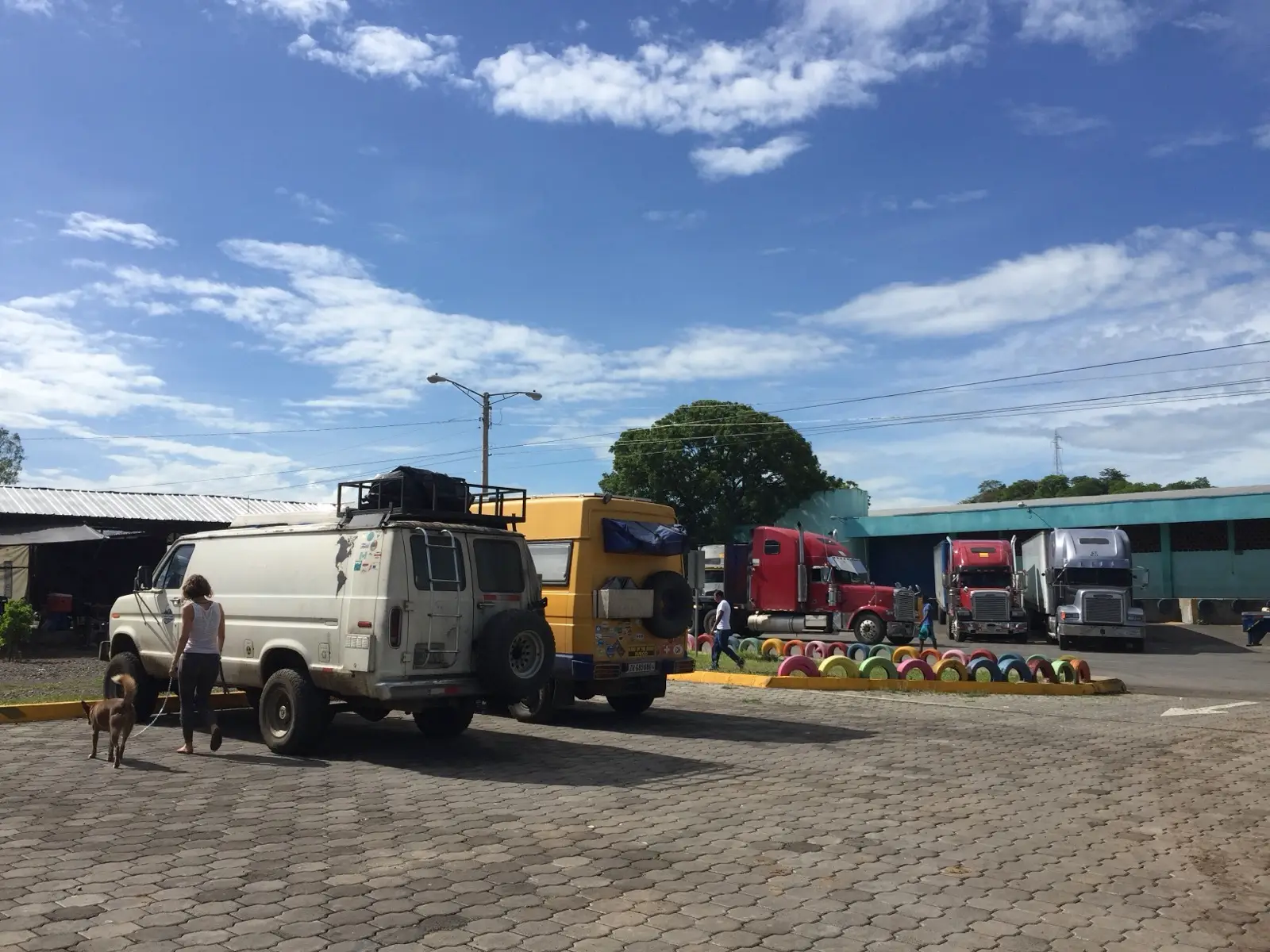
On Saturday 23 June 2018 we actually didn’t want to cross here again – entering Nicaragua had taken so long back then, and the good 3.5 hours are still all too fresh in our memory. But it’s now the shortest route out of the country, and since we’re still travelling with Aiden and Joanna, we decide to take the shortest and least complicated route. As so often, we drive past a long queue of lorries and join the line just before the faded light-blue “Bienvenidos” (welcome) arch. Lorry drivers are very patient people, and in Central America they have to be. An inspector at a small hut wants to see our passports and the TIP. We park on the right, once again in front of the light-blue building that houses immigration and customs – let the ordeal begin!

Of course we first get the wrong queue and are sent to the other end of the room, just like at the supermarket, where you always pick the slowest line. Fortunately the queues aren’t long and things move quickly. Somehow everything seems better organised today, and more booths are staffed. We pay $4 and are checked out in the system – unfortunately there’s no stamp. Next we have to find a vehicle inspector again, which turns out to be easy this time, because like last time he’s wearing a light-blue polo shirt with an orange high-vis vest. As we get closer, we recognise him as the nice man from back then who inspected Muggl when we entered. A police officer comes along, and they take a look inside the car, including the cool box. The police officer takes notes, and in a few minutes we’re done.

As always, the last stop – customs, where we stamp Muggl out – is back in the building. The woman this time is very friendly, and we’re done quickly here too. We can hardly believe it and wonder whether we’ve forgotten something, but after 45 minutes everything is done. On the bridge between the borders, a young woman from the tourist office briefly asks us about our travel plans: which regions we want to visit, what activities we’ve planned, where we intend to stay overnight, how long we want to stay and finally how old we are.


The Honduran side of this border is very run-down. A huge gravel area with potholes so big that a mid-size car could disappear in them lies opposite the immigration building. Everything is crammed with lorries, so we have to park there too. As soon as we drove in we were besieged by border helpers who want to help us with the paperwork, and young lads who probably want to become one some day offer to watch our cars – all for a propina (tip), of course. We politely decline, say we have a dog who keeps watch, and join the long queue in front of the officials’ booths. It goes quickly; a young official deals with us, and after about 20 minutes we’re done here.

Customs, where we get the papers for Muggl, is at the back of the row of booths. Without us noticing, Aiden has already wangled something, and we don’t have to queue there but are waved into an office behind the booths. A woman sits at a desk there and greets us kindly. Here we all do the TIP for our vehicles. She needs two copies each of the vehicle registration, Christoph’s passport and driving licence, and fills in a form. Finally she stamps Christoph’s passport. We also have to pay $35 for the three months (there’s nothing shorter). We’re back in the land of copies. Next I have to make copies of the form she issued (1x) and of the stamp in Christoph’s passport (2x) in a small hut opposite the building. Getting there is like running the gauntlet, as I have to pass through three rows of lorries queuing towards Nicaragua, cross the car park and dodge countless puddles. When I get back, she takes the copies and hands us our TIP. Oh, it would often be so much easier if they just put a photocopier in there. In Honduras car insurance isn’t compulsory, so we don’t even bother looking for an insurance office – that would be a waste of time, we’ve learned that much. Total time: surprisingly only about 1 hr 40 min.

Border Crossing from Honduras to Nicaragua at Guasaule

Organisation & Planung – Foto 4

Checking out of Honduras goes smoothly. We park our vehicle in front of a blue building where it is checked out. On the other side of the road we get our exit stamp at immigration. After just 15 minutes everything is done, and we continue towards the bridge. A lorry driver waiting in the queue advises us to simply drive past. That means we first have to cross a small hill and switch to the oncoming lane so we don’t have to wait. An official in front of the bridge checks that we’ve completed all the formalities and that our documents have the exit stamp for us and our vehicle, Muggl.

The Nicaraguan side seems chaotic – and it is! First a gatekeeper gives us a declaration document, which is important so that you don’t have to go back to the very start of the queue. An official checks our passports, followed by a female official who asks whether we applied for anything beforehand. We say no, as we didn’t know about anything. Next we go to fumigation, where we pay three dollars and Muggl gets sprayed a little.

Now it gets really exhausting: at immigration we’re dealt with straight away, but need various copies: two of the passport photo page, two of the page with the Honduran stamps, one of the vehicle registration and one of Christoph’s driving licence. We get the copies quickly in a small copy shop opposite. We bring our papers back, hand over our passports and wait. After half an hour another official comes back with our documents and complains that the copies are too small. We had copied both passports on one sheet and cut the pages apart to save paper. In the end he accepts it, but we copied the wrong stamp page of Christoph’s passport, so back to the copy shop.

When I come back, the official is still sorting the papers and staples Christoph’s and mine together separately. Then the questioning begins: occupation, marital status, age, vehicle make and type, colour and number plate, how much cash we have on us (after deducting the immigration fee, 26 dollars), how long we want to stay, where we’re going in Nicaragua and where afterwards. He even wants to know when we left Germany, when we entered the USA and how long we were there. He notes everything on the copies of our passports – now I understand why he wanted so many pages!

After the interrogation he disappears behind a glass door with all the documents, including our passports. He points out our passports to a colleague, who just shrugs. We feel like the first Germans ever to enter Nicaragua – there’s no recognisable system! At some point he comes back with a new form, sits down in an empty customs booth and fills it in. I suspect he’s transferring the answers he first scribbled on the copies of our passports onto the form.

15 minutes later he leads us outside and points to an elderly gentleman in an orange high-vis vest who will inspect our vehicle together with a police officer. He says we’re almost done – I don’t believe him! We wait another 10 minutes until the gentleman is free. At least he has a sense of humour – the first person with a sense of humour we’ve met today. He doesn’t want to check the chassis number; he and a young police officer who has joined us in the meantime are curious. I open the sliding door, the elderly gentleman looks around and asks: “What’s that lying in the hammock?” We have a little pink pig in a hammock above the bed. I say: “Oh dear, it doesn’t have a passport.” He laughs. They want to know whether we have a drone and look at my camera. They ask what Christoph does for a living and whether we’re reporters. The police officer looks in the cool box and the wardrobe and wants to look in the bag under the seat where the Dutch oven is stowed.

Inspection done, but far from finished. 1.5 hours have passed since we first went to make copies. During the waiting times, when the official kept disappearing with our documents, I wrote this report. We went to get money twice, once córdobas and once US dollars – better not tell him that, it would mess up all his notes. We wait another 20 minutes until the official we first saw finally processes our immigration. We pay 24 dollars (12 dollars per person) and after 3 hours we’re done! Wait, no, we still have to go to customs to check Muggl in and to the station where luggage is normally scanned, and explain that we have no luggage.

Grenzübertritt Honduras nach Nicaragua bei Guasaule – Offroad Travelers

Done? No, because for Nicaragua, unlike Guatemala, El Salvador and Honduras, car insurance is compulsory again. So off to the neighbouring building, where the bank is. There the insurance clerk has simply moved her office outdoors and sits at a small table in the shade. It takes 5 minutes to issue the insurance certificate, and for 12 US dollars it’s valid for 30 days.

Total time: 4 hours and 15 minutes, 3.5 of them at the Nicaraguan border.