Border Crossings Between the USA and Canada

USA & Kanada – Foto 37

Border on Route 221 at Lacolle, QC, towards Montréal

The first border we crossed was on Route 221 at Lacolle, QC, towards Montréal. It was Sunday 23 April 2017. This border crossing is small and apparently little used, as the border officer’s surprised reaction showed. He asked in astonishment: “What are you doing here?” Our answer: “We want to go to Canada.” There was great interest in our vehicle; a colleague came over to take a look. Our passports were checked, and we answered questions about how many of us there were and whether we were carrying alcohol, tobacco, weapons, pets or animal products. The officers were curious and also asked about the shipping: cost and duration.

They sent us off with: “Welcome to Canada and enjoy!”

Grenze an der Route 221 in Lacolle QC in Richtung Montréal – Offroad Travelers

Border from Canada to the USA – Port Huron

On 29 April 2017 we returned to the USA via Point Edward into Michigan. We were asked how many of us there were, whether we had weapons, and about our insurance – both car and health insurance. He didn’t want to see the papers. He didn’t ask about food, but about our destination. Finally he asked whether we spoke Spanish and said, reassured, “very good” when I answered “yes”.

After five minutes we were through.

Grenze von Kanada nach USA - Port Huron – Offroad Travelers

Border between Canada's Waterton NP and the USA's Glacier NP

On 22 June we travelled from Glacier National Park to Waterton National Park at Chief Mountain. It’s actually the same park: two-thirds is in the USA and called Glacier, one-third in Canada and called Waterton. The same questions again: how many are we, are we carrying weapons, what are our travel plans? They also asked about firewood. Yes, we had some with us and had to hand it over.

We were through in a few minutes.

Border from Canada to Alaska / Poker Creek

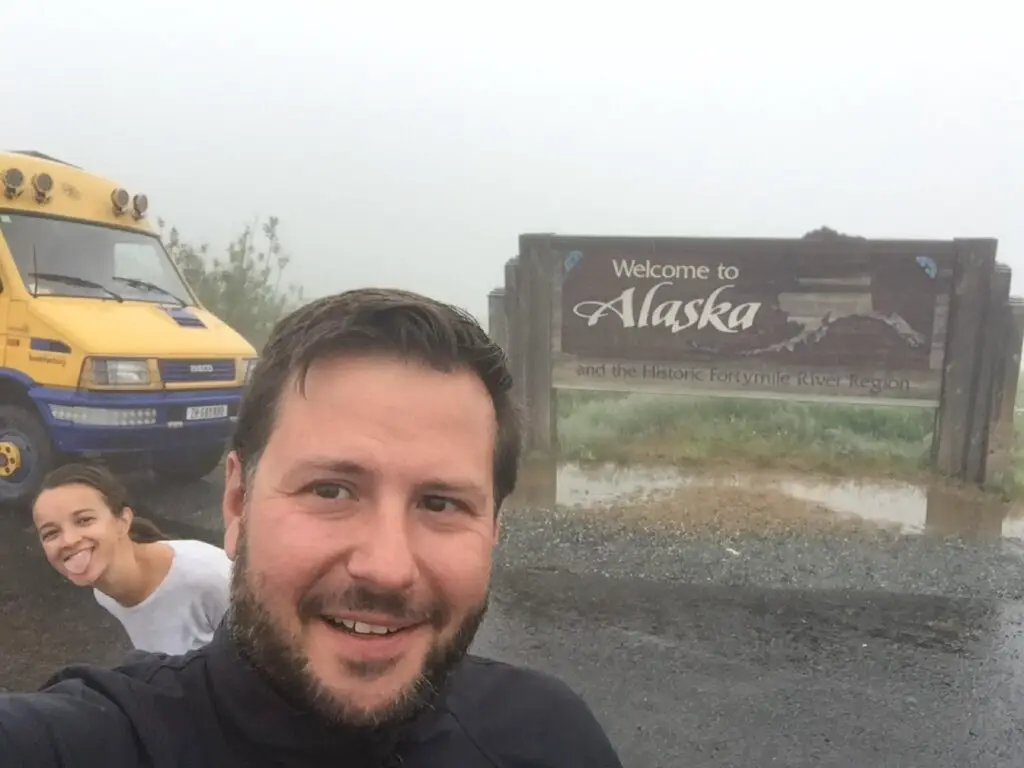
On 10 July 2017, a foggy morning, the border officer greeted us with: “Hello, how are you?” She asked whether there were two of us and whether we had pets, weapons or tobacco with us. She didn’t ask about food. She admired our world map in the cab and asked whether we were travelling “all over the world”. We said, for now just North to South America. She asked about our jobs and disappeared with our passports.

Three minutes later she happily handed back our passports and said she had given us a “special stamp”: “because you made it :-)” A caribou now adorns our passports.

Border from Alaska to Canada / Beaver Creek

At Beaver Creek, done in five minutes: questions about weapons, animal products and the length of our stay. The officer wanted to know how to ask in German: “How long do you want to stay in Canada?” We gave a short language lesson and were sent off with “Willkommen in Kanada”.

Border from Canada (BC) to Alaska / Dalton Cache

At Dalton Cache the officer rolled out of the building into the booth. Apparently not many people come by here on Sundays. “Where are you from?” – “Germany.” “What is this? A Mercedes?” – “No, an Iveco, he is Italian.” “You German guys driving an Italian vehicle? Seriously?!” The officer had a sense of humour. He asked whether we had any food from Canada with us. We said no. As a farewell he said: “Enjoy Canada and Tschüss.” Yes, he really said “Tschüss!”

Through in five minutes again.

Grenze Kanada BC - Alaska /Dalton Cache – Offroad Travelers

Border from Alaska to Canada / Fraser

On 3 August 2017 at Fraser: a young officer and the following conversation:

“Where do you live?” – “Switzerland.” “Vehicle shipped over?” – “Yes.” “Where did you start?” – “Baltimore.” “When do you fly home?” – “Next year August.” “How many days will you stay in Canada?” – “About three weeks.” “Are you working while traveling or just took time off?” – “No work, please! We took time off.” “Have you more than 10,000 cash with you?” – “Unfortunately not!” “Doing everything with credit card?” – “Yes.” “Enjoy your time in Canada!” – “Thank you.”

Grenze Alaska - Kanada /Fraser – Offroad Travelers

Border from Victoria, Vancouver Island, Canada, to the USA / Port Angeles, Washington

On 26 August 2017 from Victoria, Vancouver Island, to Port Angeles, Washington, USA, by ferry: this time the border crossing took a little longer. Time was running short. We were supposed to leave the USA for Mexico on 3 October. As our vehicle had arrived late, our insurance was valid until 10 October. We planned to ask for a two-week extension at the border. Border control took place in Victoria harbour while we were waiting for the ferry. The first questions were: “How many travelers?” “Where do you live?” “What are you doing for work?” “How long do you wanna stay in the US?”

Then it’s our turn. We say that we have to be out by 3 October and still want to travel down the coast to Mexico. Could he extend our visa by two weeks because we spent too much time in Alaska? I add that the summer there was particularly beautiful this year because it was so hot, so there were hardly any black flies and mosquitoes. He briefly lifts his sunglasses, grins and says: “Good to know.” Hesitantly he then asks whether we can confirm our jobs, employers and place of residence, and sends us into the office. We pack papers and laptop and go in. Again they ask us the same questions, and we explain our request again.

The officer sends us outside and makes us wait. I think he wants to deal with the other travellers first because we’re holding up the traffic. When nobody else is queuing, he calls us back in and asks more questions: where we entered the USA, when we were where and for how long. You really have to think about that when you don’t even know what day of the week it is. He wants to know whether we shipped our vehicle here, what vehicle we drive, what the shipping cost and how long it took. He also wants to know how much we saved for the trip, or what our budget is. We wait patiently while he deals with other travellers in between. He says it will cost 6 dollars per person and we can pay by credit card. We’re delighted, and even more so when he says he has now given us another six months. He staples a slip into our passports and says we have to hand it in when we leave for Mexico. He doesn’t know whether we could then immediately get a third six months – that’s at the officer’s discretion. We pack our documents back up; he didn’t look at them.

When we’ve stowed everything away, we look at our passports and notice with astonishment that they say “Germany (West)”… That was 28 years ago now!

Grocery Shopping in the USA & Canada

USA & Kanada – Foto 38

Grocery Shopping in the USA and Canada

Anyone travelling to the USA or Canada will often be given this advice: “Go to Walmart, you’ll find everything you need there, it’s cheap and you can even camp in the car park!” That may be partly true, but as so often, the truth lies somewhere in the middle.

Spending the night in your camper in a Walmart car park can indeed be very practical (more on that in another post). In my opinion, though, the food you get there is often borderline, and the pack sizes simply aren’t made for our fridges!

As you may already have guessed from my first sentences, we’re not big Walmart fans. Please don’t let us influence you; we’re just trying to share our experiences and don’t receive any commission from any shops.

For Germans and Swiss it’s often confusing that vegetables and fruit are more expensive than meat. For example, you can buy a kilogram of beef steak for 10 USD, while a kilogram of strawberries costs 14 USD! Annoyingly, it’s also cheaper to eat at McDonald’s than to buy vegetables and cook them yourself. That’s probably why many people here carry a little more weight.

We’ll now take a closer look at the following shops: Walmart, Safeway, Albertsons, Aldi, Trader Joe’s and Real Canadian Superstore.

Lebensmittel einkaufen in den USA und Kanada – Offroad Travelers

Walmart

As already mentioned, we’re not big fans, but there are differences from Walmart to Walmart. In Dawson Creek, Canada, we found many good, partly European products at affordable prices in the Walmart – we could hardly believe we were in a Walmart! However, that’s probably a Canadian peculiarity, as we didn’t come across this phenomenon in the USA. There all Walmarts look roughly the same. Walmart certainly has the advantage that you can get everything here, from garden chairs to pans to food. I don’t want to badmouth it, but I don’t have a good feeling buying a kilogram of meat for a few dollars – I can’t imagine that this meat comes from a happy cow! Vegetables, as already mentioned, are relatively expensive and quickly become a luxury item. We’ve never seen good bread at Walmart.
You’ll find Walmart everywhere in the USA and Canada.

www.walmart.com

Food USA & Kanada – Offroad Travelers

Safeway

On the whole, Safeway offers a higher-quality range. But let’s say it straight away: without a member card there’s no point even starting, because prices are very high without it. It only becomes affordable if you take advantage of the discounts. On one shop of over 120 USD we saved 30 USD and only paid 90 USD! That’s always worth it, and best of all, you collect points that you can redeem 1:1 when filling up at a Chevron petrol station – so you win twice! Not always, but often, you’ll also find edible bread. There’s always a counter with European sausage and cheese, though they’re relatively expensive.
Albertsons, we believe, is connected to Safeway, as the only difference we could see is the shop colour, which is blue instead of red. Maybe we’re wrong and these two shops don’t belong together. What remains is that the product range is very similar, but prices are a little higher.

You’ll find Safeway almost everywhere in the USA and Canada; Albertsons is far less common.

www.safeway.com

Food USA & Kanada – Foto 2

Aldi

Now it gets interesting 😉 Yes, that’s right, there’s Aldi! We were very surprised too, and after a lot of back and forth we decided to do a shop there. That wasn’t to our disadvantage, as Aldi USA actually surprised us enormously positively. The range is varied, and there are many German products too, such as Nuremberg bratwurst (the real ones!) or Apfelschorle. There’s also a rich selection of cheese and cold cuts that taste quite good. We were particularly surprised by the selection of vegetables and fruit, offered at reasonable prices. Depending on whether the shop is in a state where alcohol may be sold in supermarkets, there’s a decent selection of beer and wine.

But there are a few things we don’t like so much here either, such as a dozen eggs for under a dollar. I can’t imagine that hens can be kept humanely for that price! All in all, Aldi came second in our supermarket ranking!

Aldi is actually only found in the East and Midwest. There’s no Aldi on the West Coast. It’s split up a bit like Aldi Süd and Aldi Nord in Germany – but more on that later.

www.aldi.us

Food USA & Kanada – Foto 3

Trader Joe's

Without doubt our no. 1 for price, quality and range! Trader Joe’s is a subsidiary of Aldi Nord and is found mainly on the West Coast and occasionally in the rest of the USA. TJ’s is a mecca for vegans, vegetarians and people with lactose or gluten intolerance. You can get everything here, a bit like in a health food shop. The selection of vegetables and fruit is also varied and affordable. Meat is relatively expensive, but everything is organic, so you can assume the animals were kept humanely. The selection of cold cuts and cheese is also quite good, and depending on the shop you can get the odd product from home that you miss when you’ve been travelling for a long time. For me, one of the highlights at TJ’s is the very varied selection of wine and beer. You’ll find both US wines and overseas wines from Italy, France and so on. Wine prices are reasonable and the quality very good. Beer costs about the same as in a liquor store. There are always a few locally produced products in the shops, so with luck you can get decent bread (not always).

www.traderjoes.com

Trader Joe`s – Offroad Travelers

Real Canadian Superstore

As the name suggests, this shop only exists in Canada. At first glance it resembles a Walmart a little; at second glance you’ll find lots of great products, such as liver sausage from the Frey company, which presumably has German roots, if the name is anything to go by. You can certainly trust the taste – it’s very German 😉 But there’s more here that’s really pretty good. The selection of vegetables and fruit is rich and good, at affordable prices. I particularly like the cheese and sausage selection, e.g. an oversized Camembert for 7 CAD (approx. 5 USD).

www.realcanadiansuperstore.ca

Canadian superstore – Offroad Travelers

Farmers' Markets

Farmers’ markets can now be found all over the country, and you can shop quite well there, e.g. farm eggs or fresh seasonal vegetables, homemade jam, honey, bread and so on. We love shopping locally at markets. It’s usually not even more expensive than in the supermarket, so it’s certainly a good option if you don’t want to live on chemically produced food. The markets are usually on Wednesdays and Saturdays and are often announced at the entrance to town.

The Good Bread Question

Across the USA and Canada you’ll come across Swiss and German bakeries every now and then, some of which have very good bread. Especially in big cities like Vancouver, Seattle etc. it’s easy to find one. But we’ve also been lucky a few times at farmers’ markets, of which there are now quite a lot, and been able to buy very good bread. As already mentioned, Safeway and Trader Joe’s often have good, crusty bread.

For those of you who bake yourselves and like to use rye or spelt flour: stock up on these flours in Canada, as they’re much harder to get in the USA. Even though they’re generally easier to get in Canada, we mostly only found them in organic markets. In the USA it’s probably easier to get good flour on the West Coast, as people here generally live more consciously.

Forscher Bakery near Zion National Park, USA (our no. 1 bread)
forscherbakery.com

Farmers’ Market St. Jacobs, Canada
stjacobs.com/Farmers-Market-General-Information.htm

Dawson Creek Swiss Bakery
oldfashionedbakery.ca

Vancouver: Breka – a chain, but good bread
breka.ca

Victoria on Vancouver Island: Cobs Bakery
cobsbread.com

Alpine Bakery in Whitehorse (just behind Forscher, no. 2 of our top breads)
alpinebakery.ca

Valemount, Canada: Swiss Bakery
valemountswissbakery.com

Das Thema Gutes Brot – Offroad Travelers

Alcohol

You should find out in advance in which states you can buy alcohol in the supermarket and where you have to go to a liquor store. As a Bavarian I really shouldn’t say this publicly, as I’ll probably no longer be allowed back into Bavaria, but I like the microbrewery culture in Canada and especially in the USA. There are so incredibly many small breweries, some of which brew excellent IPAs and pale ales that you absolutely have to try! The selection is so huge that you could drink a different one every day and would probably need 1,000 years to taste them all. There’s also plenty for our better halves, such as grapefruit-flavoured IPA etc., which, I admit, I quite like too 😉 There are also an incredible number of brewpubs, simply called “breweries”. They usually serve burgers, salads etc. – good quality at reasonable prices – and best of all, each of these microbreweries brews its own beer, which in most cases tastes very good. Our personal favourites so far are in Oregon and Washington.

Border Crossing from the USA to Tecate, Mexico

Informationen zu Mexiko – Foto 24

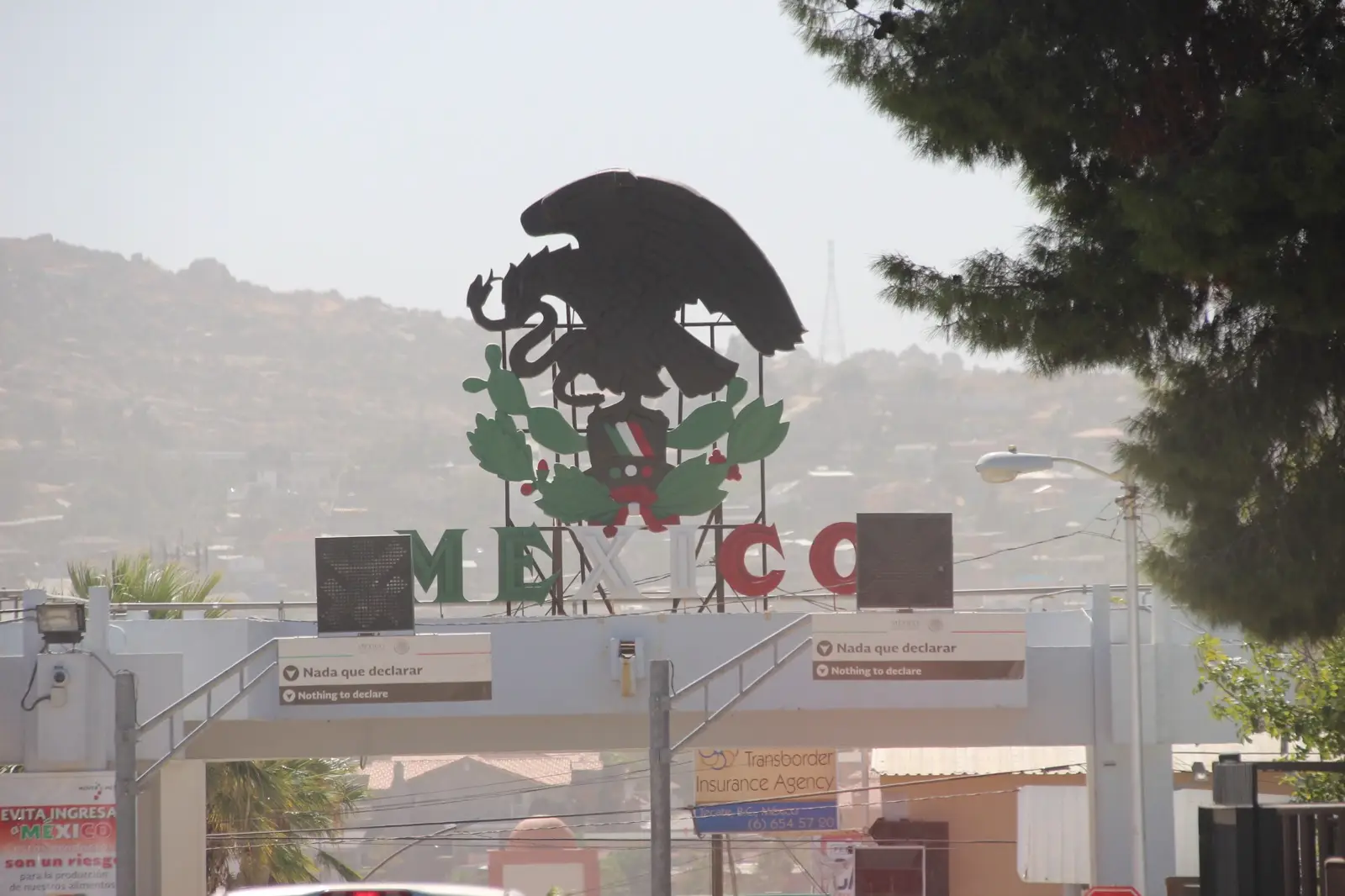
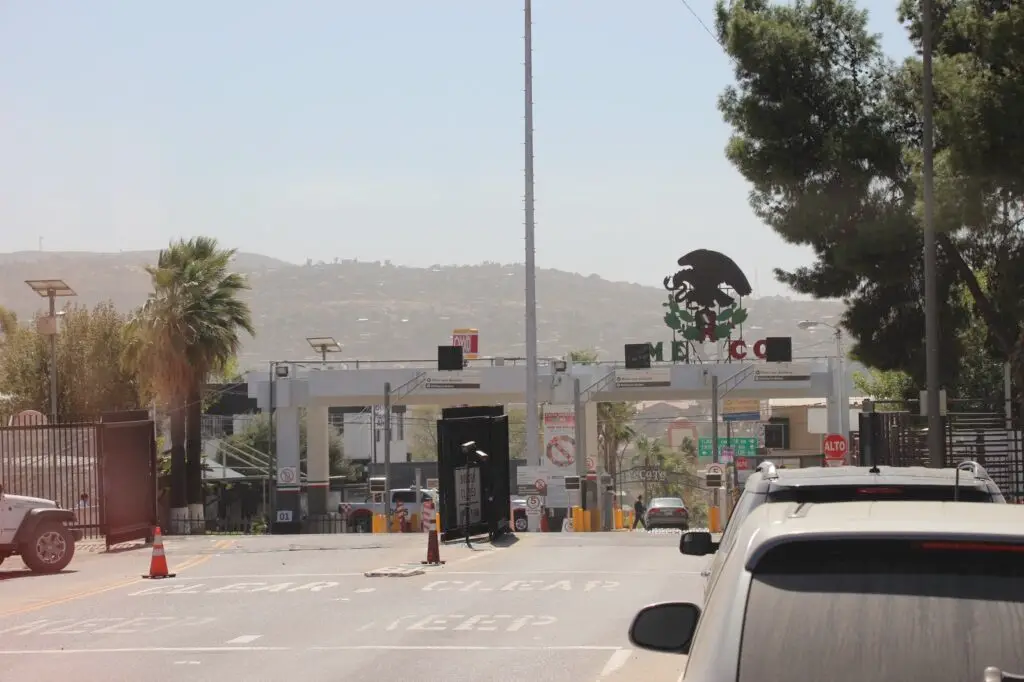
On 9 October we’re finally off to Mexico! We cross the border at Tecate, as many travellers recommend this crossing as easy and uncomplicated. At the border we drive until someone stops us. A young official asks whether we speak Spanish. Christoph says: “No.” I answer: “Un poco.” He asks us to open the sliding door, takes a quick look inside and asks for the vehicle registration and chassis number. Christoph searches, the official waits patiently, but when Christoph finds the papers, he doesn’t even want to see them. At least we now know where they are. The official says goodbye with “Adiós” and leaves.

Grenzübertritt von USA nach Tecate Mexiko – Foto 2

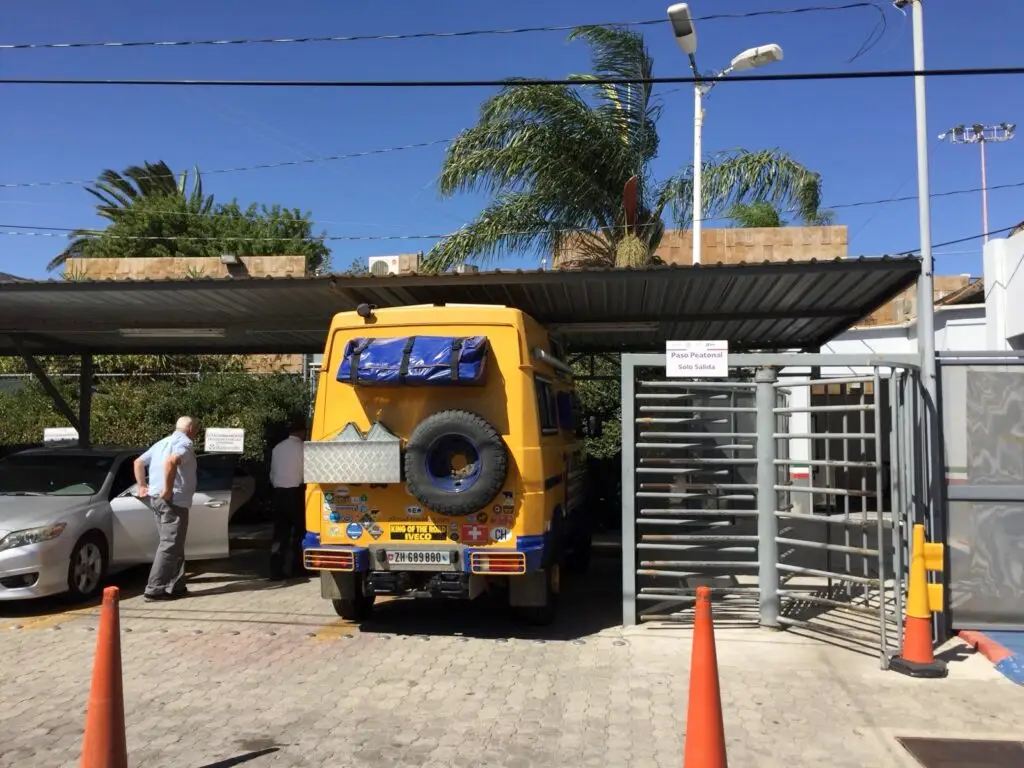
But where do we get our visa, and how do we get rid of the white slip they stapled into our passports when we entered Washington? I ask him, and he sends us back to the USA. He explains where we have to park and walk. We drive around the corner and park under a corrugated-iron roof that our vehicle only just fits under. Another official directs us in and says we may only park for 20 minutes. We had no idea it would take 1.5 hours. We walk back into the USA, where they remove the slip, then back towards Mexico into an office in front of the station where the official had asked about the chassis number. We fill in a form with our name, date of birth, passport number, reason for travel and destination in Mexico. The official sends us to the bank and kindly explains where we have to go next. The “bank” is two counters where we pay for the visa. Then back to the official, who gives us the stamp with a residence permit for 180 days.

At the same time he offers us honey and salsa. It takes me a moment to understand, as I hadn’t expected anyone to try to sell us something. I translate it for Christoph, and we have to stifle our laughter. The situation is so funny that we actually buy honey and salsa. Then he sends us to the pharmacy to make copies, because we need a copy of the visa to import the car. So off to the pharmacy right next to the border jungle. Then back to the “bank” to pay for our vehicle’s permit. The form has to be filled in twice because the clerk made a typo. Check carefully so that an O instead of a 0 doesn’t become your undoing! Our vehicle may now stay for 10 years. We’re jealous!

Grenzübertritt von USA nach Tecate Mexiko – Offroad Travelers

Now we just need car insurance. The agencies are in town, and we leave the border jungle. In the insurance agent’s office we feel as if we’re at a bazaar. We need insurance for a motorhome. She writes 379 US dollars on a piece of paper. If we hadn’t known from other travellers what they had paid, we wouldn’t have been surprised. We only need liability, not comprehensive. The price drops to 279 US dollars. Still too much! We say that friends paid less. She keeps searching and finally offers us insurance for 227 US dollars for six months. A bargain compared with the US insurance at 1,270 US dollars.

Breakdowns? Only on a Friday Before a Holiday Monday, Please

USA & Kanada – Foto 30

We’re on our way to Page, Arizona, a town in the far north of the state near the Utah border. Our goal: the breathtaking Horseshoe Bend and the mystical Antelope Canyon. But our third flat tyre thwarts our plans. Of all places, the tyre decides to let its air out on an uphill bend. We quickly pull onto the gravel beside the road to get out of the danger zone.

By now we’re practised at changing tyres, but the burning sun of Arizona’s desert landscape doesn’t make the job any easier. We also have to be careful not to kneel on one of the tiny cacti scattered everywhere. Lining up the folding ramps and positioning the jack is a challenge on the stony ground, as our vehicle, Muggl, simply has too much ground clearance for our jack. After about half an hour the tyre change is done. Fortunately traffic on Arizona’s long stretches isn’t too heavy, so we can safely get back on the road.

Pannen Bitte nur Freitags wenn am Montag Feiertag ist – Foto 2

Now it’s a matter of holding out: it’s still a good 100 kilometres to Page, and our only spare tyre is already in use. But a short stop at Horseshoe Bend is still possible. This impressive whim of nature, a tight loop of the Colorado River in Marble Canyon, is just before Page. After a ten-minute walk through the desert we reach the breathtaking view.

Having arrived in Page, we first look for a tyre dealer who also repairs tubed tyres. That’s rare in the USA, as it’s considered dangerous and the insurance for it is too expensive. We’ve already been turned away with the horrified words: “Tyres with tubes? No, we don’t do that! That’s illegal!” This time we’re lucky: Big O Tires can help us and the broken tyre is repaired straight away. But there’s a problem: some tubed tyres have a flap (rim tape) between the tube and the rim, and this is also damaged. As it doesn’t usually break so easily, we don’t have a spare with us and the garage has nothing in stock. They can order it, though, which will take a few days, because it’s Friday and Monday is Memorial Day.

Pannen Bitte nur Freitags wenn am Montag Feiertag ist – Foto 3
Pannen Bitte nur Freitags wenn am Montag Feiertag ist – Offroad Travelers

Great! Five days stuck in Page, a town where nothing’s going on and there’s only desert all around. Actually that wouldn’t be so bad, but without a spare tyre we can’t take risks with Muggl. We pass the time and set up our “office” in the car park in front of a Subway, where we use their Wi-Fi and update our website. We spend one afternoon at Lake Powell, among the megalomaniac Americans with huge motorhomes and ATVs (all-terrain vehicles, i.e. quads). Cooling off in the lake feels good. Luckily we don’t have to camp among all the motorhomes. We spend the days a few kilometres out of town at a recreation area. It means driving back and forth, but we have peace and quiet there and take the risk without a spare tyre. Where Americans don’t have a power socket, they generally don’t camp – unless they have a generator. We’re lucky: most evenings we’re all alone.

On the third day we have a funny encounter. When we come back from Page that late afternoon, the area is completely empty. No camper, tent or car – only a small figure sitting in the shade under a tree. Christoph asks the figure whether everything is all right and how he got here. The figure indicates that everything is fine and he’s just resting. Carl from Toronto, Canada, is hiking! He’s been on the road for a good three months and has another month and a half to go. His backpack with tent, sleeping bag and provisions weighs only six kilograms! We’ve just stocked up at the supermarket with steaks, fresh vegetables and cold beer and ask Carl what’s on his dinner menu. As he has to save weight at all costs, he usually has packet soups, which he fills with water and lets the hot sun heat up. Sounds delicious! Christoph asks him when he last ate a steak, and I don’t need to describe how happy Carl was when we invited him to eat steak and salad with us. When Christoph handed him a cold beer as well, it was heaven on earth for him. He sprinted off to collect firewood as if he hadn’t walked a single step that day. So we spend a long, warm summer evening together by the campfire swapping travel stories. Carl is clearly enjoying our company and offers us marshmallows for dessert, which he carries because they weigh nothing. The next morning he wakes us at six so we can say goodbye, and marches off.

Pannen Bitte nur Freitags wenn am Montag Feiertag ist – Foto 5

By now it’s Tuesday 30 May, and the part we ordered should arrive at the garage at some point during the day. So we’ve only booked the appointment for Wednesday morning. Today we want to visit Antelope Canyon. As the tours were fully booked over Memorial Day weekend, we’ve reserved for Tuesday afternoon. So first it’s back to Page, where we stop at the supermarket. As we get out, we hear a loud PFFFFFFFFFFFF. We can watch the rear left tyre losing its air. This can’t be true! What’s wrong with our tyres or tubes?! Luckily the garage is just around the corner. So out with the compressor, pump it up, hope the lights are green and round the corner. And so we stand in the car park in front of the garage watching the tyre go flat.

They have tubes in stock, so the tyre is repaired – or rather the tube replaced – in no time. We can set off for our Antelope Canyon tour on time. In the meantime we’ve asked other IVECO drivers and people experienced with tubed tyres what could be causing us to keep losing air. Our conclusion: tubed tyres are hardly made any more these days. That means the insides of the tyres are no longer as smooth as they used to be and wear through faster. So we decide to use tubes one size larger when replacing them. Also, the tubes we had fitted might have been stored for a while or stored incorrectly, so the rubber was no longer as elastic. Either way, we’ll find out in the long-term test.

Pannen Bitte nur Freitags wenn am Montag Feiertag ist – Foto 6
Pannen Bitte nur Freitags wenn am Montag Feiertag ist – Foto 4
Pannen Bitte nur Freitags wenn am Montag Feiertag ist – Foto 7

On Wednesday morning we finally get our rim flap, and the garage has its hands full with us. With completely new tubes we leave shortly after midday, make one last stop at the petrol station and leave the desert town of Page to continue our journey north.

Strange Noises, Animal Discoveries and Hot Springs

USA & Kanada – Foto 34

Shortly after half past four a crackling noise wakes me. I listen but can’t place it. I wake Christoph and ask whether he can hear it too. He says no, turns over and goes back to sleep. The noise stops but keeps starting again. It sounds like a faint fizzing – hard to describe. I wonder what it could be. Suddenly there’s a burning smell. I jump up, wake Christoph, and we look for the source.

Komische Geräusche, tierische Entdeckungen und heisse Quellen

It’s coming from the kitchen cupboard under the sink, where the fridge is. Not a good sign! Christoph immediately pulls the fuse. We clear out everything that isn’t built in: bedding, cushions, everything under the bed. I stack it all outside on the camping table and chairs and am glad of the clear sky and the sunrise. We’re parked idyllically next to a small stream. We unpack the tools and prepare for anything. The back panel of the cupboard has to come off, but everything is built in so intricately that you’d have to take half the car apart. The worktop can’t be removed either, as the tap is connected and it’s screwed down several times from below. At least we can loosen the worktop enough to take a look inside. The tap’s clamp is loose, and water is dripping onto the cables and the fridge electronics. Great!

Komische Geräusche, tierische Entdeckungen und heisse Quellen – Foto 2

Hopefully nothing is broken. With a torch in one hand and kitchen towels in the other, I dab everything dry. I tighten the clamp and shape a cap out of old plastic packaging, which we glue over the electronics with Pattex. Then we put everything back in place, screw it together, put the table back in, make the bed and put the tools away. The whole operation takes almost an hour and a half. When we’re done, we notice what a glorious day it is. The sun is shining, big yellow butterflies are fluttering around. A small consolation for the morning’s trouble, because it’s my birthday and this isn’t how I wanted to start it.

Oh well, I think, if you get up early on your birthday, you get more out of the day. We have a leisurely breakfast with a small bottle of champagne that Christoph bought at Aldi with the comment “for a special day”, and then hike to hot springs in the mountains. The hike takes a good hour. On the way we come across a rattlesnake! I’m walking in front, Christoph behind me, when I hear first a rustling and then a rattling in the leaves on the left. I just say: “Stop! Rattlesnake” and stop the hikers coming the other way. A rattlesnake a good one and a half metres long slithers rattling across the path in front of us and disappears into the bushes. One of the hikers says that’s insane! He’s lived in Utah all his life, hikes a lot and has never seen a rattlesnake. Apparently they’re not that common.

Komische Geräusche, tierische Entdeckungen und heisse Quellen – Foto 5
Komische Geräusche, tierische Entdeckungen und heisse Quellen – Foto 3

When we arrive, another snake awaits us, which we judge to be non-venomous. It’s shy and disappears into the forest. Lots of small pools of different temperatures and an ice-cold waterfall invite you to linger. Where the springs rise, the water is so hot you can hardly bear it. We have a good soak, because since we’ve been living in Muggl, showers have been short. Big yellow butterflies flutter here too; we enjoy the sun and hop from pool to waterfall and back. Wrinkled and cleaner than we’ve been in a long time, we make our way back to our little stream, where we end the day by the campfire.

Komische Geräusche, tierische Entdeckungen und heisse Quellen – Foto 4

Beautiful Alaska

USA & Kanada – Foto 32

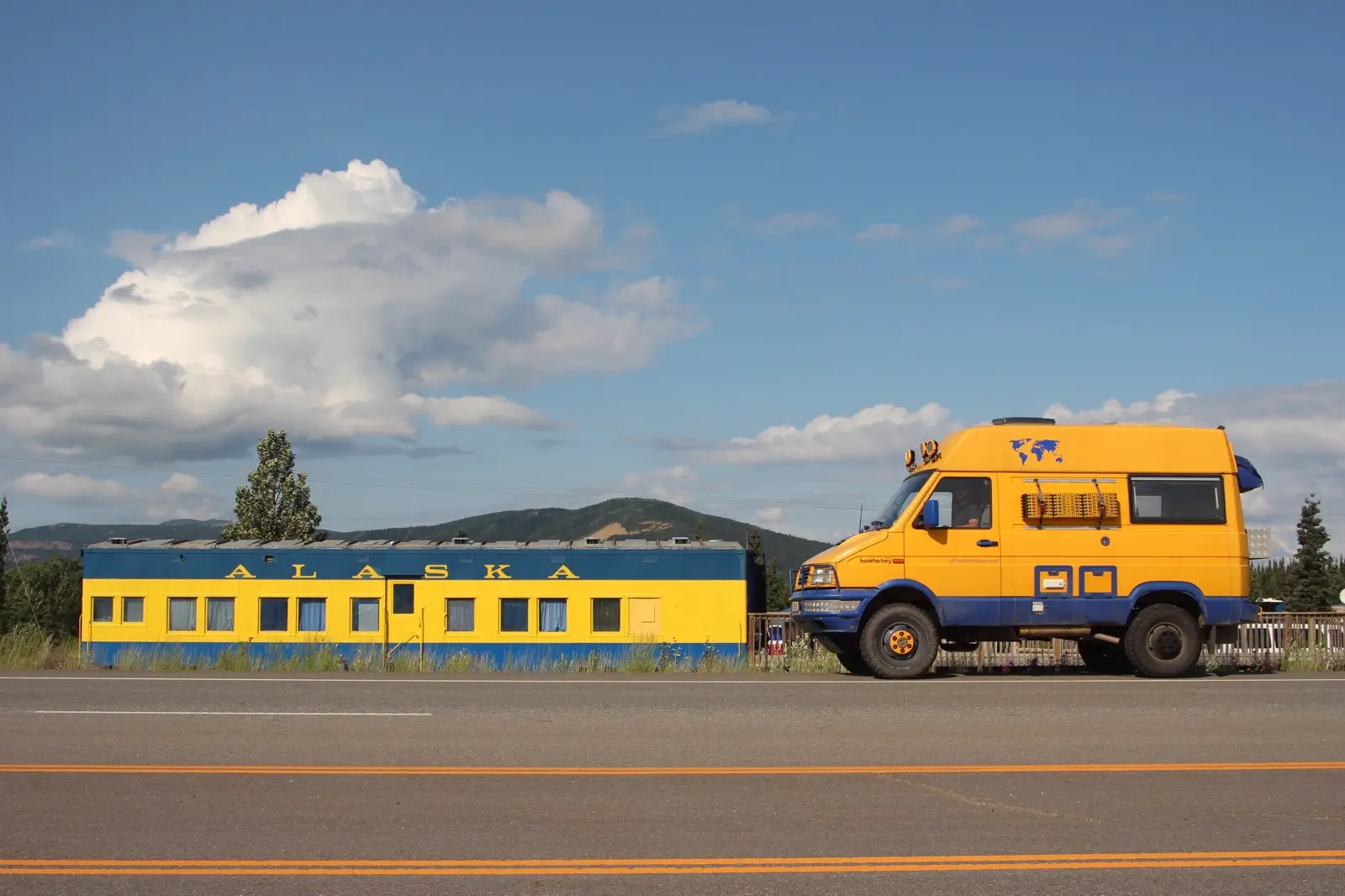
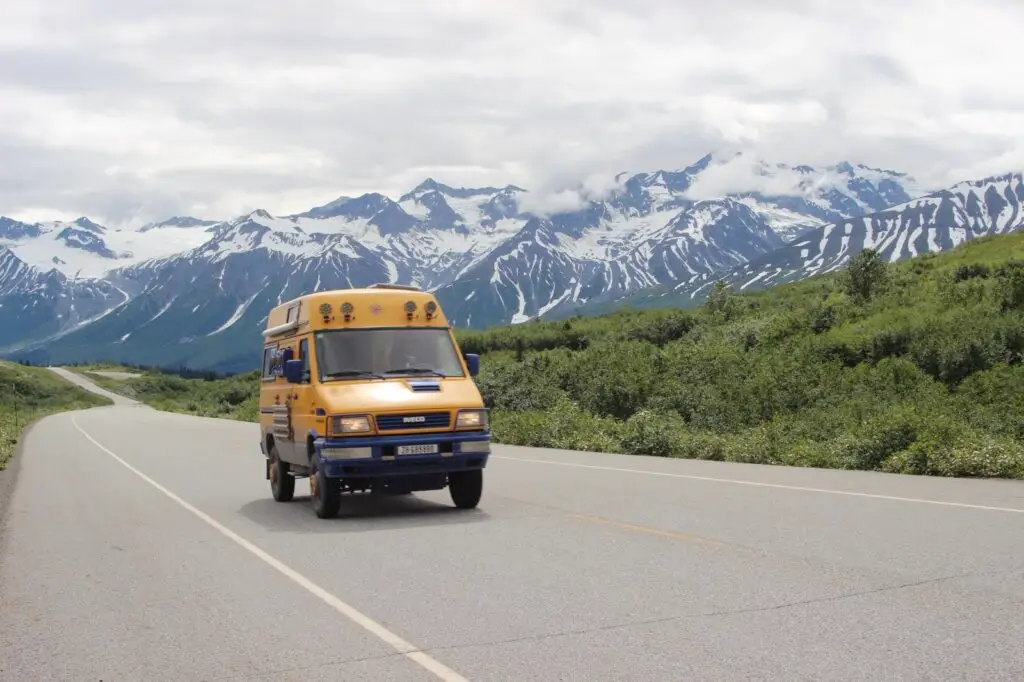
On 10 July we travel from Dawson City (Canada) along the Top of the World Highway and enter Alaska (USA) via North America’s northernmost border crossing, Poker Creek. For once the weather isn’t on our side: fog and drizzle shroud the landscape, which is said to be breathtaking here. But Alaska soon surprises us with hot, sunny days and crystal-clear lakes. Who would have thought we’d mostly be wearing shorts and T-shirts in Alaska? At the border a friendly officer asks whether we have pets, weapons or tobacco with us, which of course we deny. She admires our world map in the cab and asks whether we’re travelling the whole world. Again we say no: “No, just the Americas for now, then we’ll see.” She disappears into her booth with our passports and returns after three minutes, proudly announcing that she has given us a very special stamp: “because you made it!” Now a caribou adorns our passports, and we’re very proud.

Wunderschönes Alaska – Foto 8

Shortly before we left Canada, we met Corinna and Reiner from Ahrweiler near Bonn at a small campsite. We only wanted to sit down briefly and say hello – suddenly it was 1 am. That can happen when it doesn’t get dark. As we’re now travelling in the same direction, we’ll see them often from now on and spend many evenings together, sometimes arranged, sometimes by chance. Our next destination, and the northernmost city we’ll visit on our trip, is Fairbanks. Originally we hadn’t planned to go this far north. If we make it to Anchorage, that’ll be good, we thought. But somehow we’re doing it like Forrest Gump: “We’ve come this far, we might as well keep going.”

Fairbanks is a sleepy city, and you really feel as if you’re at the end of the world here. You can see straight away that the winters here are long and hard: cables with plugs hang out of the car bonnets, supplying heating pads under the oil sump, on the diesel lines and the cooling system so that nothing freezes in winter. All car parks have power sockets where you can plug in your car while shopping or at the dentist. We camp for two nights with Corinna and Reiner in the university car park. Sometimes you just have to be resourceful when you have no fixed address. I even find out that you can pick up the university Wi-Fi – without a password. The evenings and nights aren’t cold, a bit fresh but pleasant, which invites cooking and lingering outside together. During the day, when the sun comes out, it even gets really warm, and we visit the farmers’ market, where we buy regional specialities such as fireweed jam. Fireweed is Alaska’s official flower and blooms in a beautiful pink.

Wunderschönes Alaska – Foto 7

From Fairbanks it’s only south from now on. Our next destination is Denali National Park, where you may only drive the first 15 miles in your own car. If you want to go further or even to the end, you have to take a tour bus, which is a full 92 miles. You end up in Kantishna, at the end of the national park, and at Wonder Lake, which is crystal clear. It’s sometimes a bit annoying to spend the whole day with lots of other tourists and a non-stop chattering bus driver, but this far into the park nature is still completely untouched, so you can live with it. There are no kiosks, no food stands, no rubbish bins. You have to bring your own food and take your rubbish back with you, which is strictly checked. There’s not the slightest bit of litter lying around, and nothing is smeared or defaced in any way.

We see mountain goats as little white dots on the hills, grizzlies in the distance, some with their cubs, moose hidden in the bushes and lots of caribou, which often simply stand on the road. The landscape is impressively vast. Although it’s a bit cloudy and Denali, the highest mountain in North America, doesn’t show itself properly, we’re thrilled. On the way back it gets quiet on the bus. It’s been a long day and everyone is tired when suddenly we get into a traffic jam. Probably another caribou on the road, everyone on the bus thinks. But when the bus in front of us pulls aside, a wolf walks towards us, lies down on the road about five or six metres in front of us and rolls around on the gravel. He gets up again, sniffs the ground, stretches and lies down again to roll around. He does this four or five times. Then he slowly walks right past our bus. Everyone watches him in amazement, and even the bus driver, who has been doing this job for 17 years and is about to retire, has never seen anything like it and pulls out his camera.

Wunderschönes Alaska – Foto 6

We end this successful but exhausting day at the 49th State Brewery in Healy with excellent beer and burgers. By the way, you can see the film bus from “Into the Wild” here, with the original props. For those who don’t know the film, “Into the Wild” is the true story of a young American who in the 90s donated or gave away all his possessions and turned his back on the success-driven life that society and his parents wanted to force on him. He travelled across the USA for a few years and in autumn 1992 settled in an old Fairbanks city bus, which hunters actually used as a shelter in summer. The following spring he ran out of supplies, and the late snowmelt proved fatal. The “Magic Bus”, as Alexander Supertramp called it in his diary, became a place of pilgrimage. But if you want to follow the so-called Stampede Trail, you have to cross a river at one point, which isn’t without danger. As a young Swiss woman drowned only a year ago trying to reach the original Magic Bus, the brewery simply bought the bus from the film company, so that nobody has to risk their life for a souvenir photo any more.

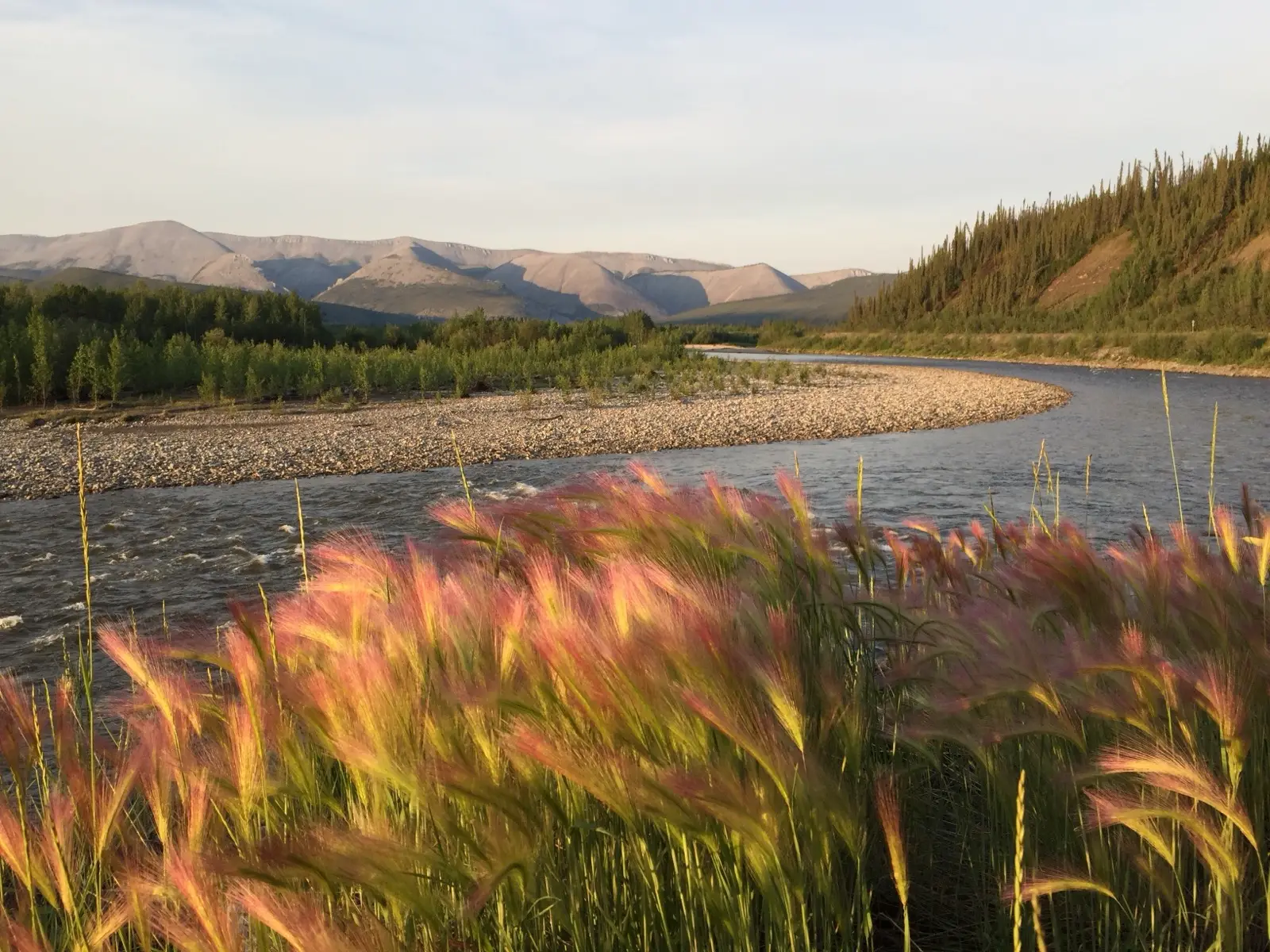
We continue south along the George Parks Highway, where we find a nice spot to camp on the bank of the Susitna River. The river bends at this point, and a grey sandbank offers good ground to park on. There’s enough driftwood around to make a campfire – the perfect opportunity to bake bread again. It’s a weekday and very quiet. It’s surely different here at the weekend, and while we’re enjoying the afternoon on the riverbank, a beaver even floats past. I had to look twice, as the piece of wood I thought I was seeing suddenly moved.

Wunderschönes Alaska – Foto 5

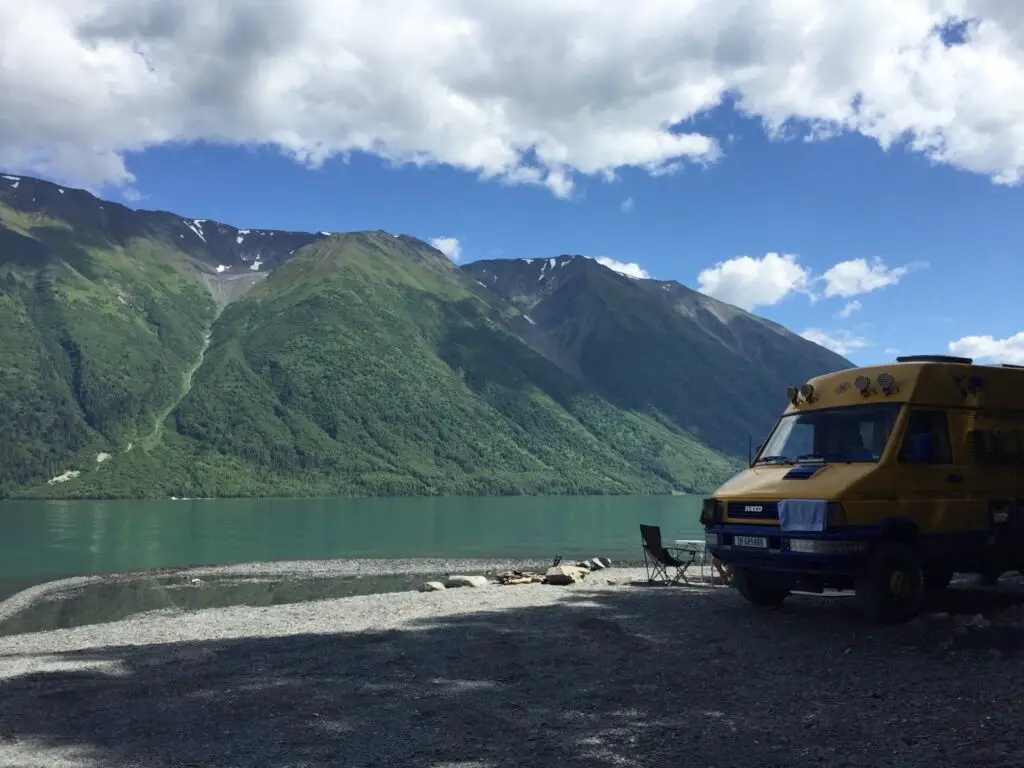
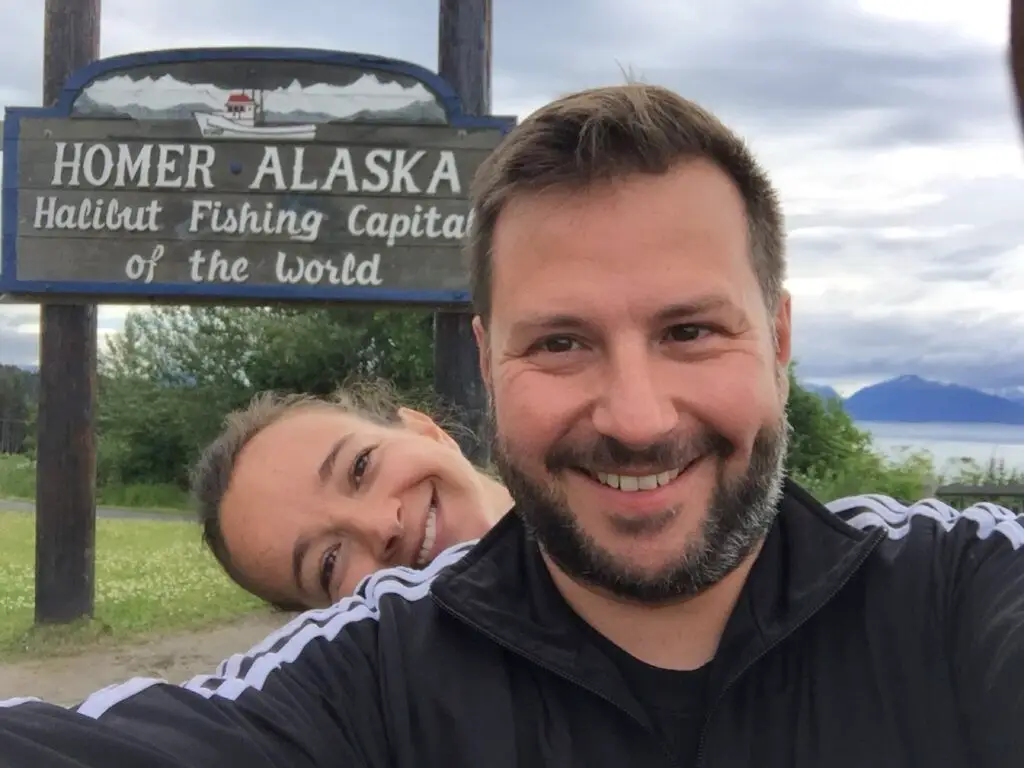
Anchorage didn’t particularly thrill us, even though the yellow street lamps and blue flower baskets are decorated in Muggl colours. We only spend an afternoon there. We want to go to the Kenai Peninsula, where once again we’re lucky with the weather. On the way there it’s still raining and dark with cloud, but the sun arrives with us (from wherever), and we park Muggl right at the end of the Spit and stroll along the harbour. All around are snow-covered hills and mountains, fishing boats are moored at the piers, the fishermen proudly show off the halibut they’ve caught, and bald eagles circle in the air. We watch, fascinated, how quickly and skilfully they fillet their halibut. A single fish is about 1.5 m long! A little further into the peninsula we quite by chance find a small turn-off at the side of the road. I just shout: “Right here!” and we end up in a small clearing by a stream among fir trees and fireweed. The evening sun bathes our home for today in a warm light, and although everyone warned us about mosquitoes and black flies in Alaska, to our delight they haven’t shown up so far – and that’s how it stays today.

Next we want to go to Kenai village. I had read somewhere that Old Town is supposed to be pretty, but in our eyes it isn’t. Still, something is going on in this sleepy little place. We follow the crowd and end up on the coast, where the Kenai River flows into the sea, and from the dunes we spot a lively bustle on the beach. We park the car and mingle with the crowd to find out what’s going on. People in waders with huge dip nets are standing in the water, some up to their necks. At first glance we can’t make out what they’re catching. And why all at once? A competition? It’s 21 July and salmon spawning season. For three weeks at this time of year, Alaskans may catch their annual supply of salmon. The rule: only with this type of dip net and “only” 25 salmon per household plus 10 salmon per child. For a family of five, for example, that makes 55 salmon! But not a single one too many – that’s checked and fined if you take too many. We watch in disbelief as the men and women proudly pull their huge salmon out of the water. Sometimes it’s a real fight, and a skilful twist of the net stops the salmon from escaping. The salmon are killed on the spot with a small club and a well-aimed blow to the head, gutted there and then, cut up and packed into cool boxes. I have to admit it’s not a pretty sight, but that’s how it is, and it’s been done like this here for decades. In between, children play and run around as if it were the most normal thing in the world – which for them it probably is, much like growing up on a farm back home. I still remember well when my grandma used to slaughter chickens.

Wunderschönes Alaska – Foto 4

Our place to sleep and rest for the next few days is to be Kenai Lake. We’ve been told it’s steep down to the south shore and you’d need 4×4. No problem, and we’re pleased, because then there’s a good chance it won’t be too busy, as it’s Saturday. It really is steep going down, and the track is rocky, but before we’re even at the bottom we see one vehicle after another – normal cars – and we wonder how they got here, or rather, how will they get back up? Something that kept surprising us in the USA: no matter how bad the road, Americans are apparently quite unfazed and drive their cars everywhere – ideally towing a trailer as well. A small wedding is taking place at Kenai Lake today, and we’re told it’s a popular backdrop for wedding photos. Well then. We find a little spot at the end of the bay, and since it’s been a long day, all we want to do is sleep anyway. On Sunday morning most – well, almost all – of them leave again. There’s squeaking and clattering as they make their way up. Engines howl, and if it weren’t broad daylight, we’d see the sparks flying, I’m sure. We move to the other end of the bay for the next two days, where we have a slightly wider gravel beach and nobody can park right next to us. In the evenings we light a campfire and grill; during the day we enjoy the sun and the blue, ice-cold (12 degrees) water of Kenai Lake.

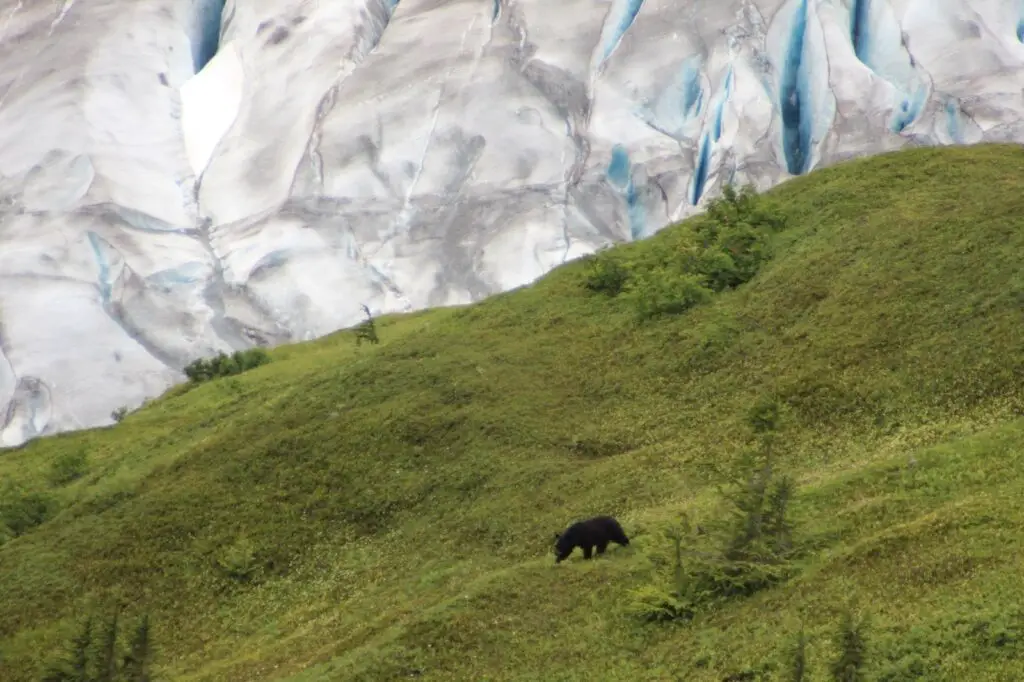
Having arrived in Seward, we first park at the visitor centre to get an overview of the area. Whom do we spot in the nearby supermarket car park? Corinna and Reiner, whom we now call Team Reico. I dash over, and we arrange to camp in a dried-up riverbed along Exit Glacier Road. Corinna, who does most of the driving, is pretty daring, as the riverbed is very stony and they’re travelling in a normal camper (Citroën). We’re proud! There we also meet Ludwig and Uschi from Regensburg, who are also travelling by camper. Yes, the world of travellers is small. That evening the six of us cook over the campfire. There’s freshly caught grilled salmon with remoulade and potatoes, and fruit salad for dessert. We also bake cinnamon rolls and bread in the Dutch oven. The next morning it’s raining a little, and our paths part again. Today we want to hike up to the glacier. Just as we’re making breakfast, someone suddenly peeks in through the door and says: “Good morning, are you by any chance driving to Exit Glacier?” Isabelle from Hamburg is travelling with a backpack and tent – alone! So we squeeze together, have breakfast first and then take her with us on the hike to the glacier. It has stopped raining and the sun comes out, so we can climb to the highest point in the best weather and visibility. Even a black bear and a few marmots show themselves, though far in the distance.

Wunderschönes Alaska – Foto 3

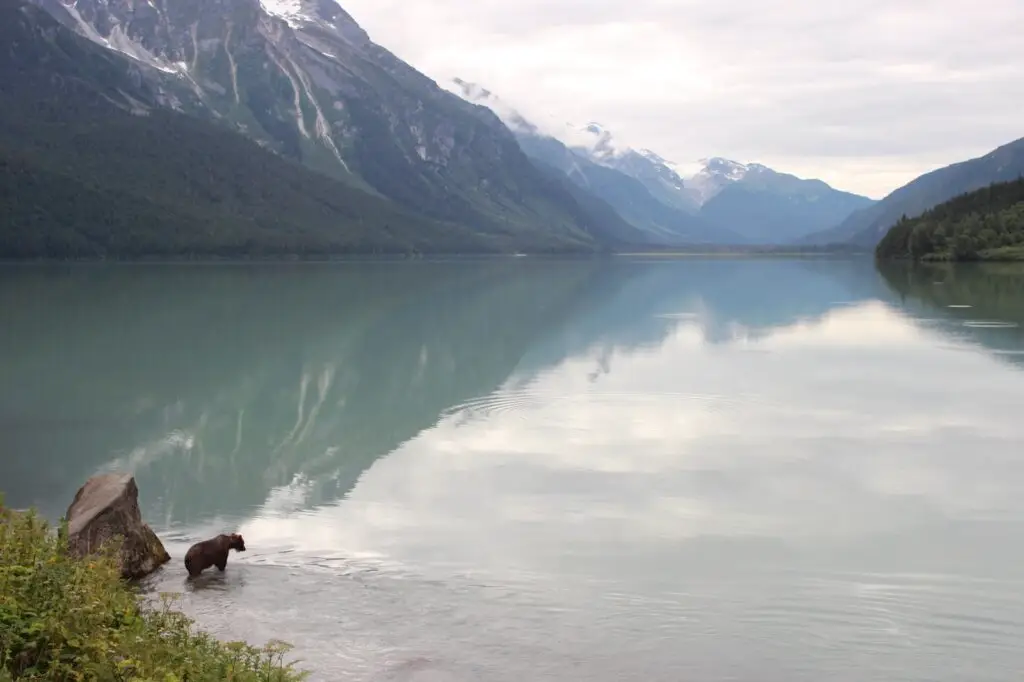
Getting to Haines is quite a drive, taking us along the last section of the Alaska Highway and through Canada back into Alaska to the sleepy little town. That’s 880 miles, i.e. 1,416 km, but we absolutely want to go to Haines, because bears are guaranteed there! The distances here are unbelievable, and you can’t imagine it if you’ve never travelled here. As soon as we arrive, our route takes us along the Chilkoot River to Chilkoot Lake at the other end of town. That’s where they’re supposed to be, the grizzlies. We park and wait, and after only about 10 minutes the people – local fishermen and a few tourists – become restless and jump back into their cars. Two young grizzly brothers walk along the river in knee-deep water, catching salmon as they go and devouring them with relish. The audience hides behind car doors and watches intently to see what happens. The two bears are about three years old, we’re told, and were chased away by their mother this spring because she’s had new cubs. They walk and splash to the end of the river, where it flows out of the lake, and where the water gets deeper, they just swim. When they’ve swum and splashed enough, they come ashore. Where the boat ramp is, it’s easy to get out. People jump into their cars and lock the doors. The two brothers are quick and explore everything very closely. The picnic bench and table smell of food and need to be thoroughly inspected. You can just walk over them, too. As there’s nothing to find and the two have already eaten one salmon after another anyway, they promptly disappear into the forest behind us. What a spectacle – we’re speechless!

Wunderschönes Alaska – Foto 2

For the night we look for a small lay-by between the riverbank and the narrow road leading to the lake and spend the night there. In the middle of the night we’re woken by a very loud snorting – both of us. It sounds as if the two bear brothers are out again and sniffing behind Muggl, exactly where we’re sleeping. Hopefully I won’t need the toilet tonight! We spend the next day entirely at the lake and the river. Further along there’s a metal weir in the river that the locals call the sushi bar. Bears like to come here during the day too to eat salmon. That’s why there’s a closed area next to it by the road where you’re not allowed to park or stand. That’s where the bears come out of the forest to have their meals. At midday a fully grown female bear is fishing there – and the sushi bar is called the sushi bar because the bears can easily press the salmon they catch against the grid and eat them. The female simply reaches into the water and pulls out a salmon, once with her right paw and once with her left. You could watch forever. Tonight we camp – or rather park – at Chilkoot Lake, even though camping there is actually forbidden. Officially it’s the first time we’ve knowingly spent the night illegally… well, “where there’s no plaintiff, there’s no judge”, and nobody knocked on our door at night. It was so quiet, in fact, that I don’t think even a bear came by – except Christoph. He caused a commotion, because some nights he has ants in his pants and finds it hard to lie still for two seconds. I tell you, that can be pretty annoying in a bed only 1.80 m by 1.20 m – and besides, the whole of Muggl wobbles too.

Wunderschönes Alaska – Offroad Travelers

From Haines we take the ferry to Skagway, saving ourselves a long drive. Two hours later we reach the harbour, surrounded by huge cruise ships. Skagway is a popular cruise destination, which surprises me, as I’d never heard of Alaska cruises before. Why not? In Skagway we get creative looking for a place to spend the night and end up at the cemetery. That sounds worse than it is: the Gold Rush Cemetery was used until shortly after the turn of the century. As it lies below a slope and was partly buried by a landslide, it’s more or less closed. It looks like a cemetery from a Wild West film, with simple wooden crosses and crooked gravestones. When we arrive, the soft afternoon light falls through the trees and bathes the area in a magical atmosphere. A walk along a small path leads us to a waterfall that springs from a narrow gorge in the mountain. There’s a long-drop toilet at the car park, and it’s quiet at night. What more could you want? It stays quiet until 8 am, then the tourist buses arrive and the historic train to White Pass sets off.

Over the next few days we’re drawn back into the wilderness. We follow the Dyea Road a little way north, where a small river flows into the bay. Christoph has spotted mushrooms by the roadside and storms into the forest, while I walk to the river and the bridge. When I get there, I’m speechless: the river is teeming with salmon, packed tightly together, laying their eggs. I knew this happens here at this time of year, but we hadn’t specifically gone looking for it. All the nicer to find it by chance. I ask a guide who arrives with a group of tourists whether there are bears here. “Yes, right behind you!” he says. Startled, I turn around but see no bear. He laughs and explains that the bears only come at night; during the day it’s too busy for them. Aha! We drive on along the Dyea Road and camp with a campfire by a beautiful river, where the Jeepsters surprise us. The Jeepsters are a Hawaiian family: Sam, Lucie and three-year-old Kali, travelling in a 1966 Jeep called Jeepster with a roof tent. As the guide at the salmon river had explained that the bears only come at night, we get up at 4 am the next morning and wait. But the bears don’t show up. For us, it’s back inland from Skagway – and back into Canada.

Somewhere in the Middle of Nowhere: a Strange Noise and an Apocalyptic Mood

USA & Kanada – Foto 33

Muggl is filled up with diesel and water, food and drinks are restocked. We’re ready for the outback! On 7 July we drive onto the Dempster Highway, which runs from Dawson City to Inuvik, Canada’s northernmost town. This lonely, wide road is unpaved and used mainly by big trucks as a transport route.

Irgendwo im Nirgendwo, ein seltsames Geräusch und Weltuntergangsstimmung – Foto 3

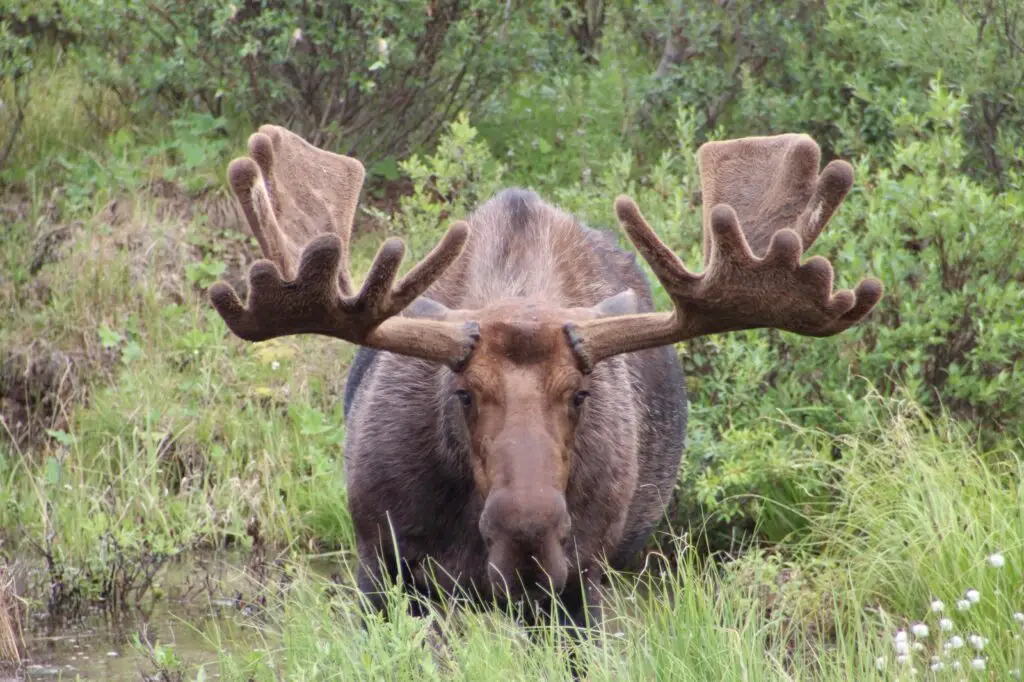
On the way to our first stage destination we finally see our first moose. The names here are a bit confusing: the huge animal with the rounded antlers that Germans call “Elch” is called a moose in the USA and Canada. “Elk” there refers to a large species of deer that’s hard to find. The ratio of animals actually seen to warning signs along the road is about 1 to 1 million. We were starting to think they didn’t exist at all and the signs were just there for fun. As we drive past a pond next to the road, I see a mound of fur and think: they’ve got big beavers here! When I spot the second animal, I realise it’s a moose. I shout: “Stop! Moose!” Christoph stops immediately and reverses. What I took for a giant beaver were actually just the shoulder blades of a moose that had just dived down to eat seaweed. So there are two of these mysterious animals in all their size and glory in front of us. You don’t really want to get out – it doesn’t look like it, but apparently they can be pretty fast.

On this Friday we drive 160 km before looking for a spot to spend the night in a dry riverbed. It’s already late, but still hot and light. Summer in Canada means it doesn’t get dark – not at all. At best there’s a bit of dusk between 1 and 2 am, and that’s it. We saw the last car hours ago, and this “evening” only one more truck drives past us. As it doesn’t get dark, the mosquitoes don’t go to bed either. We still don’t have a mosquito screen on the sliding door, as we’ve been pretty lucky with the little beasts so far. I quickly cut the net to size and attach it to the door with Velcro. Now we can open everything up for a through-draught, and it’s more or less bearable.

Irgendwo im Nirgendwo, ein seltsames Geräusch und Weltuntergangsstimmung – Foto 4

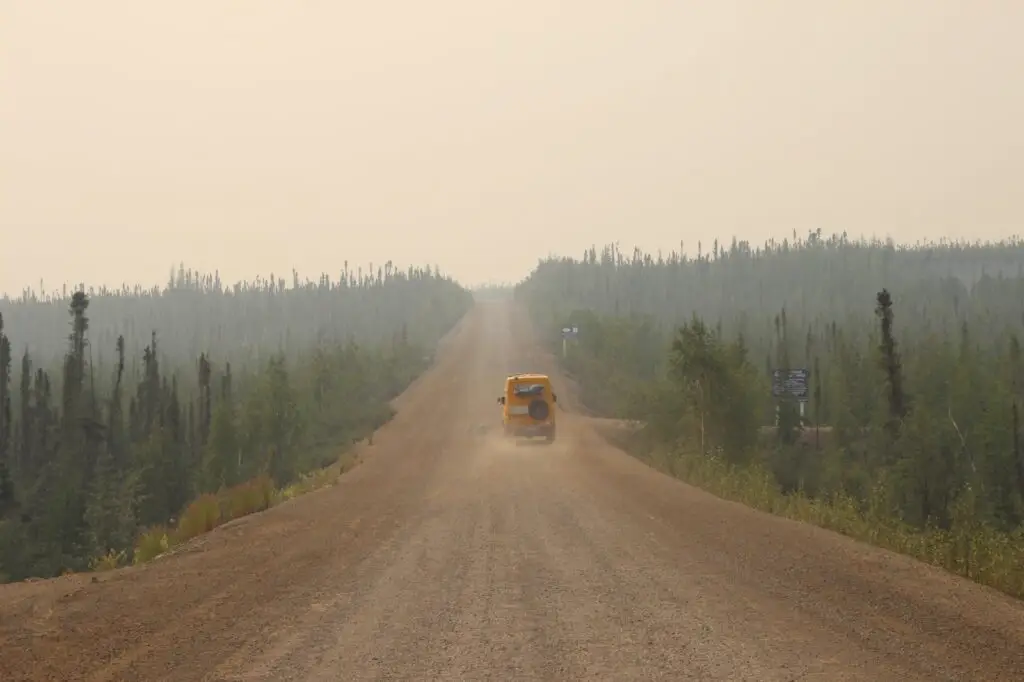
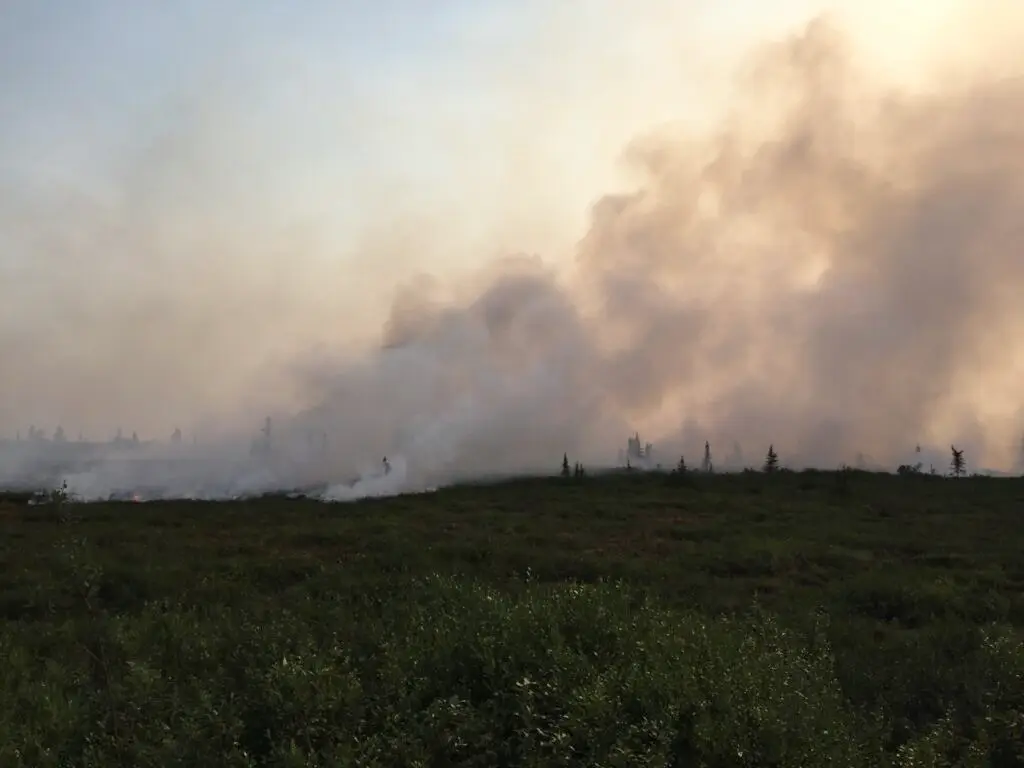
We hadn’t expected summer in Canada to be so hot, but the locals tell us this summer is also unusually hot and sunny. Because of the heat and drought, Canada has big problems with wildfires. When we look north, the sky is orange-pink. As it doesn’t get dark, you can read a book here without light until midnight and don’t get tired at all. After a few weeks it feels like permanent jet lag and is pretty exhausting. So at 11:30 pm we’re still sitting in Muggl reading. Absolute silence around us – until I hear a noise. It slowly gets closer and I wonder what it could be. It sounds like stones or sticks clattering and doesn’t stop. As always, Christoph hears nothing, and I peer out of every window. Although it’s still almost as bright as day, I see nothing. Picture a sunny late afternoon in midsummer, around half past four – that’s what half past eleven at night is like in July in Canada!

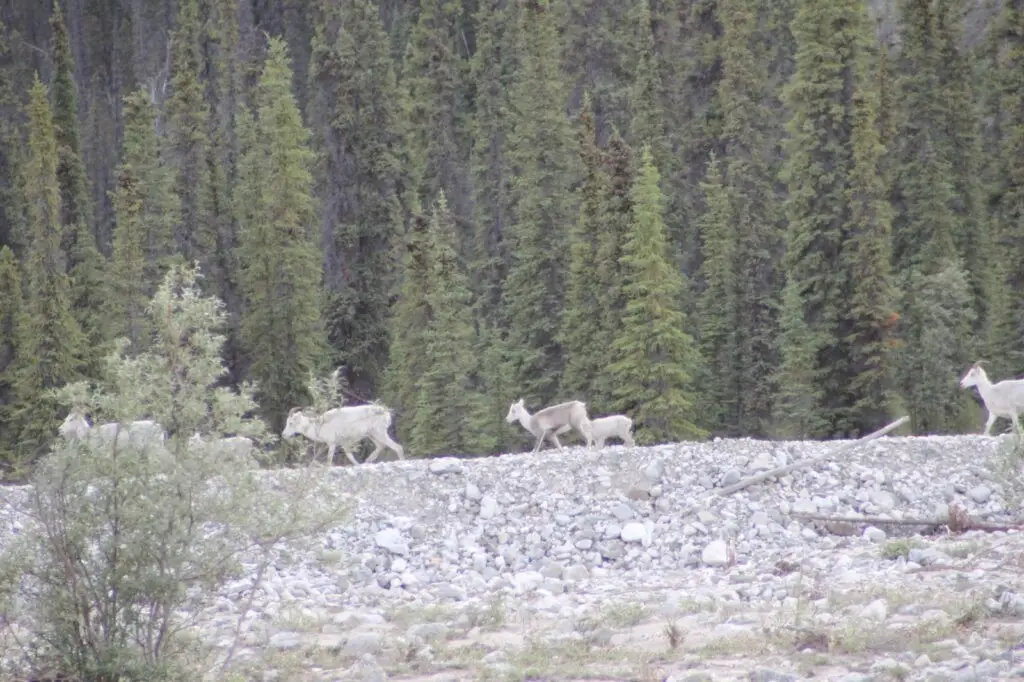
The noise gets closer, and I remember that other travellers saw a wolf here last year. The tension rises, because the noise is coming straight towards us. It’s now so loud that I can tell something is walking on stones, and it must be big, because it’s getting really loud. Christoph still hears nothing, and I don’t understand how anyone can’t hear the racket! I’m getting pretty excited and curious about what’s coming towards us. Just as Christoph is about to declare me crazy, I see what’s causing the noise and have to laugh out loud. Goats! A whole herd of little goats – tiny ones, slightly bigger ones, old ones, young ones, and lots of them. I couldn’t count them, but they march past Muggl one after another about five metres away. I really hadn’t expected that, especially as this kind of goat isn’t actually found here. The people we told about it afterwards didn’t know anything about goats like that here either. Anyway, after all the excitement we go to bed and decide to get up and drive on whenever we wake up the next morning. That turned out to be 3 am.

Irgendwo im Nirgendwo, ein seltsames Geräusch und Weltuntergangsstimmung – Foto 5

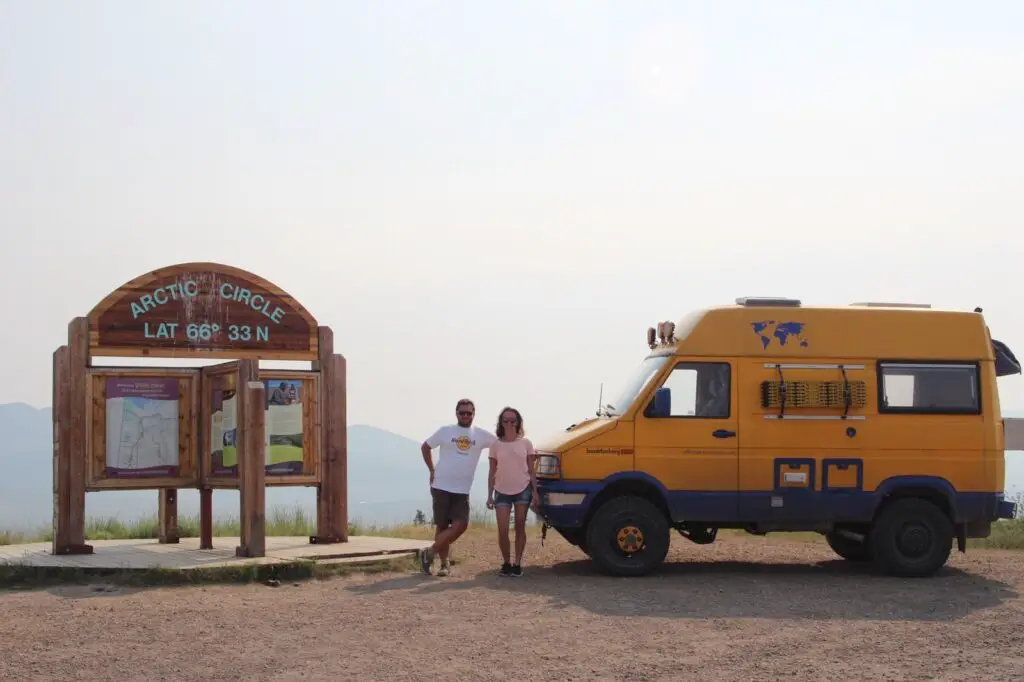
But we don’t get far, because about 40 km further on the road is closed because of wildfires – or more precisely, tundra fires, as there isn’t much forest left this far up. The vegetation this far north is quite different. Next to the roadblock there’s an entrance to a large gravel area. Two big trucks and a car are waiting there. We recognise one of the trucks as the last one we saw drive past us the evening before. So the road must have been closed for a while. We had heard that fires had broken out along the Dempster Highway and that it was sometimes closed from the north, especially at night, to prevent accidents due to poor visibility. We decide to wait two hours at most, have breakfast first and then take a nap. About an hour and a half later the road is open and we drive on. Hundreds of kilometres of gravel road lie ahead of us. To our right we see burnt little spruce trees. They don’t grow very tall here anyway; all that’s left is a black stalk. They look like oversized burnt matches. The wind is coming from the west and blowing the smoke away from us. We have good visibility, but decide not to drive all the way to Inuvik, because we can’t assess the risk of getting stuck there should the wildfires spread. Our final destination that day is the Arctic Circle, which is also the northernmost point of our trip. There we take a souvenir photo of the three of us (the two of us and Muggl) at the sign, and then we head back quickly.

Irgendwo im Nirgendwo, ein seltsames Geräusch und Weltuntergangsstimmung – Foto 2

The return journey is less relaxed, because in the meantime the wind has turned and is now blowing the smoke straight across the highway. We see nothing, absolutely nothing. At times we work our way back at walking pace. We have the windows closed, and still we feel we can’t breathe properly. Fortunately we soon leave the dense smoke behind, but because of another change in wind direction the whole 400 km of our way back are pretty smoky. That day we drive almost 700 km and are glad to be able to breathe reasonably fresh air again at the end of the highway. We didn’t need most of our supplies, apart from the fuel, but you never know what will happen when you drive lonely roads in Canada.

Irgendwo im Nirgendwo, ein seltsames Geräusch und Weltuntergangsstimmung

A Nocturnal Visitor

USA & Kanada – Foto 35

As yesterday was a long day, we went to bed early

It’s Wednesday 9 August, shortly before half past midnight, when I hear noises. I look out of every window several times to spot the troublemaker. Although there’s a full moon and the night is clear, I see nothing. It goes quiet and I lie down again. After a few minutes it starts again: scratching, scraping and knocking. Above, below, at the sides. I wonder what it could be: a raccoon on the roof, a porcupine under the car, a squirrel climbing up the walls. Again I get up, search and see nothing. Again I lie down. The noises seem to be everywhere and getting closer.

Da der gestrige Tag lang war, sind wir früh ins Bett gegangen

An invasion? Are we under siege? That can’t be! What animal is that fast? Is something whizzing over the car like Speedy Gonzales? Through the car? Through the panelling? I think I’m hearing things. Suddenly there’s a rustling under the bonnet. Ha! Maybe a marten! I’m sure of it and wake Christoph, who had been sleeping peacefully until then. “Start the engine, I think a marten is going after the cables.” He hears the rustling and scratching too, starts the engine, and indeed: we manage at least to chase the little creature out of the engine compartment, and it plops into the passenger footwell! It’s a teeny-tiny mouse! We hadn’t expected such a little critter to cause so much excitement. But now it’s here – and immediately gone again. It has actually found its way into the insulation and seems to like it there. It races from front to back, from top to bottom, and occasionally peeks out of a slit or hole here and there. It seems to want to tell us: “Here I am, you won’t catch me, I’m moving in!” Great!

We sit on the bed wondering how to get rid of this little rowdy, while it happily explores the cab, climbing up the passenger seat to the headrest and back down again. Finally we build a trap from a plastic box propped up on a clothes peg. A biscuit about three times the size of the mouse serves as bait. On the first attempt I’m too quick; the mouse isn’t fully inside yet and escapes before the trap snaps shut. It doesn’t take long before the greedy little mouse comes back. On the second attempt it’s caught! It’s half past four. It has no idea what’s happening and looks sceptical. To make sure it can’t get out, we put the four-kilogram compressor on top of the box. You never know.

Da der gestrige Tag lang war, sind wir früh ins Bett gegangen – Foto 2

We only let it go in the morning, just before we drive off, so that it doesn’t come back. But it doesn’t let us sleep any more. It gnaws on the biscuit to build up its strength and then tries to dig its way out of the trap, which of course it doesn’t manage – but it makes a huge racket. In the morning I put it on the picnic table. It seems tired – no wonder, it was up all night. Now we almost feel a bit sorry for it, sitting there like that. Before I let it out of the box, I say to it: “Think carefully next time whether you want to move into a camper again.” I imagine it nodded. When I lift the box, it sits there for a moment as if turned to stone before disappearing into the bushes Speedy Gonzales-style.

To Arizona Instead of Alaska – a Worthwhile Detour

USA & Kanada – Foto 31

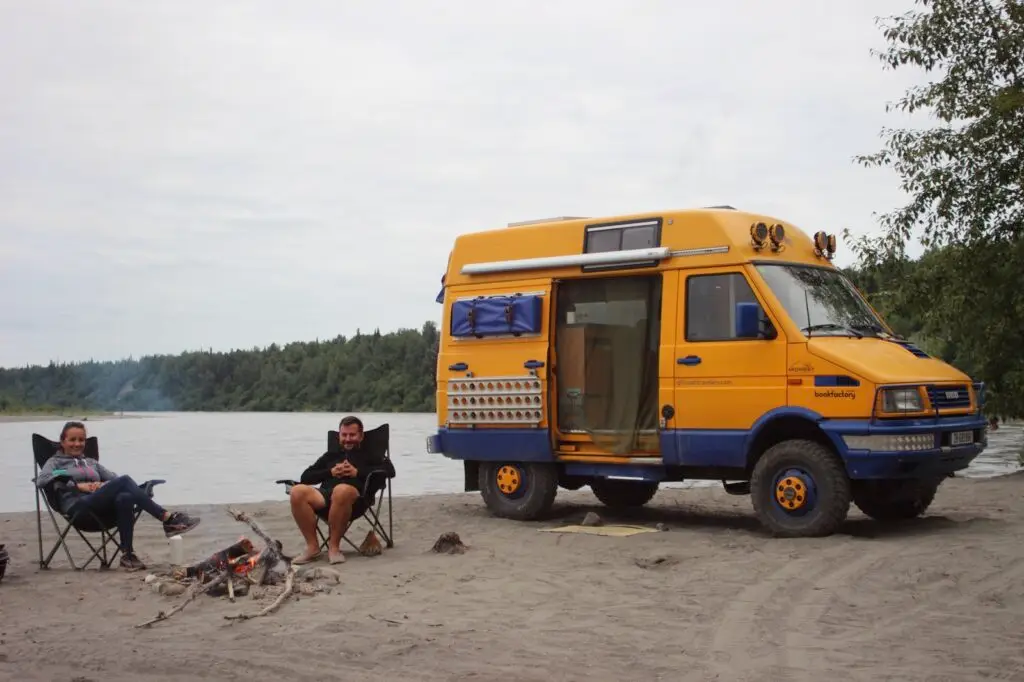
How we found our way back on track after our detour to Arizona – and discovered the most beautiful national parks along the way

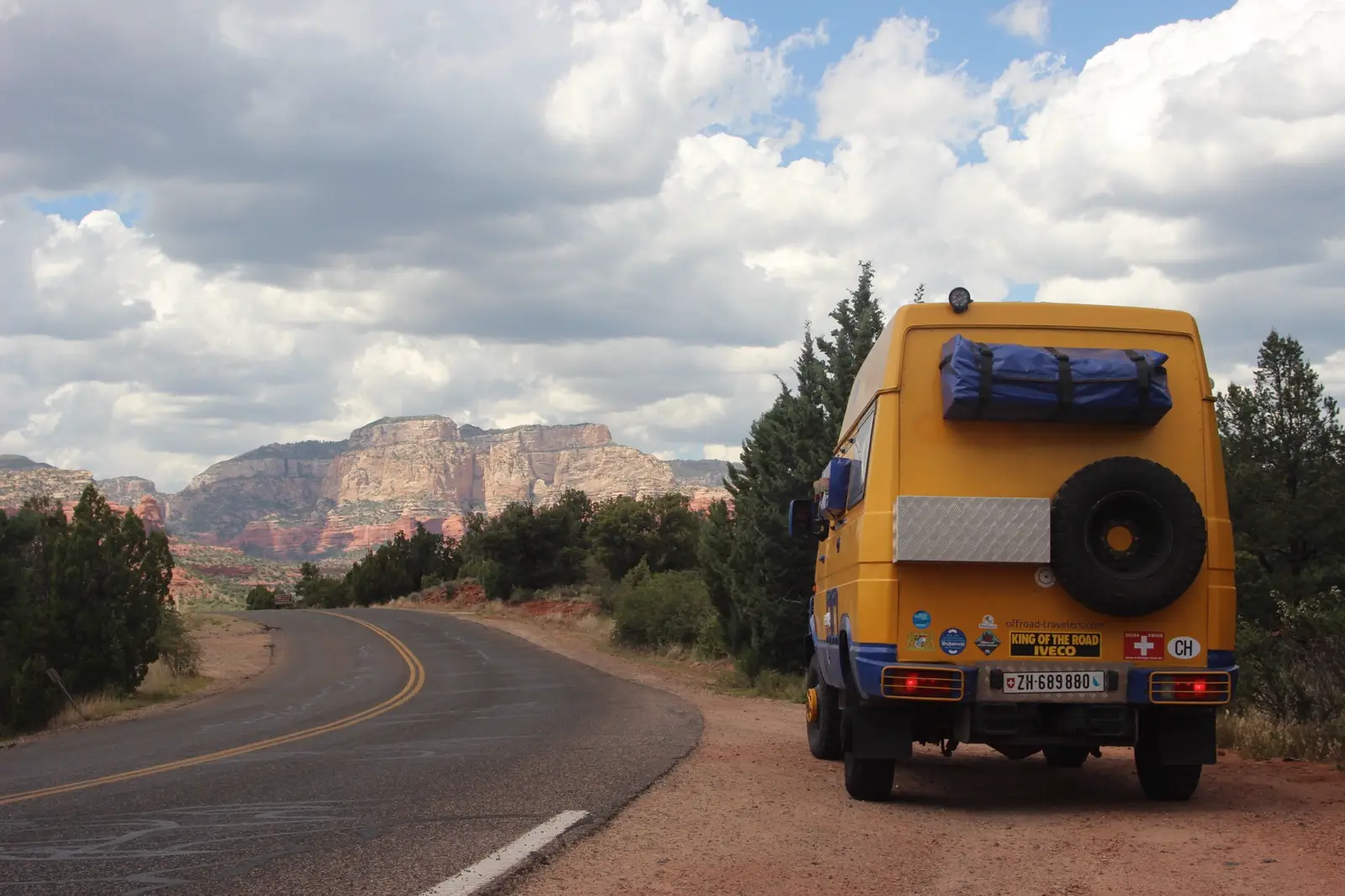
Originally we wanted to go to Alaska, but now we’re sitting in Arizona at Lake Mead studying the map to find the best route north. In hindsight our detour turns out to be a stroke of luck. Our odometer will go up by an estimated 6,500 kilometres, but in return some spectacular national parks and sights now lie on our route that we would otherwise have missed – and that really would have been a shame. We don’t even have to deviate from the route, as they’re all right on our way!

As we’re already down here, we took the opportunity to visit Las Vegas. In May it isn’t as hot here as in August or September, and we had planned the side trip to Las Vegas on the way down anyway. I’d been there once before; for Christoph it’s the first time. I think you have to have seen Las Vegas once – at least once. And as you all know: “What happens in Vegas, stays in Vegas.” So I won’t say any more about it.

Wie wir vom Umweg nach Arizona wieder auf den richtigen Weg finden und dabei die schönsten Nationalparks entdecken – Foto 9

After Las Vegas we visit the Hoover Dam, take a sightseeing flight over the Grand Canyon and camp for three days at Lake Mead before setting off again. The first national park on our route is Zion National Park. With its red, rocky earth and the green of the trees and bushes, it offers a truly impressive picture. Unfortunately it’s holiday season (end of May) and it’s incredibly busy. We decide on just one hike, and since we’re fit when it comes to mountain climbing, we choose Angels Landing. With almost 500 metres of ascent (its summit is 1,765 metres high), it’s a challenge, especially as there are warnings that you absolutely must have a head for heights.

We set off at 8 am, which turns out to be too late. There aren’t many people on the trail yet, but when we head back, whole hordes come towards us. Once you’ve made it to the furthest point of the platform at the very top – the last stretch has to be walked along a chain, which with my limited alpine knowledge I’d classify as an easy via ferrata – you look almost 500 metres straight down. No wonder you need a head for heights!

Wie wir vom Umweg nach Arizona wieder auf den richtigen Weg finden und dabei die schönsten Nationalparks entdecken – Foto 8

On the way back we meet a trembling Chinese woman clinging to the chain who asks whether it’s still far. We advise her to turn back if she’s already so scared, because it keeps getting steeper. But she doesn’t turn around and holds up the traffic. As long as you can say afterwards that you made it to the top. Still, it was beautiful up there, and for us the worst part wasn’t the height or the steep drops but the crowds.

A little outside Zion National Park, to the east, we find a beautiful, quiet spot to camp by a small stream with a sandy beach. We stay there four days to recover from all the driving and enjoy the sun. When we arrive, someone is just pitching his tent. I ask whether he’d mind if we set up camp next to him. “No, not at all,” replies Bruce, a retired teacher from Vancouver who is travelling by motorbike for a few weeks. We spend the evening together swapping travel stories over Kaiserschmarrn with fruit compote. As Bruce’s space is limited, his meals mostly consist of instant noodles and packet soups. So his first Kaiserschmarrn is a welcome change, and he invites us to visit him in Vancouver. We should let him know shortly before when we’re nearby.

Wie wir vom Umweg nach Arizona wieder auf den richtigen Weg finden und dabei die schönsten Nationalparks entdecken – Foto 7

Oh, we could have stayed forever. This place is already one of our favourite spots, not least because of the nearby Forscher Bakery, which bakes delicious rye bread in a wood-fired oven, just like in Bavaria. But our destination is Ushuaia! On the short way from Zion National Park to Bryce Canyon National Park we pass Horseshoe Bend. This impressive whim of nature lies just before Page in northern Arizona, near the Utah border. At first you only see a huge car park, from which you walk for about ten minutes through the desert until you’re standing at the edge of a cliff. Below you the Colorado River winds in a tight loop through the rocks of Marble Canyon. From above, as the name suggests, it looks like a horseshoe. Some natural wonders are so beautiful because of their simplicity, and Horseshoe Bend is one of them. The green water of the canyon between the reddish rocks, and the blue sky in the background.

From Page we book a tour to Antelope Canyon. These days the canyon can only be visited on a tour; entry without a guide is no longer possible and is also life-threatening. In a sudden thunderstorm the canyon fills with water within minutes. A few years ago a whole family died like that. So we queue with hundreds of other tourists and wait. At least we managed to get tickets, as we have a talent for always ending up at particularly popular sights on public holidays. The wait isn’t bad; we’re a fun group, and two American retired couples keep us entertained. Antelope Canyon lies on Navajo land, and a young woman leads us in. The soft light, the terracotta tones and the shapes are so warm and soft that you can hardly believe you’re walking through rock. You immediately feel at ease and don’t want to leave.

Wie wir vom Umweg nach Arizona wieder auf den richtigen Weg finden und dabei die schönsten Nationalparks entdecken – Foto 6

We spend almost an hour in the sometimes narrow passages, climbing steps up and down and being shown formations reminiscent of eagles or Native American chiefs. Not far from Page lies Bryce Canyon National Park, which shows a fascinating variety of stone and rock formations. I’d never have thought stones and rocks could be so impressive. You can drive through the whole park by car and there are spectacular viewpoints from which you can look far out over the Grand Staircase. Rocks in all kinds of shapes – towers, arches, windows – some formations look as if someone had built them. And yes, someone did: nature built them, or more precisely water, which in the form of snow, hailstorms or rain has washed out the limestone to create the most bizarre shapes. A hailstorm surprises us that afternoon too. Quite suddenly it starts to rain, and when we turn on the windscreen wipers, a white rim quickly forms. I wouldn’t have expected a hailstorm here in the otherwise barren desert landscape. The next morning we hike among the huge limestone formations.

You feel very small, even though the rock formations don’t look that big from above. But when you’re standing in the middle of them, the landscape looks completely different. Chipmunks and prairie dogs keep us company, and down there you seem to be on another planet. After a few days we reach Grand Teton National Park. It’s now early June, and it’s nice and warm during the day. There’s still a lot of snow on the peaks of the Teton Range, but down below the dandelions are blooming and we almost feel at home – except that bison graze here instead of cows. Goslings hatched here a week ago, and the meadow in front of the visitor centre is teeming with the fluffy little creatures. We hike around half of Jenny Lake, as one side is closed. Helicopters are flying building materials to higher elevations, because the heavy snow that fell so late destroyed large parts of the trails.

Wie wir vom Umweg nach Arizona wieder auf den richtigen Weg finden und dabei die schönsten Nationalparks entdecken – Foto 5

We realise how incredibly lucky we were with our detour to Flagstaff! At the visitor centre we’re told that it was still snowing heavily at the beginning of May and that this winter set an absolute record with well over 600 inches of snow – that’s 15 metres. We should be careful, because the bears are now coming out, hungrier than usual in spring, as they too had to wait for the snow to melt before they could successfully forage. The lakeshores are flooded; the meltwater is driving up the water level. We hike along the east shore of the lake and with difficulty spot a moose – or is it just a deer? – in the tall grass in the distance. Hard to tell at that distance. The weather couldn’t be better, and the sun beats down pretty hard during the day. We have to be careful not to get sunburnt. We camp just outside the national park by a lake with a fire pit, where we grill burgers in the evening and listen attentively to our surroundings. But no animal shows itself.

North of Grand Teton National Park lies Yellowstone National Park. On Thursday 8 June we reach it around midday. We drive past snowfields and marvel: it’s warm, we’re wearing shorts and flip-flops, but the snow isn’t melting as fast as it suddenly got warm. The late onset of winter is clearly visible. We’re glad we took the detour via Flagstaff, otherwise we’d have ended up here in a snowstorm at the beginning of May. The park is just waking up from its winter sleep and it’s quiet. We drive out to camp for free and find a lonely spot. A small plateau east of the park, a little higher up at the edge of the forest, becomes our place to sleep. On the way there we come across elk, bison and a herd of bighorn sheep. We haven’t seen so much wildlife on the whole trip. We quickly cook something and retreat into the car so as not to provoke any bears. It gets cool in the evening, so we watch a film on the laptop.

Wie wir vom Umweg nach Arizona wieder auf den richtigen Weg finden und dabei die schönsten Nationalparks entdecken – Foto 4

And then we see him: a grizzly lumbers from the edge of the forest along the meadow, straight towards us. Christoph says, startled: “There’s your grizzly!” I had been waiting the whole time to see wild bears. The bear sniffs around the car, so close that I can no longer see him. He can apparently smell the grey water we tipped out 20 metres away. Grizzlies have an extremely good sense of smell – they say over two kilometres. He scrapes at the ground, finds nothing and briefly looks in at the window, where Christoph is just looking out. Unimpressed, he walks over to where we tipped the water, finds nothing there either and disappears into the undergrowth. Our first grizzly! Christoph won’t forget this encounter.

The next day we drive back into the park and see geysers that erupt at certain times. The colours of the geyser basins are a spectacle in the sunshine; steam rises everywhere. The landscape seems alien, almost like another planet. We walk through the park on boardwalks and bridges, as the surface is too dangerous and fragile. We hike to a small waterfall; at the end of the trail a family of marmots has its burrow. The young come out curiously, even though we’re sitting close by. The mother isn’t there, but you can hear her whistling to warn the little ones when they stray too far. That night we leave the park through the north-west exit and find a place to sleep by a small stream. Early the next morning we return; deer, stags and fawns are still sleeping in the meadow in front of the Albright Visitor Center. They know they’re safer from wolves and bears there. We don’t see any wolves, but we do see lots of bison herds, deer, elk, bighorn sheep and bears with cubs.

Wie wir vom Umweg nach Arizona wieder auf den richtigen Weg finden und dabei die schönsten Nationalparks entdecken – Foto 3

It’s spring. Our last national park in the USA is Glacier National Park. It’s a bumper year for bears, we’re told. The mother bears are finding plenty to eat and raising most of their cubs. At the end of June everything is in bloom and there are lots of berries. On our first day in Glacier National Park we see a female grizzly with a cub. They cross the road leading us out of the park. The cub, probably born in spring, stands curiously at the roadside, rears up on its hind legs and then follows its mother. The female wears a collar and is monitored by the national park. Once on the other side, they carry on eating. The cub peeks out curiously from behind the grass, almost like a baby panda with black rings around its eyes. In the car opposite a dog barks; the cub stretches up even more, the mother remains unimpressed and moves on. That was an exciting day – seeing a grizzly with a cub for the first time. We’re glad to be in the car, as grizzlies with cubs are considered aggressive. The next morning we’re back in the park early, want to do a four-hour hike and have bear spray with us. It’s like pepper spray, only stronger, and is supposed to disorient the bear in an emergency if used correctly.

The weather is glorious, and we plan a hike to Iceberg Lake, 16 kilometres there and back in total. The narrow path leads through forests and over flower meadows, gets steep in places, and at the end we cross a snowfield. The panorama at the lake is impressive – and icy. On the way we meet Lynn, an older woman who is hiking the trail for about the hundredth time. She lives near the park and has been observing the grizzlies for years. She tells us about a female grizzly called Panda, whom she has been observing in the national park since her birth. Panda now has cubs of her own, and Lynn plans to write a book about her. I mention that we saw a female bear with a cub the day before that looked like a panda, and that we took photos. Lynn, whom we guess to be in her mid-seventies, is thrilled and asks for the photos. We exchange mobile numbers, and as soon as we have internet I’ll send her the pictures.

Wie wir vom Umweg nach Arizona wieder auf den richtigen Weg finden und dabei die schönsten Nationalparks entdecken – Foto 2

On the way to the lake Christoph spotted red-capped boletes but didn’t want to take them so as not to squash them. On the way back we find them again, because Americans rarely pick mushrooms. We buy toast at the park kiosk and ask the restaurant for some cream so we can cook creamy mushrooms with bread dumplings. At the edge of the forest outside the park we prepare our dinner. The next morning we drive via Chief Mountain to the Canadian border and Waterton Lakes National Park. The route passes snow-covered mountains and blooming meadows. The border lies alone in the middle of idyllic nature, and I wonder how often a bear passes by here. Once in the park, we pick up the free annual pass, as Canada is celebrating its 150th birthday. We save 140 Canadian dollars and plan to hike to Upper Rowe Lake early the next day. Today we only take two short walks and get told off by an irate squirrel – we probably entered its territory.

We spend the night outside the park to save money and find a quiet farm track. The next morning we get up early to see animals and are the first in the car park. With sturdy mountain boots, bear spray and a bell, we set off. Christoph rings the bell wildly to warn bears, which nearly drives me mad, as I have good hearing. When we find fresh bear droppings, the bell rings even louder. The bear is certainly not far away; it’s probably hiding and hoping we’ll disappear soon. The Upper Rowe Lake Trail gets steep and snow-covered, so we have to turn back. On the way back we make a detour to Lower Rowe Lake and rest on the shore. The snow is thawing, and you can see how deep it was in winter. We see few animals, just birds and squirrels making a lot of noise.

Wie wir vom Umweg nach Arizona wieder auf den richtigen Weg finden und dabei die schönsten Nationalparks entdecken

Back at the car park we pack our things and drive to the visitor centre. On the way we spot a big brown black bear eating dandelions. We stop and I take photos. Only when a dog barks does the bear become alert, but it stays calm. It only has half a year to eat, so it thinks carefully about how to use its time. Yes, there are brown black bears, which we had to learn first. You can recognise grizzlies by the hump on their shoulders and their size. Our detour ends here, and the next national parks, Banff and Jasper, are on our list.

The Overland Expo West in Flagstaff, Arizona

USA & Kanada – Foto 28

As we’re up for all kinds of adventures and it usually doesn’t take much persuading, we promptly set off for Flagstaff! First, though, we continued west, as we had to wait for an answer. The pitches at the campground at Fort Tuthill in Flagstaff, where the Overland Expo takes place, were fully booked, so we had to get creative. We searched the website and signed up as volunteers at the last minute. When the message came that we could look after the showers for four hours on each of two days and in return camp for free right next to the showers – how handy – we immediately agreed and changed course. After all, this is supposed to be the biggest show for overlanders in the USA, and we expected great things. Something like the Abenteuer & Allrad in Bad Kissingen, only much bigger – but more on that later!

Die Overland Expo West in Flagstaff Arizona – Offroad Travelers

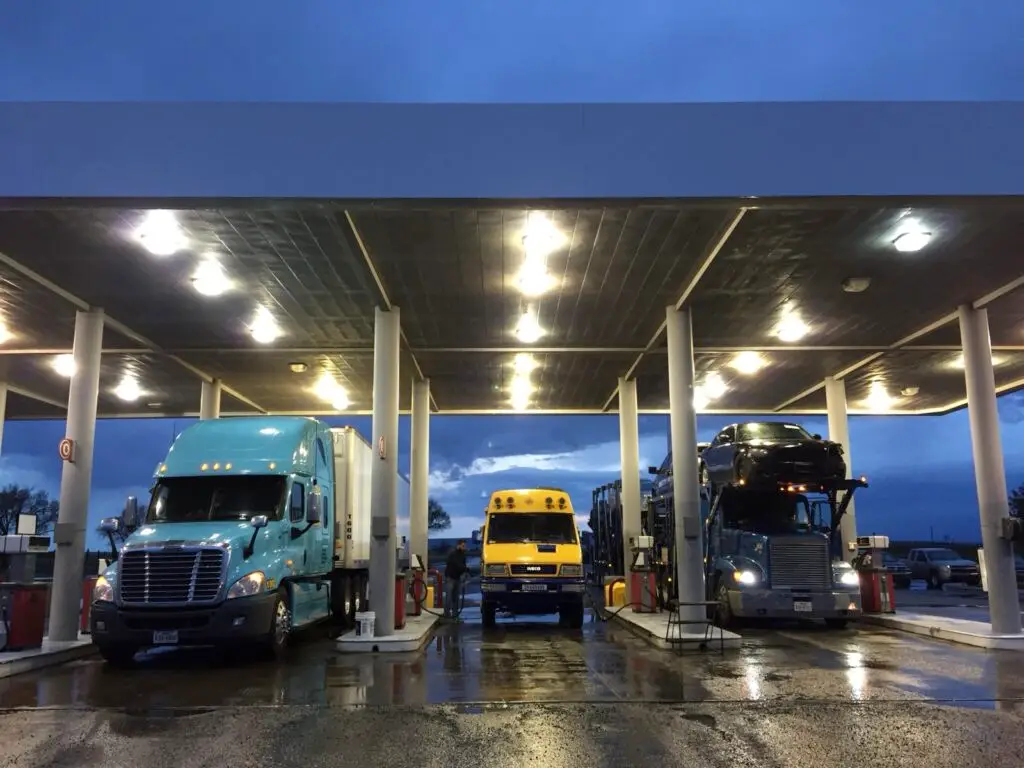
After three and a half days of driving, overnight stays at truck stops between huge lorries, crossing about five climate zones with temperatures between zero degrees (Colorado) and 36 degrees (Nebraska), and an express order for business cards in Albuquerque, we reached Fort Tuthill in Flagstaff, Arizona, around 3 pm on 11 May. We were a little surprised: almost nothing had been set up yet, the site was relatively small, and the organisation was – I won’t say bad, but let’s call it minimal. We were curious … Maybe as Germans and organised people we just have too high expectations?

The Overland Expo was founded by travellers as a place to exchange experiences. At the beginning it was just a meeting of a few vehicles, similar to various meetings back home like the Pritz or Därr meetings. It first took place in 2009. Now there’s an Overland Expo West, held every May in Flagstaff, Arizona, and an Overland Expo East in Asheville, North Carolina, which always takes place at the end of September. This spring there were more than 250 different exhibitors in Flagstaff. From vehicle converters and 4×4 rental companies to accessory sellers, everything was represented. There was also a huge offering for motorcycle travellers and numerous courses, for example on how to navigate a rock field or recover your vehicle when something has gone wrong. A Land Rover course (similar to the one at Abenteuer & Allrad in Bad Kissingen), film talks and much more rounded off the programme. I’d say the range of courses and talks is richer than in Bad Kissingen.

Die Overland Expo West in Flagstaff Arizona – Foto 3

What we also noticed was that road traffic laws in North America are MUCH more relaxed than in Germany or especially Switzerland. You see off-road vehicles here that are jacked up so high you can hardly get in. Back home something like that would never get approved, but here in the USA it’s apparently no problem!

But it will certainly take a few more years before the Overland Expo reaches the size of Abenteuer & Allrad in Bad Kissingen. I’m not even sure it ever will, because the community in Europe is constantly growing, as you can see from the camping area in Bad Kissingen, which grows every year. What both shows have in common, though: the most interesting part is the camp area. You’ll find all kinds of vehicles and types of travellers. In the USA there are still fewer exotic vehicles than in Bad Kissingen, but I think that will change in the future, as Americans are very interested in exotic off-road vehicles like the ones we’ve had in Europe for decades. Some long-distance travellers from all over the world are even specially invited to show their vehicles and talk about their travels. We met many of these travellers and keep in touch with one or two of them. You meet up when you happen to be travelling in the same area. Among them were many Swiss, but also Germans, some of whom have been on the road for many years. Only when you move in this scene do you realise how many people travel the world by vehicle. For example, we met a Swiss couple who spent seven years in their Land Cruiser on every continent on earth. There were also travellers from South America and South Africa. For me, though, the most exotic were a Turkish couple travelling the world in a self-converted Sprinter. And there was even another Iveco, much younger than ours and much more comfortable – but for the first time we weren’t alone.

Die Overland Expo West in Flagstaff Arizona – Foto 2

This show definitely has potential for development, and we’re sure it will grow considerably in the coming years. For us, though, Abenteuer & Allrad is definitely more interesting – and the Americans apparently see it the same way, because everyone here knows the European counterpart and dreams of going there one day.

After four exciting days, countless interesting encounters and hours of sometimes very good conversations, the show closes its doors. It’s time to set off and pick up our originally planned route again (more or less, at least), because what we’ve learned from this exercise is that a plan usually doesn’t last longer than 24 hours before it’s replaced by a new one …