Border Crossing from Panama to Costa Rica at Paso Canoas

Berichte Zentralamerika – Foto 6

The fastest border of our trip so far

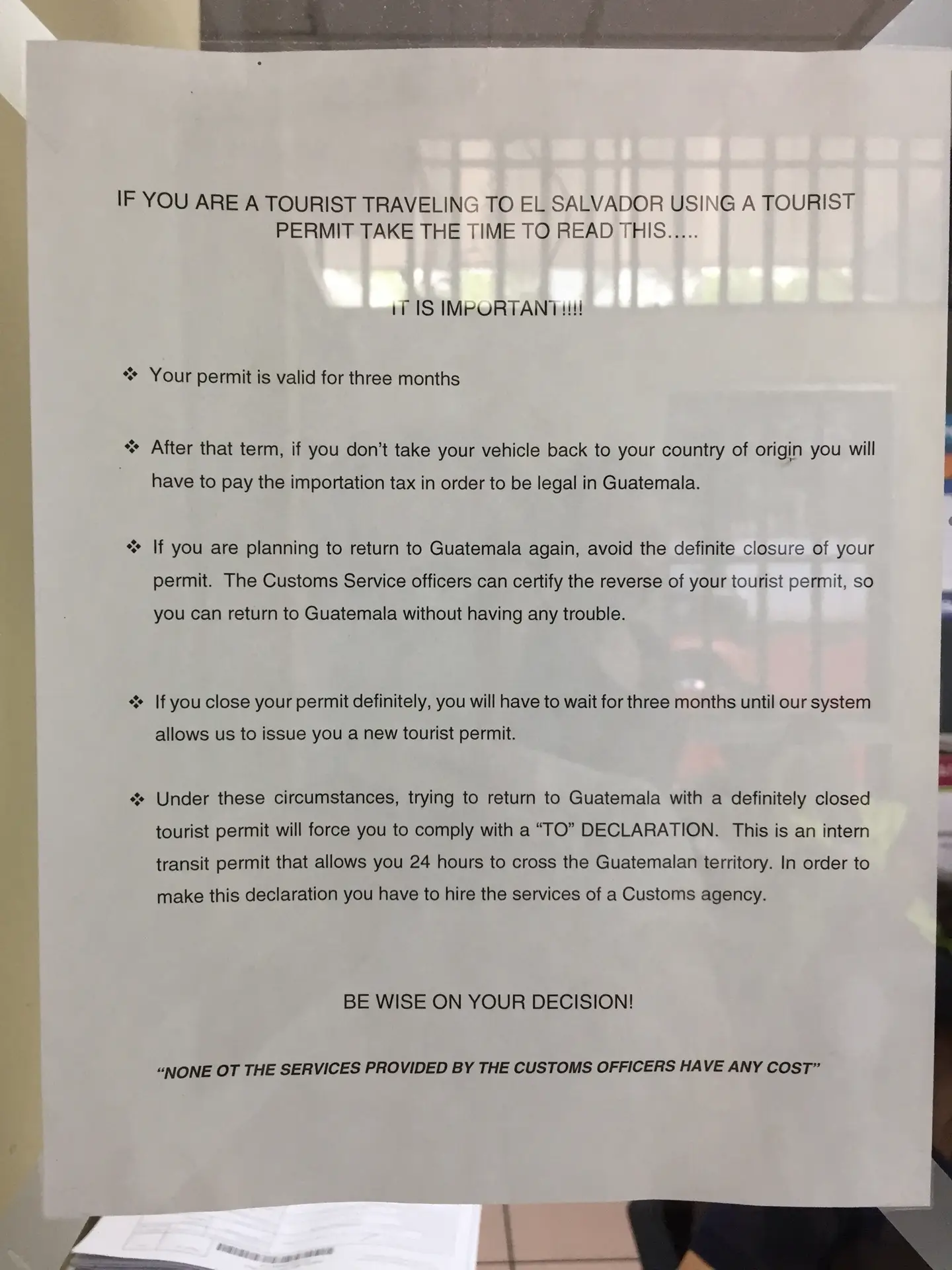
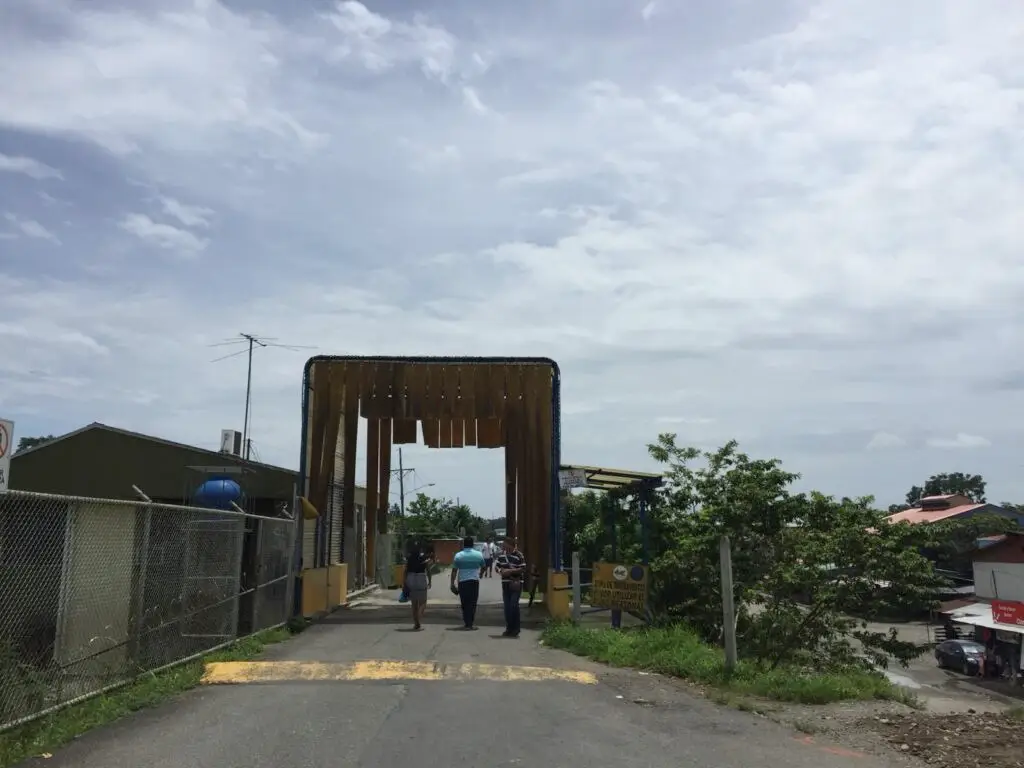
On 15 June 2018 we drive up under the arch and park in the left lane as the front vehicle at the red line. A friendly and helpful official border helper explains what to do. I ask whether there’s a waiting period if we export the vehicle now and want to come back, as we don’t yet know whether Nicaragua will let us in. He makes enquiries for us so that we definitely won’t have any problems and says that the TIP then simply starts again from scratch and there’s no waiting period. So at this time Guatemala is the only country in Central America where you mustn’t close the TIP if you want to return within three months; you have to suspend it and reactivate it on re-entry.


He sends us to the customs counter, where we get a stamp on the TIP. Then he and a colleague take a look at Muggl, sign the stamp and send us to immigration, where we have to check out. A photo is taken of us and our fingerprints are taken. With the exit stamp we have to go back to customs; the official checks Christoph’s passport and keeps the stamped TIP form. That was quick, even though we went to the toilet in between.

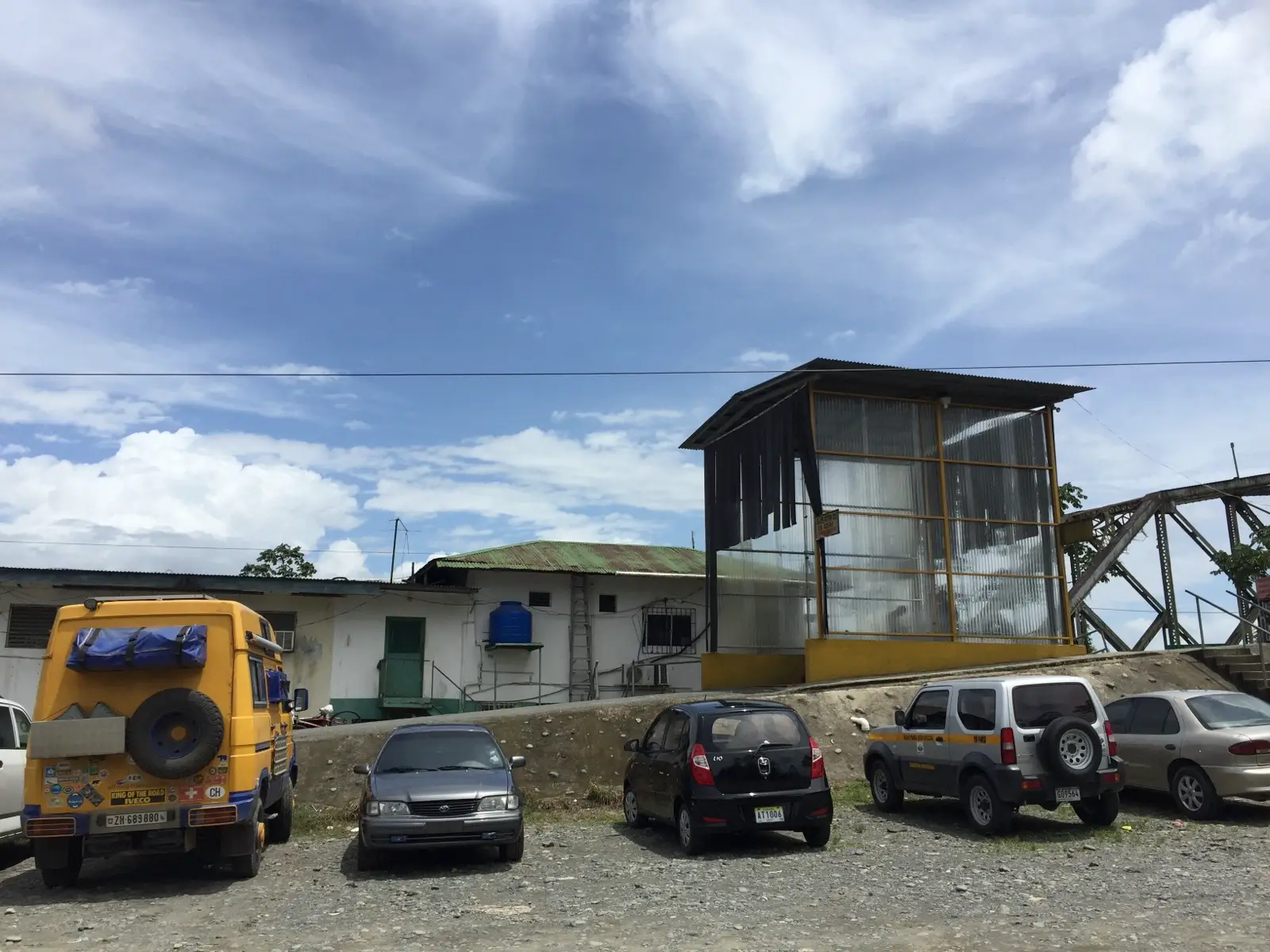
On to Costa Rica. Between the borders there’s a fumigation station, and although nobody signals us to drive there, we do it anyway. We don’t want anyone running or shouting after us. The man notes our number plate, signals that we should close the windows, and Muggl is deloused once again. It costs nothing. Right after that there’s a green building on the right – it doesn’t look like it, but it’s the border. All around are no-parking signs, and we’re wondering what to do when a volunteer border helper signals that we should park in the no-parking zone. There’s no point even trying to understand it.

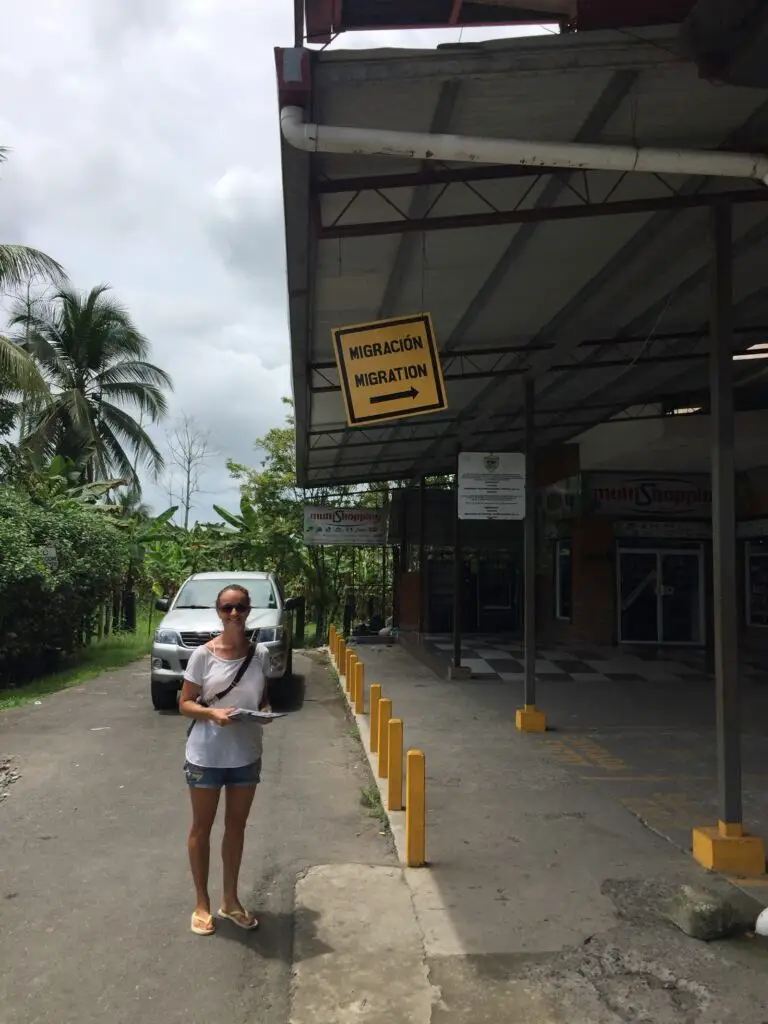
It’s not easy to tell the volunteer border helpers from the official ones. The volunteers, if they’re fair, identify themselves beforehand by saying they’ll help us for a tip or a regalo (gift). After almost 20 border crossings on this trip we no longer need help. At first it was a bit tedious, but that’s the only way to learn and remember how it works. We march to immigration and check in. On our last entry Costa Rica asked for a return flight ticket, but it’s enough to say you’re travelling in your own vehicle. This time the official didn’t even want to see the vehicle registration. We get our stamps and have to go round the corner, somewhat hidden, to customs to reactivate the TIP. Because even though we wouldn’t have had to suspend the TIP when leaving Costa Rica, we did it anyway and are therefore faster now. For that we have to fill in the application form and an import slip. He wants to see the insurance certificate, which we still have from last time. He checks the VIN and takes a quick look inside Muggl. A quick look in the fridge – nobody had looked in it for a long time, and because we hadn’t even thought about it any more, we had gone shopping the day before. But apparently we didn’t have anything forbidden with us. A short “listo” and the official has disappeared again. Total: 50 minutes including a toilet break! But that’s also because we only had to reactivate the TIP and already had the insurance.

Border Crossing from Nicaragua to Honduras at Guasaule

Berichte Zentralamerika – Foto 4

Nicaragua to Honduras at Guasaule

On Saturday 23 June 2018 we actually didn’t want to cross here again – entering Nicaragua had taken so long back then, and the good 3.5 hours are still all too fresh in our memory. But it’s now the shortest route out of the country, and since we’re still travelling with Aiden and Joanna, we decide to take the shortest and least complicated route. As so often, we drive past a long queue of lorries and join the line just before the faded light-blue “Bienvenidos” (welcome) arch. Lorry drivers are very patient people, and in Central America they have to be. An inspector at a small hut wants to see our passports and the TIP. We park on the right, once again in front of the light-blue building that houses immigration and customs – let the ordeal begin!

Of course we first get the wrong queue and are sent to the other end of the room, just like at the supermarket, where you always pick the slowest line. Fortunately the queues aren’t long and things move quickly. Somehow everything seems better organised today, and more booths are staffed. We pay $4 and are checked out in the system – unfortunately there’s no stamp. Next we have to find a vehicle inspector again, which turns out to be easy this time, because like last time he’s wearing a light-blue polo shirt with an orange high-vis vest. As we get closer, we recognise him as the nice man from back then who inspected Muggl when we entered. A police officer comes along, and they take a look inside the car, including the cool box. The police officer takes notes, and in a few minutes we’re done.

As always, the last stop – customs, where we stamp Muggl out – is back in the building. The woman this time is very friendly, and we’re done quickly here too. We can hardly believe it and wonder whether we’ve forgotten something, but after 45 minutes everything is done. On the bridge between the borders, a young woman from the tourist office briefly asks us about our travel plans: which regions we want to visit, what activities we’ve planned, where we intend to stay overnight, how long we want to stay and finally how old we are.


The Honduran side of this border is very run-down. A huge gravel area with potholes so big that a mid-size car could disappear in them lies opposite the immigration building. Everything is crammed with lorries, so we have to park there too. As soon as we drove in we were besieged by border helpers who want to help us with the paperwork, and young lads who probably want to become one some day offer to watch our cars – all for a propina (tip), of course. We politely decline, say we have a dog who keeps watch, and join the long queue in front of the officials’ booths. It goes quickly; a young official deals with us, and after about 20 minutes we’re done here.

Customs, where we get the papers for Muggl, is at the back of the row of booths. Without us noticing, Aiden has already wangled something, and we don’t have to queue there but are waved into an office behind the booths. A woman sits at a desk there and greets us kindly. Here we all do the TIP for our vehicles. She needs two copies each of the vehicle registration, Christoph’s passport and driving licence, and fills in a form. Finally she stamps Christoph’s passport. We also have to pay $35 for the three months (there’s nothing shorter). We’re back in the land of copies. Next I have to make copies of the form she issued (1x) and of the stamp in Christoph’s passport (2x) in a small hut opposite the building. Getting there is like running the gauntlet, as I have to pass through three rows of lorries queuing towards Nicaragua, cross the car park and dodge countless puddles. When I get back, she takes the copies and hands us our TIP. Oh, it would often be so much easier if they just put a photocopier in there. In Honduras car insurance isn’t compulsory, so we don’t even bother looking for an insurance office – that would be a waste of time, we’ve learned that much. Total time: surprisingly only about 1 hr 40 min.

Border Crossing from Costa Rica to Nicaragua at Peñas Blancas

Berichte Zentralamerika – Foto 5

Costa Rica – Nicaragua at Peñas Blancas

On 21 June 2018 at midday we meet Joanna and Aidan, our compañeros with whom we want to travel through Nicaragua, in La Cruz, 20 km before the Nicaraguan border. At 12:15 pm we arrive at the border and first have to pay our $8 tourist tax at a small kiosk to the right of it. Then we pass the queue of lorries that has formed on the right past the border and park opposite the immigration building, where we check out of Costa Rica. There we can also make a copy of the TIP straight away and then – how could it be otherwise – have to go 300 m back to the building where we got the insurance and the TIP when we entered. At the same counter the reactivated TIP is suspended again, as we don’t yet know whether Nicaragua will let us in and out again to the north, or whether in the worst case we’ll have to come back. But that’s all no problem; the woman at the counter is very nice and quick, so we’re back outside after a few minutes.

Costa Rica - Nicaragua bei Peñas Blancas – Foto 2

Off to Nicaragua – but first, as always, we have to pass the last Costa Rican, who is usually positioned a few metres from the border and checks that we really have done everything and have every stamp. We get closer to the Nicaraguan border; a man wants to see our passports and explains that we now have to drive through the fumigation, then park on the left and pay for the fumigation in the building next to customs. All clear! It’s not so confusing for us here because we’ve been here before. By chance we park exactly where we parked last time and go to immigration first. A more or less friendly, plump young woman first has to plug in her mobile phone and then rummages around under the desk. She asks for our passports, asks (mumbling heavily) what we do for a living and at which border crossing we want to leave. We don’t know the latter yet, because we don’t yet know how and where we’ll get through the country. We pay $24 and are now officially in crisis-hit Nicaragua.

Costa Rica - Nicaragua bei Peñas Blancas – Offroad Travelers

Now it’s Muggl’s turn. Behind the building we stop at the seguro (insurance) counter. A woman is interrupted in her crocheting, and the insurance certificate for 30 days and $12 is quickly issued. As we’re already on the other side of the building and there was no vehicle inspector in sight at the front, we immediately look for the person we have to pay the fumigation to, but the counter is empty. We ask the woman next door, who sits at customs, and she says he should actually be there. She comes out from behind her desk, goes to the fumigation counter and knocks hard on the glass. A man in the glass booth jumps up, and all four of us are very amused, as we’ve already walked past it three times. The fumigation costs $3, and the sleepy man issues the corresponding document.

Now comes the hardest part: we have to find the vehicle inspector, but once again there’s nobody there. People are very helpful; someone says he’ll look for him for us, someone else says he’s on his lunch break. Well, those are the best conditions! But after about 15 minutes someone actually comes to us with the vehicle inspector in tow. He first hands us a piece of paper and turns around again. I just think: “Nooo, please don’t go away!” I fill in the form, and luckily the inspector is back. He takes a quick look at Muggl from outside and then asks if he can get in. Sure, we have nothing to hide. A brief look is enough for him; he asks whether we have a drone, which we deny, and we’re sent off with a “Buen viaje”. Now just customs, where we have to show the insurance, passport and driving licence and finally get Muggl’s TIP. Total: 2 hrs 15 min. Totally relaxed, and no sign at all of the unrest in the country.

Border Crossing from Honduras to Nicaragua at Guasaule

Organisation & Planung – Foto 4

Checking out of Honduras goes smoothly. We park our vehicle in front of a blue building where it is checked out. On the other side of the road we get our exit stamp at immigration. After just 15 minutes everything is done, and we continue towards the bridge. A lorry driver waiting in the queue advises us to simply drive past. That means we first have to cross a small hill and switch to the oncoming lane so we don’t have to wait. An official in front of the bridge checks that we’ve completed all the formalities and that our documents have the exit stamp for us and our vehicle, Muggl.

The Nicaraguan side seems chaotic – and it is! First a gatekeeper gives us a declaration document, which is important so that you don’t have to go back to the very start of the queue. An official checks our passports, followed by a female official who asks whether we applied for anything beforehand. We say no, as we didn’t know about anything. Next we go to fumigation, where we pay three dollars and Muggl gets sprayed a little.

Now it gets really exhausting: at immigration we’re dealt with straight away, but need various copies: two of the passport photo page, two of the page with the Honduran stamps, one of the vehicle registration and one of Christoph’s driving licence. We get the copies quickly in a small copy shop opposite. We bring our papers back, hand over our passports and wait. After half an hour another official comes back with our documents and complains that the copies are too small. We had copied both passports on one sheet and cut the pages apart to save paper. In the end he accepts it, but we copied the wrong stamp page of Christoph’s passport, so back to the copy shop.

When I come back, the official is still sorting the papers and staples Christoph’s and mine together separately. Then the questioning begins: occupation, marital status, age, vehicle make and type, colour and number plate, how much cash we have on us (after deducting the immigration fee, 26 dollars), how long we want to stay, where we’re going in Nicaragua and where afterwards. He even wants to know when we left Germany, when we entered the USA and how long we were there. He notes everything on the copies of our passports – now I understand why he wanted so many pages!

After the interrogation he disappears behind a glass door with all the documents, including our passports. He points out our passports to a colleague, who just shrugs. We feel like the first Germans ever to enter Nicaragua – there’s no recognisable system! At some point he comes back with a new form, sits down in an empty customs booth and fills it in. I suspect he’s transferring the answers he first scribbled on the copies of our passports onto the form.

15 minutes later he leads us outside and points to an elderly gentleman in an orange high-vis vest who will inspect our vehicle together with a police officer. He says we’re almost done – I don’t believe him! We wait another 10 minutes until the gentleman is free. At least he has a sense of humour – the first person with a sense of humour we’ve met today. He doesn’t want to check the chassis number; he and a young police officer who has joined us in the meantime are curious. I open the sliding door, the elderly gentleman looks around and asks: “What’s that lying in the hammock?” We have a little pink pig in a hammock above the bed. I say: “Oh dear, it doesn’t have a passport.” He laughs. They want to know whether we have a drone and look at my camera. They ask what Christoph does for a living and whether we’re reporters. The police officer looks in the cool box and the wardrobe and wants to look in the bag under the seat where the Dutch oven is stowed.

Inspection done, but far from finished. 1.5 hours have passed since we first went to make copies. During the waiting times, when the official kept disappearing with our documents, I wrote this report. We went to get money twice, once córdobas and once US dollars – better not tell him that, it would mess up all his notes. We wait another 20 minutes until the official we first saw finally processes our immigration. We pay 24 dollars (12 dollars per person) and after 3 hours we’re done! Wait, no, we still have to go to customs to check Muggl in and to the station where luggage is normally scanned, and explain that we have no luggage.

Grenzübertritt Honduras nach Nicaragua bei Guasaule – Offroad Travelers

Done? No, because for Nicaragua, unlike Guatemala, El Salvador and Honduras, car insurance is compulsory again. So off to the neighbouring building, where the bank is. There the insurance clerk has simply moved her office outdoors and sits at a small table in the shade. It takes 5 minutes to issue the insurance certificate, and for 12 US dollars it’s valid for 30 days.

Total time: 4 hours and 15 minutes, 3.5 of them at the Nicaraguan border.

Border Crossing from Guatemala to Mexico at La Mesilla

Berichte Nordamerika & Mexiko – Foto 6

The most adventurous border crossing awaits us: narrow and getting narrower towards the immigration building. La Mesilla is like a huge marketplace. We arrive at 12:36 pm. A friendly official in a blue polo shirt with an embroidered SAT emblem greets us. He tells us to go to customs first and asks whether we want to return to Guatemala. We say no and remove the sticker from our windscreen, where it had been stuck until today. We stick it on the back of the SAT form, which is stamped and kept at customs. He isn’t interested in Christoph’s passport. Then it’s off to immigration, where our passports are stamped. At the check, the official asks about whisky and tobacco. I say we don’t like whisky and we don’t smoke. That’s not even a lie, and Christoph only smokes now and then. Still, he wants to look in the car, checks the cool box and looks in the cupboards. He doesn’t get in; it’s enough for him that I open the cupboards and explain what’s inside. Then, as always, there’s fumigation right in the middle of the market bustle. This time Muggl is only sprinkled with a pressure-washer-like device, for which we pay 50 quetzales.

Grenzübertritt von Guatemala nach Mexiko bei La Mesilla – Offroad Travelers

At 12:56 pm, after 20 minutes, we leave town and drive the 3 kilometres to the Mexican border. But there the official sends us back first. The exit stamp has the wrong date: today is 10 July, not 10 June! Damn! Not paying attention once – but it was bound to happen at some point.

So back into the hustle and bustle. We look for a parking space, but we’re refused the half-empty taxi car park. No amount of explaining helps. In the time spent negotiating we could easily have walked to immigration and got a new stamp. I walk down the street to the friendly old traffic guide who had waved us towards the edge of town earlier. He understands immediately. We park at the back entrance of a supermarket, which is presumably a loading zone otherwise.

At immigration the clerk is very embarrassed. He apologises several times for his mishap. The wrong stamp is declared invalid and a new one goes in. Well, that was easy. Now it’s time for a taco break!

Grenzübertritt von Guatemala nach Mexiko bei La Mesilla – Foto 2

At 2:45 pm we’re back at the Mexican immigration, and with us a minibus. Of course. I wonder how many people fit in a minibus. We wait a good 35 minutes until it’s finally our turn and then get the classic customs form to fill in. At least afterwards we don’t have to go to the back of the queue again, but are waved in between. Then a quick trip to customs to ask whether anyone wants to see Muggl’s import permit. The official explains that he can simply drive in and out for 10 years, as often and whenever he likes. For that he got a sticker on the windscreen when he first entered. Well, he has it easy!

At 3:26 pm we’re finally done and set off for San Cristóbal de las Casas. Almost, anyway, because we don’t get far. The first military checkpoint is waiting for us just three kilometres after the border. Oh, how we’ve missed that. “Revisión del vehículo,” they say, and I patiently open the sliding door. It’s broken, I say, and the curious Mexican helps me lift it. Yes, they’re curious, the young soldiers, but also very polite. His colleague gets in and looks around. He carefully opens the wardrobe and carefully closes it again afterwards. Still, this military check seems more serious than the ones we had on Baja so far. Two soldiers walk around the checkpoint with dogs, and as we drive on we see a stinger lying at the end of the barrier.

Total time without the military check: 2 hours 45 minutes, but including a taco break. If the official on the Guatemalan side hadn’t set his stamp wrong, this could have been our fastest border crossing.

Border Crossing from Guatemala to El Salvador at La Hachadura

Organisation & Planung – Foto 5

On 8 May 2018 we reached the La Hachadura border crossing from Guatemala to El Salvador. Even from afar we could see the chaos that awaited us. We had read that you should simply drive past the lorries. So we passed the roughly three-kilometre-long queue of lorries and reached the Guatemalan border. There we checked out and made copies of the stamp in Christoph’s passport and of Muggl’s Guatemalan temporary import permit (TIP). Luckily the copy shop was right opposite.

In the office of the SAT, which is responsible for the temporary import of vehicles, I explained that we wanted to suspend Muggl’s permit, as we would be travelling through Guatemala again on the way back. Cancelling the permit or letting it expire would have meant a three-month ban on re-entry. At the counter an employee checked our documents and asked us to wait. As all the seats were taken, we stood for half an hour. With no recognisable system, we were finally called. A female official, who seemed grim at first, dealt with us, checked Muggl’s number plate and chassis number and suspended the permit.

Grenzübertritt von La Hachadura Guatemala nach El Salvador – Offroad Travelers

On we went to check in to El Salvador. The barely one kilometre between the border offices was full of lorries squeezing across a two-lane bridge. As there was oncoming traffic from El Salvador, we had to slot in between the lorries. Meanwhile we chatted with the drivers and learned that a crossing further north would have been faster. We were surprised, as we were the only car.

When we finally arrived, we passed a barrier that represented the official immigration, as there are no more stamps. The CA-4 countries Guatemala, El Salvador, Honduras and Nicaragua issue a joint 90-day visa, which speeds up border processing – except for vehicles. Because of Muggl we had to go to customs and fill in a form that was only available in Spanish. Fortunately we were given a sample form that helped us understand the questions. Here too the official wanted to see Muggl and checked the details on the form, including number plates and chassis number. He even looked for the model designation, which wasn’t recorded, but showed a will to check thoroughly. Then he entered everything into the system, which took another 15 minutes.

Finally we checked the details, and after a good three hours in total we were finally done.

Driving Through the Nicaraguan Revolution

Zentralamerika – Foto 26

Rain, rain, rain ...

The incessant rain slows our drive through Costa Rica towards the Nicaraguan border. We still have 150 kilometres ahead of us and are making only slow progress. Finally we spot a small roadside restaurant and take the opportunity for a break. The owner kindly directs us to park under the canopy so we stay dry getting in and out. We order something to eat and hope the rain will ease. But it doesn’t get any better – it’s pouring buckets, no, bathtubs, torrents, whole waterfalls. At this moment we think of a friend who is also travelling in Costa Rica and assured us a few days ago: “The rainy season here isn’t that bad at all.” I wonder whether he’ll change his mind after this night.

Meanwhile the animals are also seeking shelter in the restaurant: grasshoppers, spiders, geckos – everything is fleeing the rain. The English say “it’s raining cats and dogs”, but in Costa Rica you could safely say “it’s raining elephants and hippos”. It really beats everything we’ve experienced so far. Eventually we can finally drive on and reach La Cruz around 11:30 pm, only 20 kilometres from the Nicaraguan border. We had actually wanted to be here six hours earlier.

Regen, regen, regen ... – Foto 2

But it wasn’t only the rain that held us up. Customs had delayed our onward journey by refusing to release the spare part we had ordered from Germany. Express shipping or not, the Costa Ricans couldn’t have cared less! The parcel sat at customs for over a week, and Manuel, who works at the Iveco garage in San José and is responsible for import and export, had to go to the customs office five times before he finally got it.

Our ignition lock had been causing problems again and again for some time. Sometimes we couldn’t switch Muggl off, even with the key removed. As we didn’t want to break down somewhere in Nicaragua, we decided to replace it. In the end it worked out at the last minute: 20 minutes before our deadline, Manuel arrived beaming with the parcel. Fitting it took only about 15 minutes. Crazy really – days of waiting and then the part is replaced in 15 minutes!

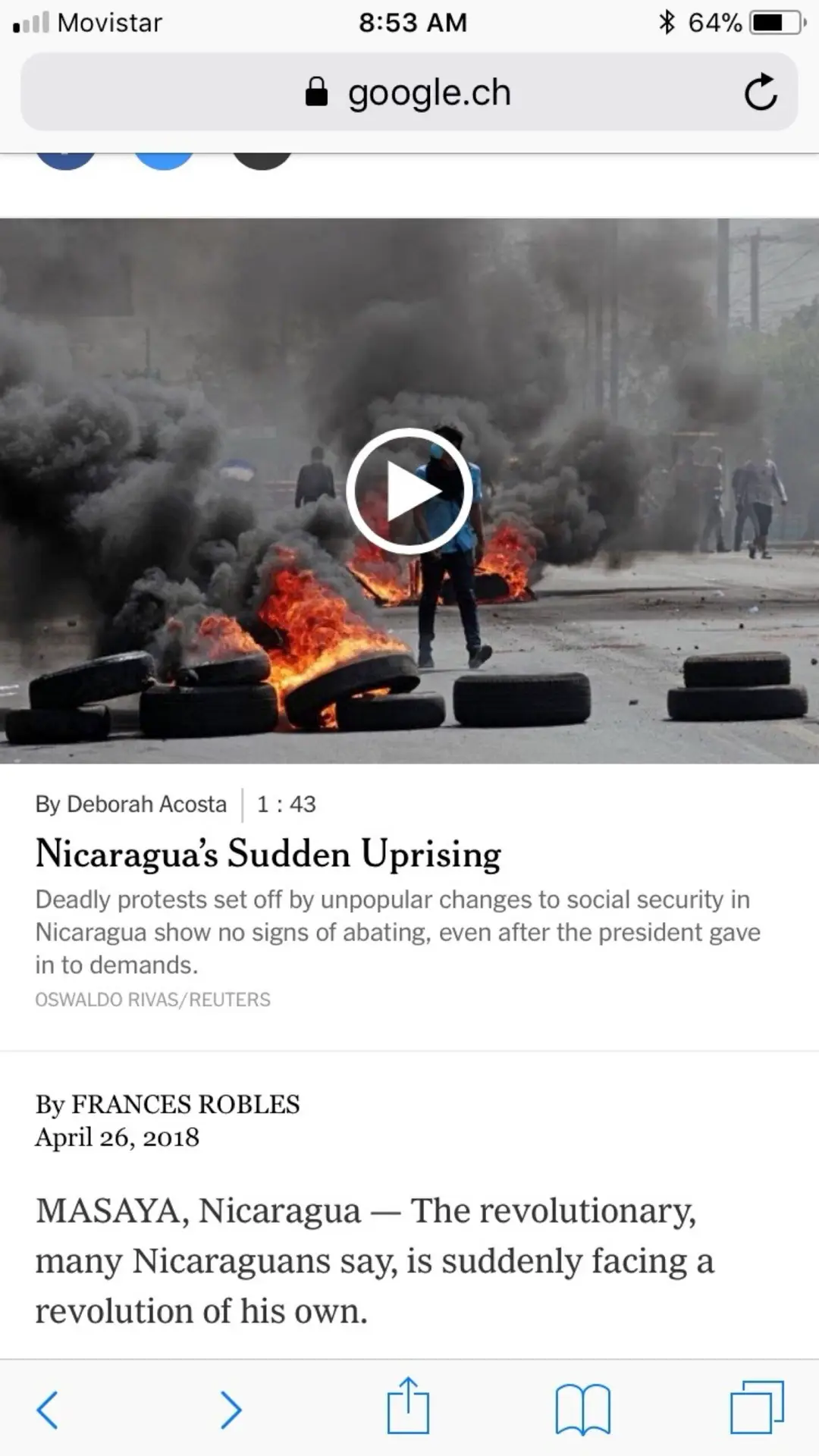
It’s Thursday morning, 21 June, and we’re waiting in a petrol station car park in La Cruz for our compañeros. We won’t cross Nicaragua alone. The tanks are full, water and food stocked up. While waiting I ask lorry drivers coming from the north how the drive through Nicaragua was. “Difficult,” they answer. We shouldn’t drive alone under any circumstances and should preferably join a Costa Rican truck convoy. You can recognise them by their number plates and big yellow plates with the country code CR on all sides of the trucks. They would take us between them and have their alternative routes. Not a bad idea! For weeks I’ve been working on a route through the crisis-hit country, based on reports from other travellers, news and traffic reports.

Regen, regen, regen ... – Foto 4

Shortly before 12 noon we’re ready to go and reach the border 20 minutes later. We get out of Costa Rica quickly, and entering Nicaragua isn’t really difficult. A bit chaotic and disorganised, but that seems to be normal here. We first have to wake up the man at the counter where we pay for the fumigation. The woman with whom we take out the insurance for Muggl is crocheting calmly, and the inspector has to be fetched from his extended lunch break. People here are relaxed, no sign of revolution. Nobody scares us or asks whether we’re sure we want to go to Nicaragua. Aiden and Joanna take a little longer at the border because they have a dog with them. Semuc, the Mexican, has to be properly registered, because a four-legged friend has a passport too. Around half past two, after some waiting and a lunch break, we’re finally done. That day we only drive about 10 more kilometres to a small beach on Lake Nicaragua, where we enjoy the sunset with meatballs and pasta and go to bed early. Aiden has organised an escort for us, so the alarm goes off at half past four! I can’t remember the last time I got up that early. Quickly drink coffee, stow everything and off we go … almost! Because around half past midnight it poured for an hour and softened the ground. A stream ran past Muggl. The water has seeped away, but the ground is still muddy. Aiden gets stuck and can’t get back up the slight incline in reverse. So we hitch Muggl up behind and pull. We’re always amazed at how easily he can pull much heavier vehicles.

Regen, regen, regen ... – Foto 3

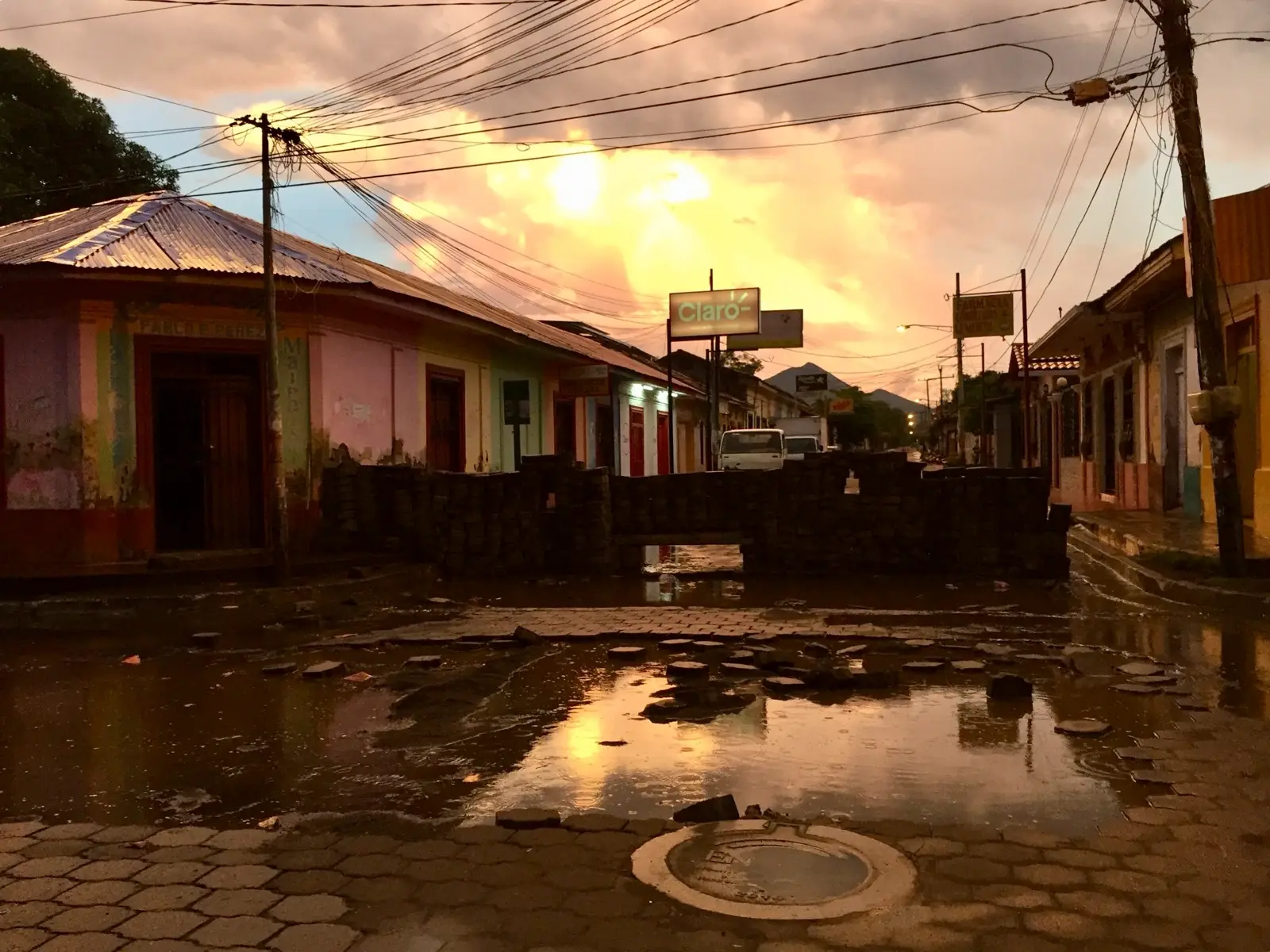
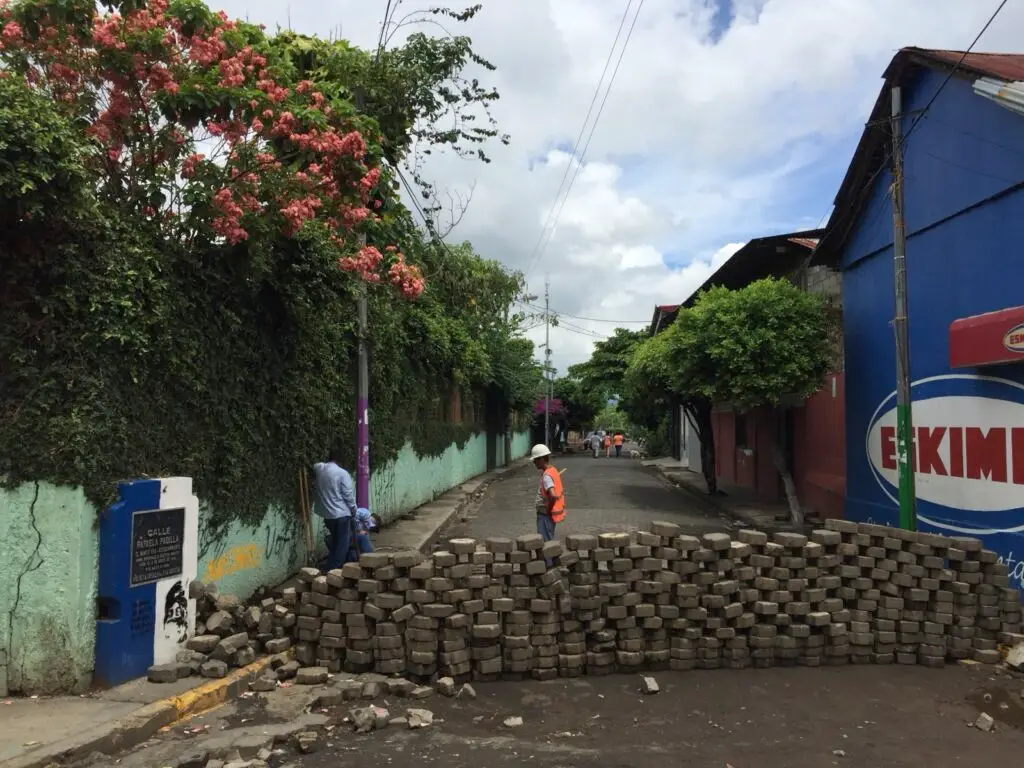
5:15 am – 15 minutes late we arrive at the Puma petrol station in Rivas, where we meet our first “guide”. The man is standing next to a motorbike and waves to us. He introduces himself as Roni and greets us warmly. We follow him for about 15 kilometres, zigzagging through three surrounding villages, because in Rivas there are two roadblocks (called tranques) set up by supporters of the student movement to block transport traffic. Aiden is in a WhatsApp group of Nicaraguans who guide tourists through the country and help them with detours. Roni is one of them. The evening before we had received the message that a barricade had been removed by government supporters, but shortly afterwards the information that it had been put back up. The detour goes smoothly, and Roni says goodbye even more warmly than he welcomed us. He won’t take the beer we want to give him. We should save it for the next one.

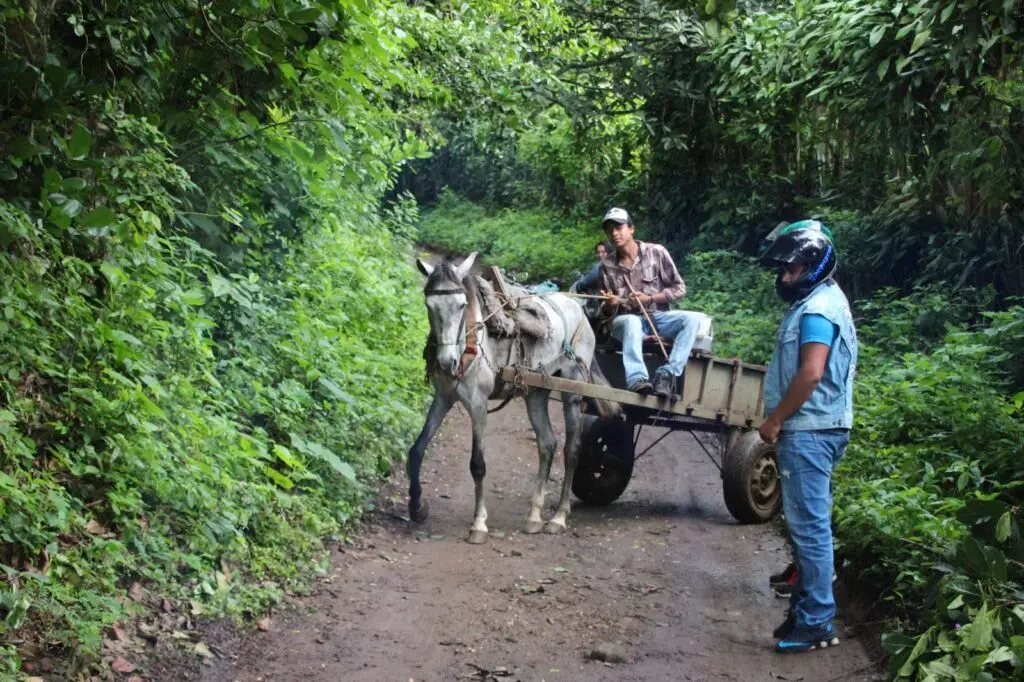
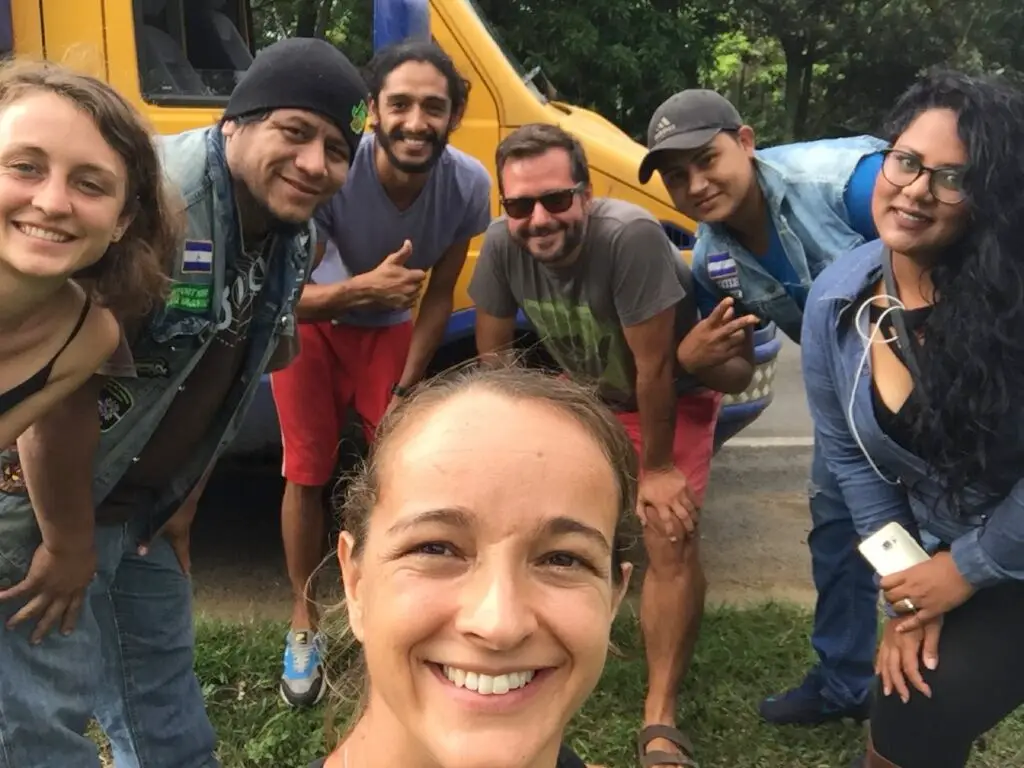
7:25 am – we meet the next “guides” 53 kilometres further on at the entrance to El Rosario. What a surprise, there are three of them: Frank, the vice-president of the Nicaraguan motorcycle club “Güegüenses Nicaragua”, together with Jorge and Betsy. The three accompany us for 18 kilometres to just before San Marcos along narrow farm tracks, where at one point a horse cart even has to be lifted aside so we can get through. We have to manage the last 135 kilometres of today’s stage alone. So we go through our onward route with Frank, and he thinks we shouldn’t have any further problems. 8:25 am – we say goodbye, take souvenir photos and get rid of our beer.

Regen, regen, regen ... – Foto 6

Shortly after San Marcos we pass two police checkpoints that have been taken over by masked, armed young men. Later someone tells us that they don’t belong to the student movement but are just exploiting the situation. We’re not stopped at either. The first ones wave us through, and the second ones just stand by the road watching the traffic.

10:28 am – 90 kilometres later we’re stuck in a queue at the entrance to La Paz. Street vendors walk along the line, and we ask what’s going on. Roadworks? An accident? It’s actually a tranque, a roadblock. A woman says we could drive to the front and pay 20 or 30 córdobas (54–82 euro cents) or simply wait. They let vehicles through every hour. We decide to drive past the lorries and pay if necessary. When we get to the front, two of the “blockers” come towards us. When they read “Turista + Alemania” on our windscreen, the barricade is immediately cleared aside and we’re allowed through without paying. La Paz is a small town, and we decide to drive through the village rather than take the bypass, as we suspect more roadblocks there. Almost out of town, our journey is delayed again to feed an almost starving puppy. He’s so busy with a mango that he only notices the bowl of food and me when I push it under his nose. He wags his tail like crazy and eats quickly. The mango is instantly uninteresting or serves as dessert. We always take time for things like that!

Regen, regen, regen ... – Foto 5

11:14 am – after about six hours and 263 kilometres we reach Malpaisillo, where we stay with Jimmy, a friend of Aiden and Joanna. Jimmy is 22, recently dropped out of university and opened a bar. He proudly shows us his new floor made of black sand. We hadn’t expected to make such good progress. We could actually have driven the rest too, but the stopover at Jimmy’s was arranged, and he’s happy we’re here. So we settle in and almost feel as if we’re doing something forbidden. We hide in a bar during the day, let the owner fill us in on the situation in the country and wait for the next morning to set off early again. In the afternoon Jimmy takes us on a little tour of the town. It’s more of a village, and even this small place recently got a tranque, a roadblock that serves more as a memorial to show solidarity with the students. As we’ve already covered most of the country and it’s only 77 kilometres to the border the next day, we don’t start quite so early. The north of the country is less densely populated and very flat, so it’s mainly used for farming, Jimmy explains.

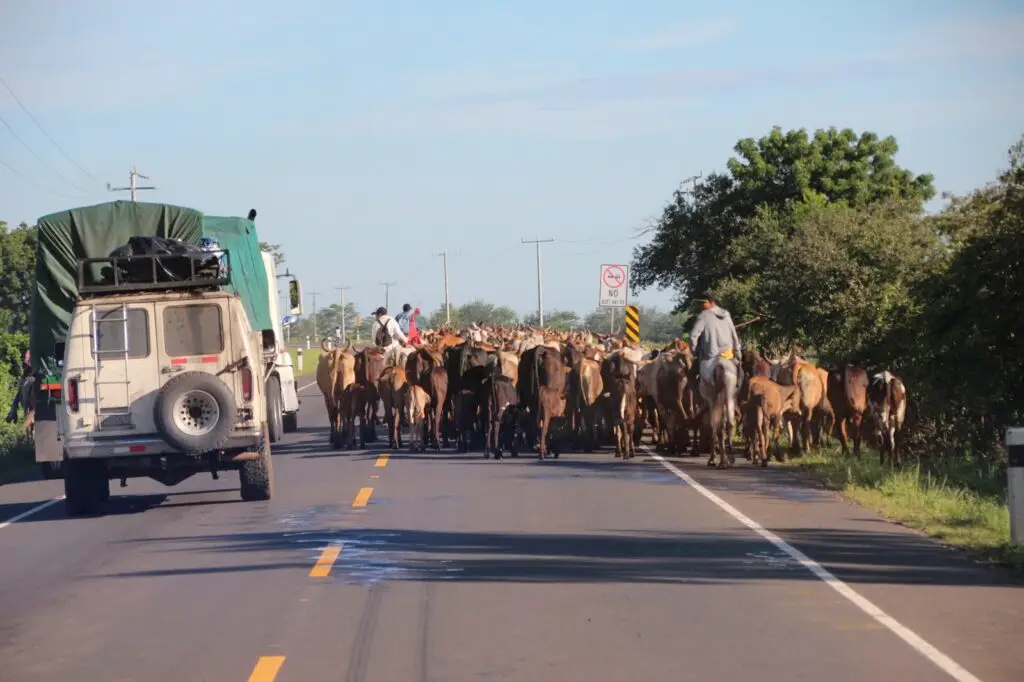
6:30 am – our only roadblocks that day are three herds of cattle, which are quickly gone again. The drive goes smoothly and without any sign of tranques. As always there’s a queue of lorries before the border, and the street vendors are already there too. One tries to tell us that the police probably won’t let us through. But we want to see that for ourselves and, as always, drive past the long queue.

8:09 am – we reach the car park in front of the border building. No police in sight anywhere, neither on the way to the border nor at the border. In fact we didn’t see a single police officer in the whole of Nicaragua, anywhere! Which the Nicaraguans are of course now taking advantage of. A young lad explains to us that they’re all driving without a licence now. Well, if that’s all! The police are under the government’s thumb and are suspected of shooting students and setting houses on fire, which also cost people their lives. So they too are the enemy.

Regen, regen, regen ... – Offroad Travelers

Our conclusion on driving through Nicaragua:

The Nicaraguans went to great lengths for us and were friendly and helpful. We never felt unsafe or afraid. Of course there may be black sheep, like those young men who took over the two police checkpoints. I’ll call them hooligans – and you get those in Germany or Switzerland at football matches, without any revolution. Life here goes on largely as normal. Work continues at roadworks, men put up power lines or mow the verges next to the highways. Heavy traffic is running too, albeit on detours. Neither on entering nor on leaving did we feel that anything was wrong. For weeks beforehand we had monitored the situation, heard and read reports from other travellers, followed newspapers, news and various forums. But in the end it always depends on the people on the ground, because tomorrow everything can be completely different again.

Border Crossing from Costa Rica to Panama at Sixaola

Organisation & Planung – Foto 3

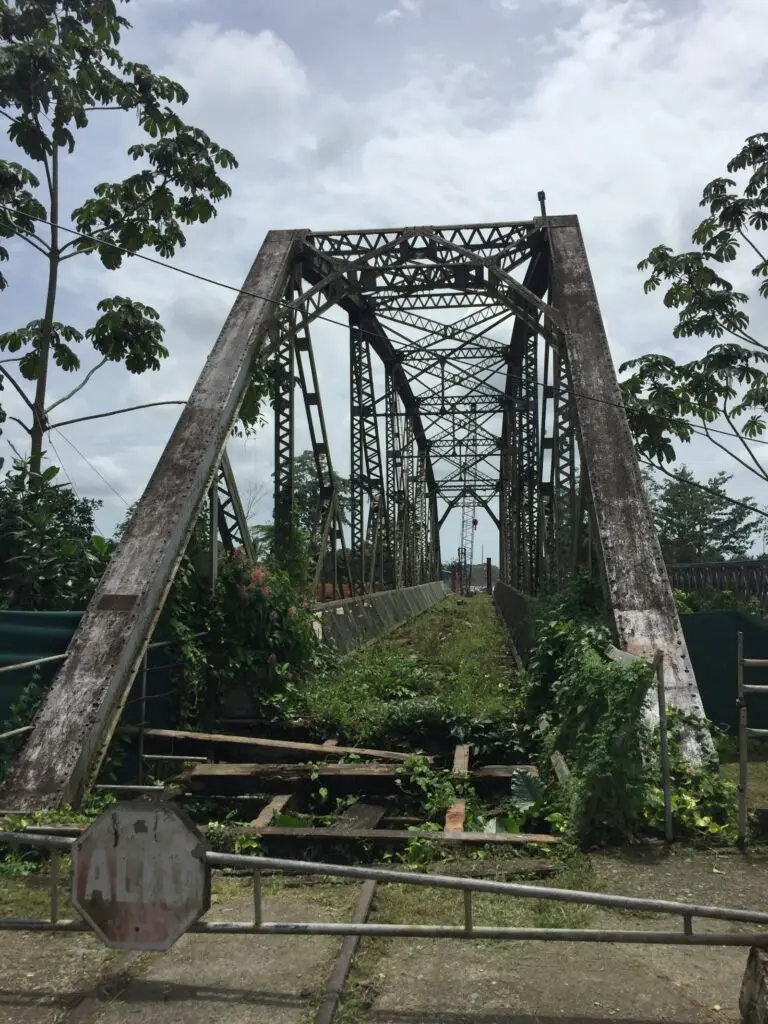
On 8 June 2018 we crossed the border between Costa Rica and Panama at Sixaola on the Caribbean coast. Just before the blue arch with the yellow flaps we parked on the right and walked across a small covered bridge into the building. At the end of the building we paid the tourist tax of 7 US dollars and made copies of our documents. Then we drove through the blue gate and parked on the left.

Opposite was the immigration office, where we had to check out of Costa Rica. An official first sent us to the counter to the right to suspend the temporary import permit (TIP) for our camper “Muggl”. An employee briefly checked the vehicle, compared the number plates and issued a form that suspends the TIP for a maximum of 71 days. This also lets us re-enter at a different border. Then we got our exit stamps at the left-hand counter. The official leafed through our passports and discovered the caribou stamp from our entry into Alaska. He laughed and showed it to his colleague, who laughed too.

Grenzübertritt von Costa Rica nach Panama bei Sixaola – Offroad Travelers

We drove across the roughly 150-metre-long bridge, where an official wanted to see our passports. He pointed out that only one vehicle at a time is allowed on the bridge. Then we drove through the fumigation, where our camper was sprayed. We parked on the left and zigzagged across the square several times. We paid for the fumigation (3 US dollars) and checked in at Panamanian immigration. Photos were taken of us, our fingerprints were taken and we were asked for a return flight ticket. In the end the vehicle registration and the import documents from Costa Rica were enough proof that we have our own vehicle.

Grenzübertritt von Costa Rica nach Panama bei Sixaola – Foto 3

There were two offices for car insurance. The one right at the car park was closed, but a young man sent us about 10 metres down the road to another office. A young woman in a light-blue painted tin hut processed our documents via WhatsApp with a colleague. It took almost three-quarters of an hour to get the insurance certificate, as we were third in the queue. Fortunately the woman dealt with us before her lunch break.
Next we applied to customs for the temporary import permit for our camper. The official wanted copies of Christoph’s passport and vehicle registration. He briefly checked the vehicle and compared the number plates. After the first five digits of the VIN he was satisfied and disappeared. In total the whole process took 2.5 hours, but was very relaxed.

Grenzübertritt von Costa Rica nach Panama bei Sixaola – Foto 2

Addendum: traffic rules in Panama

Panama is very strict about speed limits. On many roads outside towns a limit of 40 km/h applies. About 15 minutes after the border we were lasered by the traffic police at 67 km/h. The officer explained that we would get a ticket for 50 US dollars because we had exceeded the limit. He saw in Christoph’s passport that we had only been in the country for 20 minutes and decided not to give us a ticket. He did, however, tell us to watch the speed limits in future.

During our stay we learned that wearing a seatbelt is strictly enforced in Panama. Without a seatbelt you pay 70 US dollars, for a further offence within a month 150 US dollars, and the third time your licence is taken away. Driving without shoes is also prohibited, and there are many other rules to observe.

Belize – Unbelizeable

Zentralamerika – Foto 24

On 20 February we travel from Chetumal, Mexico, to Belize. On the way to the border we stop at a police check. A policewoman says we were driving too fast. I ask about the speed, but she doesn’t answer and just laughs. Christoph never drives fast while Muggl is still cold. I ask again how much too fast we were, but get no answer. A colleague joins her and repeats the statement. Everyone laughs, which surprises us, as we had expected a more serious check. Nobody tells us how fast we were driving. When I ask what happens now, the policewoman steps out from behind her colleague with a laser gun in her hand. Aha, they’ve got new toys and love playing with them. Nobody wants money from us. They give us a slip of paper and tell us to drive carefully and watch the speed limits. Mexicans are just big kids. At first we think a fine on our last day in Mexico is really the last thing we need.

At the border we quickly check out of Mexico. Hardly on the Belizean side, everything is different. People look indigenous but speak English with a Caribbean slang. An official greets us and explains where we have to go and that our vehicle will be checked last. We quickly get visas for us and for Muggl. During the vehicle inspection I realise with horror that I forgot to hide the eggs. The official takes them from us, as they’re not allowed. “Sorry,” he says. He patiently explains that they don’t allow eggs from abroad because of bird flu. “But don’t worry, we have eggs in Belize.” Thank God, I think. I don’t want to be responsible for another outbreak of bird flu.

Belize – Unbelizeable – Foto 3

100 metres after the border we buy the insurance for Muggl and off we go. In Orange Walk, the first town on our route, we buy eggs and Belizean beers. Then we drive to Crooked Tree, to a small campsite by a river that is more of a lake because of the heavy rain. The dirt track along the bank is partly under water, but that doesn’t stop us from setting up camp for the next three days. Even if the water keeps rising, Muggl will just get wet feet. I caught a cold diving in Mexico, so we use the quiet days to let me recover. It still rains occasionally, but the water doesn’t rise any further, so we get out again with almost dry feet.

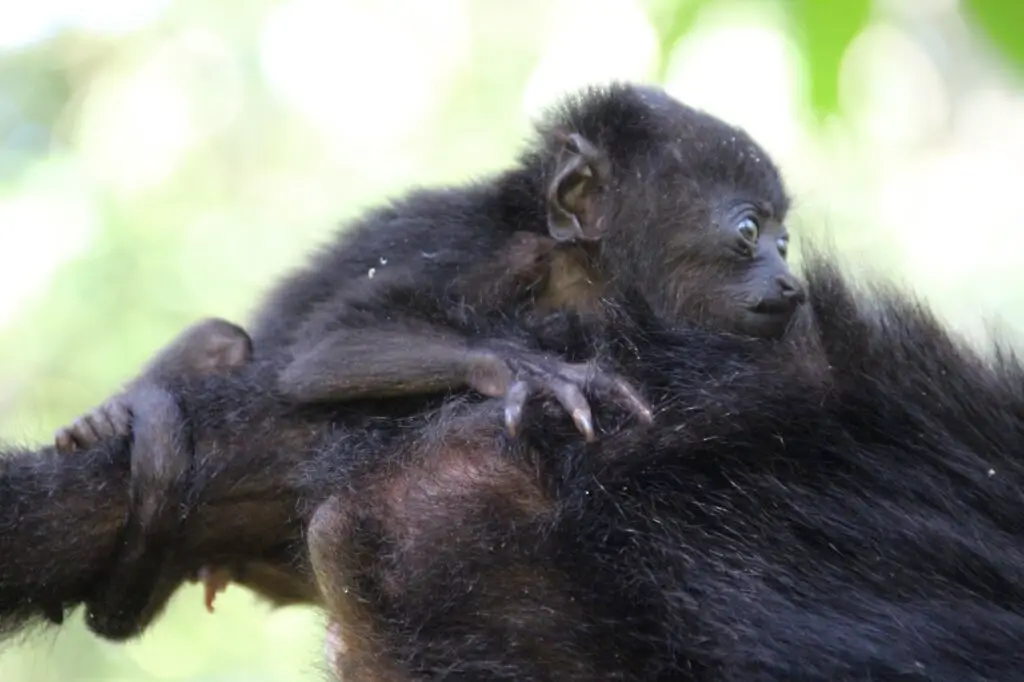
On we go to Bermudian Landing and the Community Baboon Sanctuary, a reserve for howler monkeys. The very next morning Robert gives a guided tour. He has been working to protect the howler monkeys and their habitat for over 40 years. It doesn’t take long for a family of howler monkeys to appear. Six or seven monkeys hide in the trees, including two mothers with babies on their backs. Robert lures them closer by picking a big leaf from a bush and holding it up. And they really do come towards us. We watch up close as the little monkeys try to grab the leaves and eat them. That was really worth it!

Belize has a lot of wildlife to offer, especially wild cats. As they’re hard to find in the wild, we decide to go to the zoo. The Belize Zoo only houses Belizean animals that were injured or separated from their mothers as youngsters. “Problem jaguars” that came too close to people also find a home here. That raises the question of who’s getting too close to whom, but at least the animals don’t have to be shot.

Belize – Unbelizeable – Foto 4

The night tour at the zoo is said to be great, but there’s no group we can join that day. So we visit the zoo during the day and are thrilled. It gives a good insight into Belize’s diverse wildlife. The ocelot fascinates me most. The four-eyed opossum and the kinkajou don’t show themselves. So a night tour after all?

The Tropical Education Center (TEC), which belongs to the zoo, offers camping. We had read that it’s supposed to be great. And the TEC really is super nice. There are hiking trails, a pond with a crocodile, a pool with a huge mosquito-net house, hot showers and very nice people. Here we meet Frank, a Canadian who has been cycling through Guatemala and Belize for four months. He has adopted a puppy that sought refuge at the zoo. Frank tells us about a remote island he wants to visit again soon. The island is in the Caribbean, surrounded by crystal-clear water, and has no electricity, no cars and no restaurants. You can only get there on a Sunday and back the following Saturday. That sounds tempting. The island has been family-owned for many years, and the family deliberately keeps it simple. There are rainwater showers and composting toilets, huts on the beach or over the water.

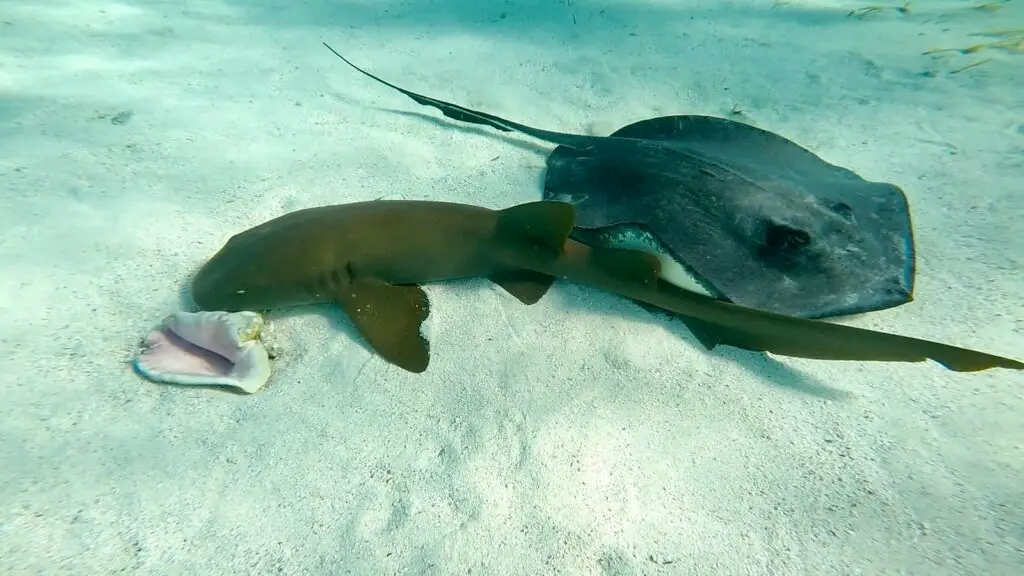
I find an old website with dreamy pictures. You can dive there too. We spontaneously decide to come along and make a reservation. In the meantime we go to Caye Caulker, a touristy island with Caribbean charm. Muggl parks in the old harbour of Belize City and we take the water taxi. As soon as you arrive, you feel relaxed. The island’s motto is “go slow”. As my cold won’t go away despite all the medication, we decide to just snorkel. With Caveman we find a great agency that offers us a super tour. We see manatees, seahorses, eagle rays, southern stingrays, a loggerhead turtle, green sea turtles, nurse sharks, moray eels and colourful fish. We’re so thrilled that we book a half-day tour for the next day straight away. We can warmly recommend Caveman!

Belize – Unbelizeable – Foto 6

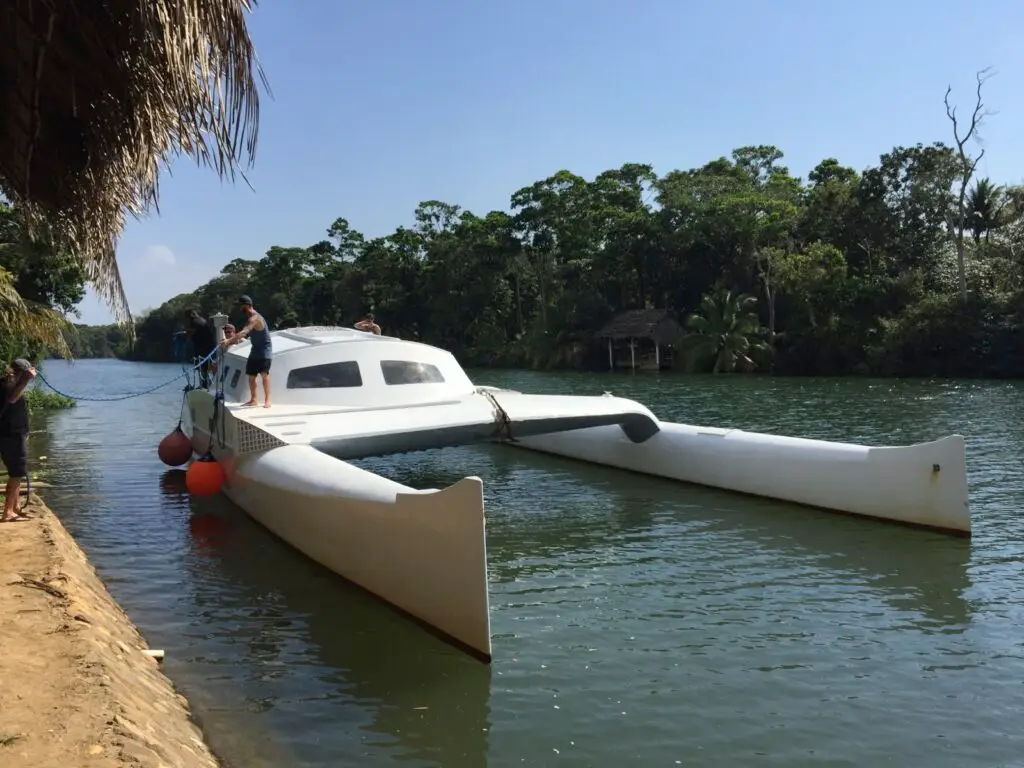
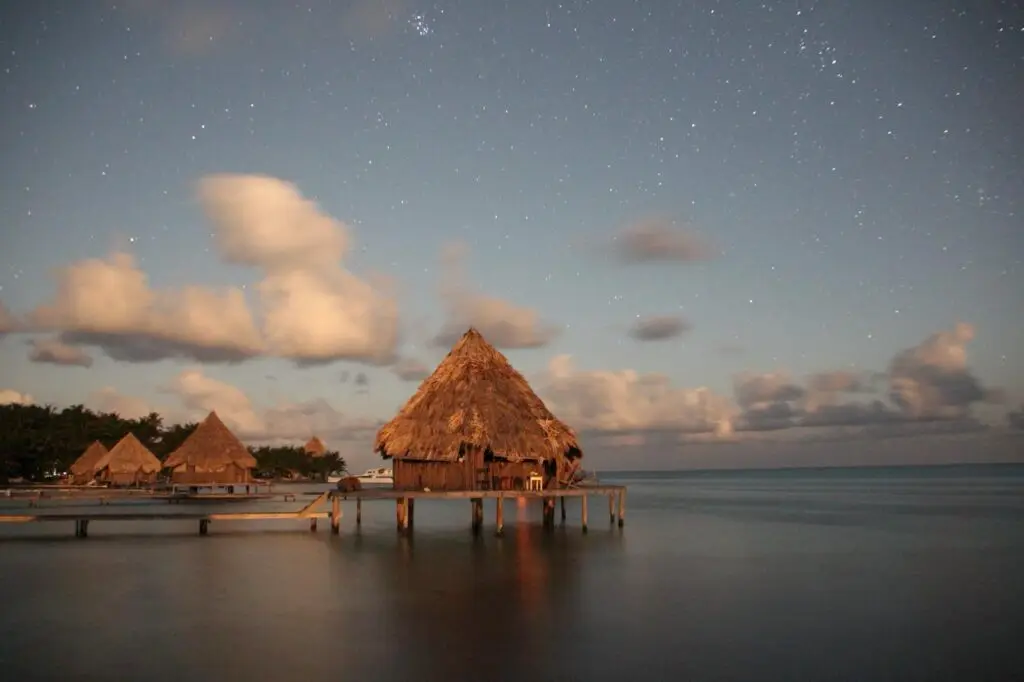
After three days we return and meet Frank with Biscuit and his buddy Matt, who has come over from Canada. On Sunday 4 March we set off. We wait on the bank of the Sittee River for the catamaran that will take us to Northeast Caye. It arrives an hour late. We load our luggage, provisions and drinking water onto the catamaran. The trip takes three hours. We sail out of the Sittee River onto the open sea, past islands, until finally there are none left. The sun is shining and Matt gets sunburnt despite sun cream. When we arrive, we can’t believe our eyes: turquoise water, white sand, palm trees, round bamboo huts on stilts in the water, reached by jetties. We’ve booked a beach cabin but wonder whether we should ask for an upgrade. After a welcome with drinks and watermelon, it’s time for the cabin numbers. We’ve already received a hand-drawn site plan and search excitedly for cabin no. 7. YES! It’s a cabin over the water. We’ve been given a free upgrade! We spend the following week diving, snorkelling and cracking coconuts. They have a station for opening coconuts and a grater to scrape out the flesh. We squeeze the fresh coconut flakes through a cloth and make our own coconut milk for coffee and White Russians. Because there’s no fridge, we didn’t bring much beer, but all the more rum. On the first night the sea glows. It looks almost like fireflies in the water – it’s called bioluminescence. We watch stingrays and nurse sharks from our “front door” as they swim under our cabin or sleep beneath it. The island isn’t big; you can walk around it in about 40 minutes. It’s full of coconut palms and we can eat and drink as many coconuts as we like. The guys go spearfishing now and then, so every so often fresh fish ends up on our plates.
Belize – Unbelizeable – Foto 2

If you walk around the island, you inevitably come across a small shipwreck. In 2012, 25 Cubans accidentally landed on Northeast Caye in it. They had been at sea for 15 days and had travelled almost 1,000 kilometres across the Caribbean Sea. The boat was home-made, powered by a small Slovenian lorry engine. It’s a miracle that everyone arrived safely, even two pregnant women. Three days before reaching Northeast Caye the engine broke down and they were only driven by the current. On the island they were given food and drink and allowed to call their families. Belize doesn’t take in refugees, so the fishermen took the refugees to Honduras. Time flies and we have to go back. Frank, Biscuit and Matt are staying another week; for us the journey continues. On Saturday 10 March we say goodbye to the three of them and the rest of the islanders and go back to Hopkins, where Muggl has been waiting for us.

That same day we drive on to Placencia, which Christoph in particular doesn’t like. On the way we pass showy villas built mainly by American and Canadian retirees that don’t fit in there at all. We drive back a bit towards Hopkins and decide to look for a free spot on the beach to camp. On the edge of the village of Seine Bight we find one. As always, we introduce ourselves to the people and ask whether we may spend the night there. The neighbour Lauren and her son Brian come to meet us and it’s no problem. Brian even speaks a little Swiss German – he was with a Swiss woman and has two children there. He shows us where they live, and we find a bunch of puppies in their “garden”, which here is simply the sandy beach. He also gives us a little tour of the village, where we meet a relative or two of his and end up in the bar where the locals buy bitters. Bitters are pickled roots whose liquid is diluted with rum and water and is said to help against various ailments. We’ve ended up in an entirely Black village.

Belize – Unbelizeable – Offroad Travelers

At half past six he brings us back as it slowly gets dark. We’re tired from the long boat trip in the sun and all the driving, so we go to bed early. At two o’clock there’s a knock: it’s Brian, a little tipsy. He wants to show us how beautiful the moon is and that there’s a disco nearby where the whole village is gathered. We’re the only white people, which makes us a little uneasy, but otherwise nobody minds. In the disco there’s an MC who interrupts the Caribbean music with rap. Half an hour later Brian brings us back to Muggl. The next morning we just want to quickly say goodbye to the family – which was to prove our undoing.

Belize – Unbelizeable – Foto 5

El Mirador – The Largest Maya Pyramid in the World

Zentralamerika – Foto 25

El Mirador – a 100-kilometre hike through the Guatemalan jungle

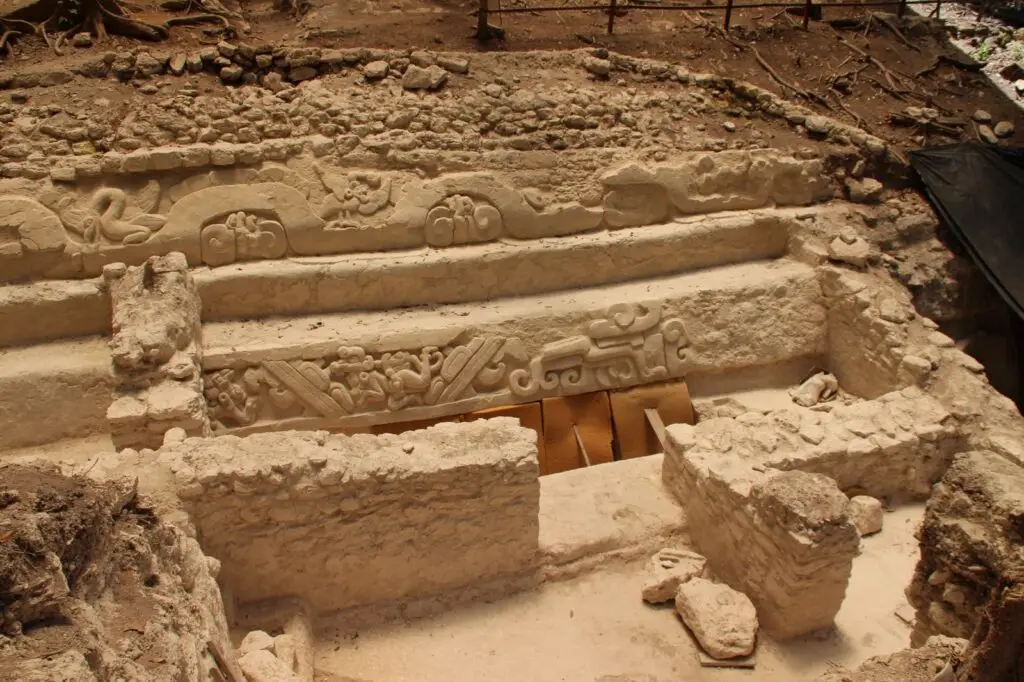
In our first days in Guatemala we keep hearing about El Mirador. Locals ask us whether we plan to hike there, as it’s so impressive and the dry season is the best time for it. El Mirador is the largest and most important Maya site of the Preclassic period. Not only is the height of the largest pyramid, La Danta, at around 70 metres impressive, but also its volume of 2.8 million cubic metres. That makes it one of the largest pyramids in the world. Only a fraction of the more than 30 buildings has been excavated so far, and you can only guess what lies hidden beneath the overgrown hills.

Excited by the idea, we find out how and from where you can get there. We quickly come across the organisation Cooperativa Carmelita. Carmelita is the last village before the outback and is already inside the Maya Biosphere Reserve. Almost the whole village works for the expeditions to El Mirador. So in Flores we march into this cooperative’s office and get more information. It all sounds great! The tour takes five days: on the first day you hike 17.5 kilometres, on the second day 23 kilometres, then you have a day at the ruins and hike the same route back in two days. Mules carry our luggage, and we sleep in tents at camps.

El Mirador - Eine 100-Kilometer - Wanderung durch den Dschungel Guatemalas – Foto 2

As luck would have it, a German has just come back from the expedition to the office and also tells us enthusiastically about his experience. All right, we’re in. But what do we do with Maya? I ask Juan Carlos, the man in the office, whether he has any idea what people with dogs do in this case. No problem, he says. In Carmelita they can find someone to look after Maya for five days. They do that now and then. He looks at Maya himself, as he has a three-month-old pit bull puppy. But since Maya needs food several times a day and not just morning and evening, unfortunately it doesn’t work for him to take her. But he says there are families in Carmelita who do this from time to time. He’ll call Hugo, the head of the organisation, and register us. By the time we arrive, Hugo will have found someone for us. There’s just one barrier at the entrance to the reserve that we have to pass. There we have to show our ticket and shouldn’t say that we have a dog. All right then.
We quickly take the clothes we need for the hike to the laundry, buy some food, and at 3 pm we set off for Carmelita. It’s a good 80 kilometres from Flores to Carmelita. But the road is very bad and unpaved, so we have to allow three hours. The drive is beautiful, if pretty bumpy. It goes through green meadows, over hills, past ranchos and herds of horses and cattle. Every now and then there’s a small village where children, dogs and pigs of all sizes run around in the streets.

El Mirador - Eine 100-Kilometer - Wanderung durch den Dschungel Guatemalas

When we arrive at the barrier, we show our ticket. The man doesn’t ask us about pets but immediately says “vehicle inspection”, so he wants to look in the car. Great! During the drive Maya had hidden under the bed behind the camping chairs and gone to sleep. I had to search for her briefly and thought, the dog can’t just disappear during the drive! But shortly before the barrier she crawled out again. I open the sliding door, and she’s lying flat on the floor next to the cool box, her head between her paws, looking at me with big eyes. He doesn’t see her; I’m standing in between, play dumb and ask what he’s looking for. “Mascotas,” he says. He still doesn’t see her, but now I can’t say we don’t have any pets. So I have to give her away.

“Oh,” I say, “we didn’t know that. We have a dog, but she’s still a puppy.” That doesn’t impress him much, and he won’t let us through! Neither Juan Carlos nor we had expected that. No amount of negotiating helps, even though there are street dogs everywhere in the villages. We’re furious, but we have to turn around whether we like it or not. But what now? Quickly think about what options we have left: drive back, try to get our money back and give up on El Mirador?

In the end we drive back to the last village and decide to find someone who looks trustworthy and simply ask whether anyone can look after our little one for the five days. But where to start? On the way there we had noticed an old woman sitting in front of her house with a whole herd of tiny piglets around her, each about a handful in size. I climb the few steps from the road up to the house, where the woman already calls out to me, “Adelante…”, which means something like “come on in” or “come closer”. I explain in Spanish that I have a very strange question, to which she replies that no question is strange.

El Mirador - Eine 100-Kilometer - Wanderung durch den Dschungel Guatemalas – Foto 5

When I describe our situation and ask whether she knows anyone, she thinks for a moment and remembers a neighbour up the road. She calls him straight away – and it really does work via the bush telegraph: she shouts (so, without a phone) to the neighbour opposite, who shouts to the neighbour next door, who in turn shouts to the next neighbour, until the message reaches Raul, who comes marching over straight away. I explain the whole situation again. Raul doesn’t hesitate long and agrees, which may also be because we’ve offered him money. But Maya also needs care, food several times a day and antibiotics morning and evening.

We follow Raul with Maya and her things to his house. It’s fenced in, he explains, so no other animals can get in. His wife Dora is waiting for us, and a whole crowd of children follows us. Everyone is curious about this special dog who comes with so many toys and a bag of dog food and dog biscuits. People here aren’t particularly interested in dogs; nobody pets them anyway, and they very rarely get dog food. Raul has a dog too, and it looks as if it’s doing quite well. He shows me where Maya will sleep, and I put her blanket on the bare floor in his living room. By bare floor I mean earth – not concrete, wood or even tiles. The people here are very poor.

You’re probably thinking: how can they just leave their dog with some random people? Maya spent the first two months of her life in far worse conditions, and strangely we have a very good feeling about it. Of course I was a little sad when we left her behind.

El Mirador - Eine 100-Kilometer - Wanderung durch den Dschungel Guatemalas – Foto 6

So we drive back to the gate fairly quickly, as it’s almost dark and there’s still quite a stretch of bad road ahead of us. The nasty man at the gate looks rather incredulous when we turn up again. Of course he wants to look in the car again and doesn’t believe that we simply left Maya somewhere. He gets into the car and even tries to coax her out of her hiding place. Not a sound, but he still doesn’t believe us! Christoph took photos of us, Raul and the many children, and we show them to him. He’s sceptical, but a colleague recognises Raul in the picture. Good, that’s settled. But now he first has to make phone calls for about ten minutes, and we wonder what he’s doing?! It’s already getting dark when, after about 20 minutes in total, we’re finally allowed to continue. How lucky that Muggl has four big spotlights on his head! At 8:30 pm we finally arrive. Hugo had already left the cooperative’s office but comes running straight over. Not many vehicles arrive there, especially at night, so our arrival doesn’t go unnoticed.

He had actually found a young woman to look after Maya for us. Yes, they search the cars at the entrance now, I explain to him. He’ll have to come up with something else with Juan Carlos. He explains what the next morning will look like and where we can shower and park. We’re so exhausted that we only just manage to pack our things for the next five days. Then we fall into bed dead tired. The next morning at 7 am we’re at the cooperative’s office with our luggage. At 7:30 we’re taken to the comedor, a kind of outdoor dining room in a family’s backyard, where we get breakfast (scrambled eggs with beans and coffee). From now on we’ll literally be fattened up for the next few days.

El Mirador - Eine 100-Kilometer - Wanderung durch den Dschungel Guatemalas – Foto 7

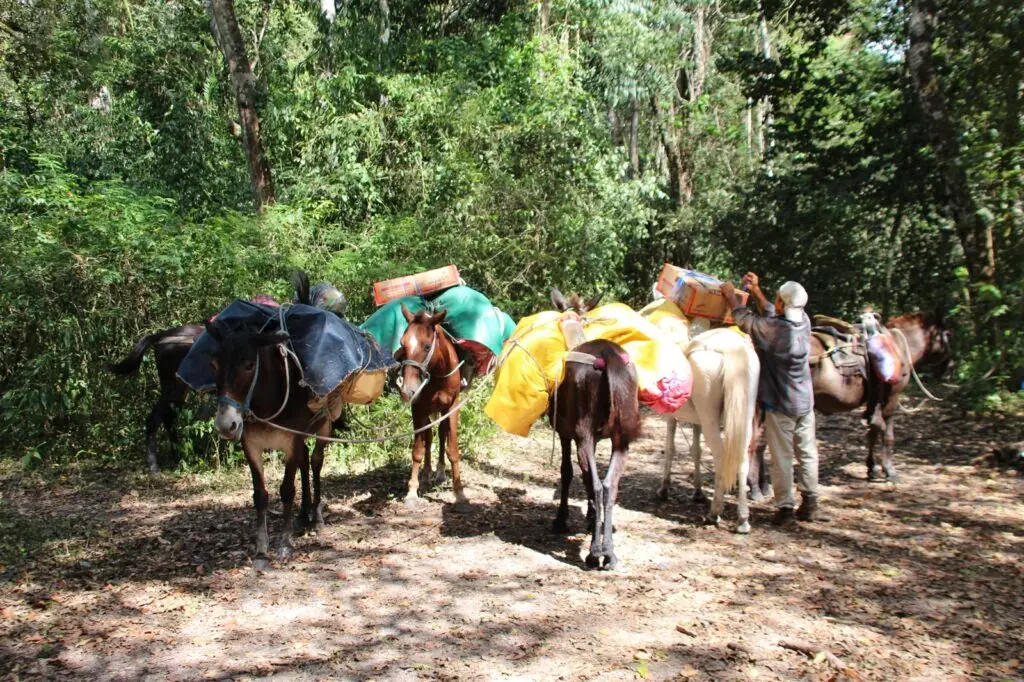
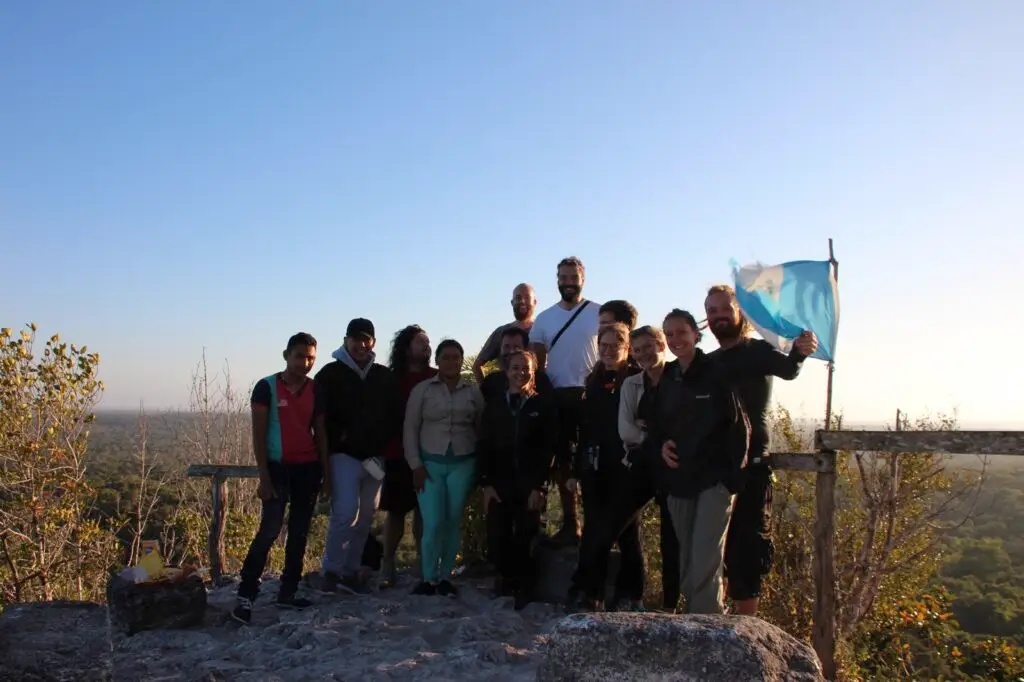
The other members of our group are all only arriving from Flores in the morning. A minibus picked them up at 5 am, and we’re glad we’re already here and didn’t have to get up so early. They’re supposed to arrive at 8 am; we wait. Slowly our team arrives, including mules, only the rest of the group is late. At 9 am they’re finally here too, first get everything explained and have breakfast as well. By the time we get going it’s half past ten, and I’m almost hungry again. When we set off, we’re a group of 17 people in total: eleven adventurers, a guide called Rosa with her assistant Rodolfo, the cook Ingrid with an assistant cook, the muleteer Giovanni and a young guy called Juan, who will be our English interpreter, plus two horses and five mules.

The eleven adventurers are Eva from France (originally from Vienna), Rafael and Lisi from Austria, Nerie from New York (originally from Guatemala City), Johanna and Jannis from Germany, Matthias from Germany, Sophie from Denmark, Florian from Germany and the two of us.

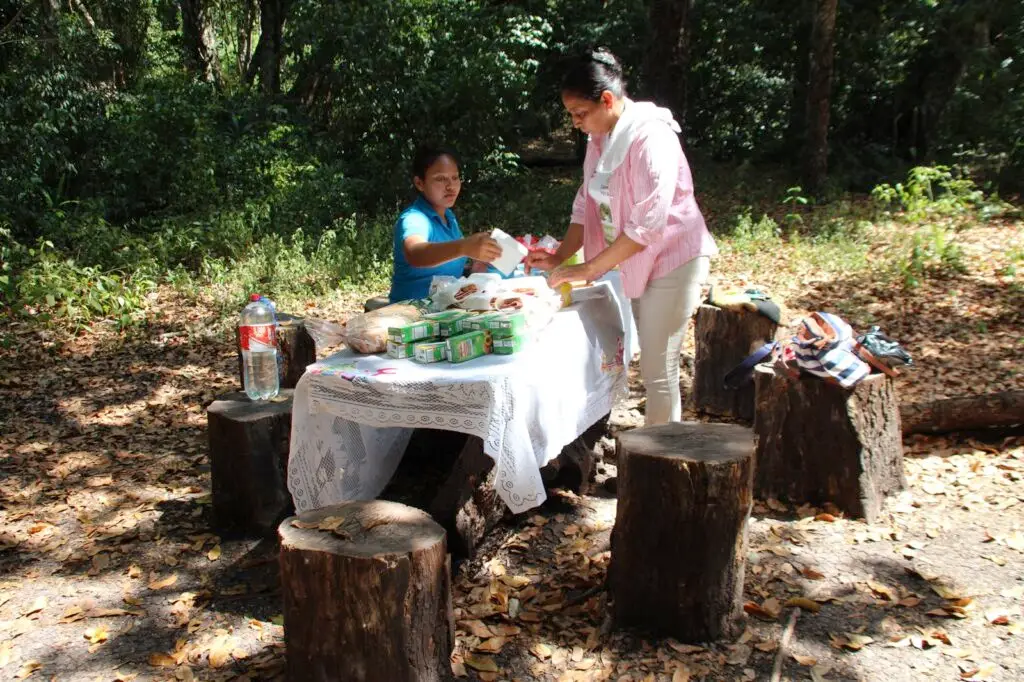
Today’s stage is 17.5 kilometres. The ground gets rough quite quickly, and you can see from the deep ruts how deep the mud is here in the rainy season. The dried-out ground is as hard as tar, and we balance skilfully over it. You always have to watch where you step, so there’s not much time to admire the landscape, which is forest all the way but still beautiful. The two cooks are a little ahead of us on horseback and supply us with fresh fruit and sandwiches along the way. Our guides carry water bottles that we can refill on the way. So we hike through the jungle in the shade of the trees and actually find it quite pleasant despite the burning sun. Fortunately there are no mosquitoes or other pests here during the dry season – which unfortunately also applies to the rest of the wildlife. At this time of year the wild animals are higher up in the mountains, where there’s more water. So only those walking right at the front catch a fleeting glimpse of a small snake or the odd wild pheasant.

El Mirador - Eine 100-Kilometer - Wanderung durch den Dschungel Guatemalas – Foto 7

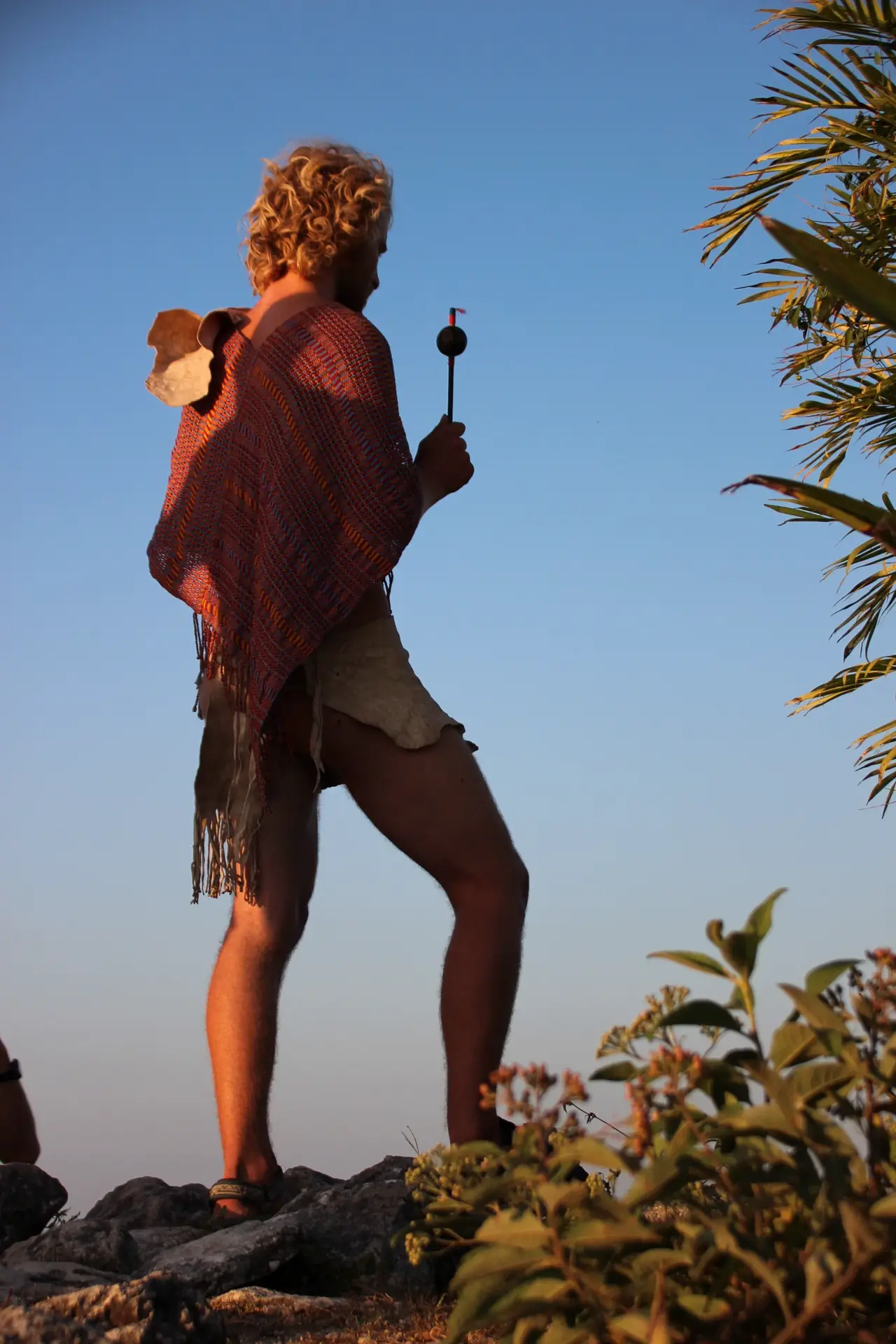
Around 4 pm we arrive at the Maya site of El Tintal, where howler monkeys greet us. Just before we enter the camp, Rosa is explaining something about the wall remains we’re standing on when a young man with tousled blond hair, a poncho, a short leather loincloth with nothing underneath and bare feet comes towards us. He says hello as if it were the most normal thing in the world to walk half-naked through the jungle. We say hello back and try to keep our attention on Rosa, which we don’t really manage. At least we manage to pull ourselves together until he’s out of earshot before bursting into loud laughter. Christoph had the GoPro running at that moment – you absolutely have to watch the video!

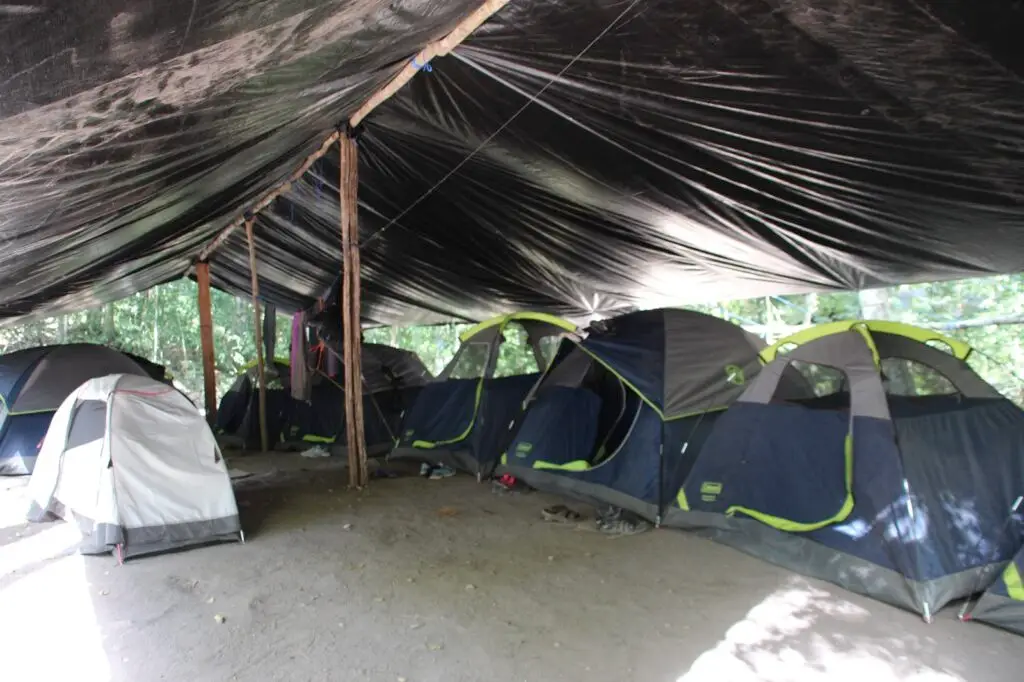
He definitely made our day! When we finally reach our camp, tents with mattresses, pillows and blankets, hammocks, cold drinks and more fresh fruit await us. We could get used to this! There are rainwater showers and a long-drop toilet. The kitchen is rustic, and cooking is done over an open fire, where our cooks are already preparing dinner. We rest briefly and then walk just a short way back to the El Tintal pyramid to watch the sunset. Our friend in the loincloth is there again too, this time with a rattle. He hums some tune and rattles along. Once again we have to pull ourselves together – the sight is too funny, especially as he seems completely serious. He says in all seriousness that this experience “is already life changing”. Well then, let’s wait until enlightenment comes to us or our “life changes”.

El Mirador - Eine 100-Kilometer - Wanderung durch den Dschungel Guatemalas – Foto 8

We don’t stay up late that evening; besides, we have to get up early tomorrow, as the longest section still awaits us. Up at 5 am, hand over the luggage so the mules can be loaded, breakfast at 5:30 with scrambled eggs, rice and beans, set off at 6. 23 kilometres lie ahead of us today. But the path gets better – we’ve largely left the hardened muddy section behind, and it’s pretty flat all the way, which makes it easier. Our group has pretty much the same pace, so nobody falls behind and we make good progress. We march for about seven hours that day and are glad when we finally reach the camp at El Mirador. It’s a bit more rustic than the first one, but still very well organised. Here too there are tents with mattresses, blankets and pillows. For showering there’s one bucket of water per person. Ocellated turkeys – colourful wild turkeys – wander through the camp looking for food.

We rest first before setting off on the 20-minute walk to the highest pyramid, La Danta, for sunset. Out of the hiking boots, and I immediately stub my little toe on the first stone that gets in my way. A flap of skin is hanging off and it’s bleeding. Sh…! And that with about 50 more kilometres of hiking over the next three days – I already feel sick. So I patch myself up as best I can, fold the flap of skin back where it belongs and bandage it with a Compeed blister plaster, which I only take off again after the expedition. Grit my teeth and get through it.

El Mirador - Eine 100-Kilometer - Wanderung durch den Dschungel Guatemalas – Foto 3

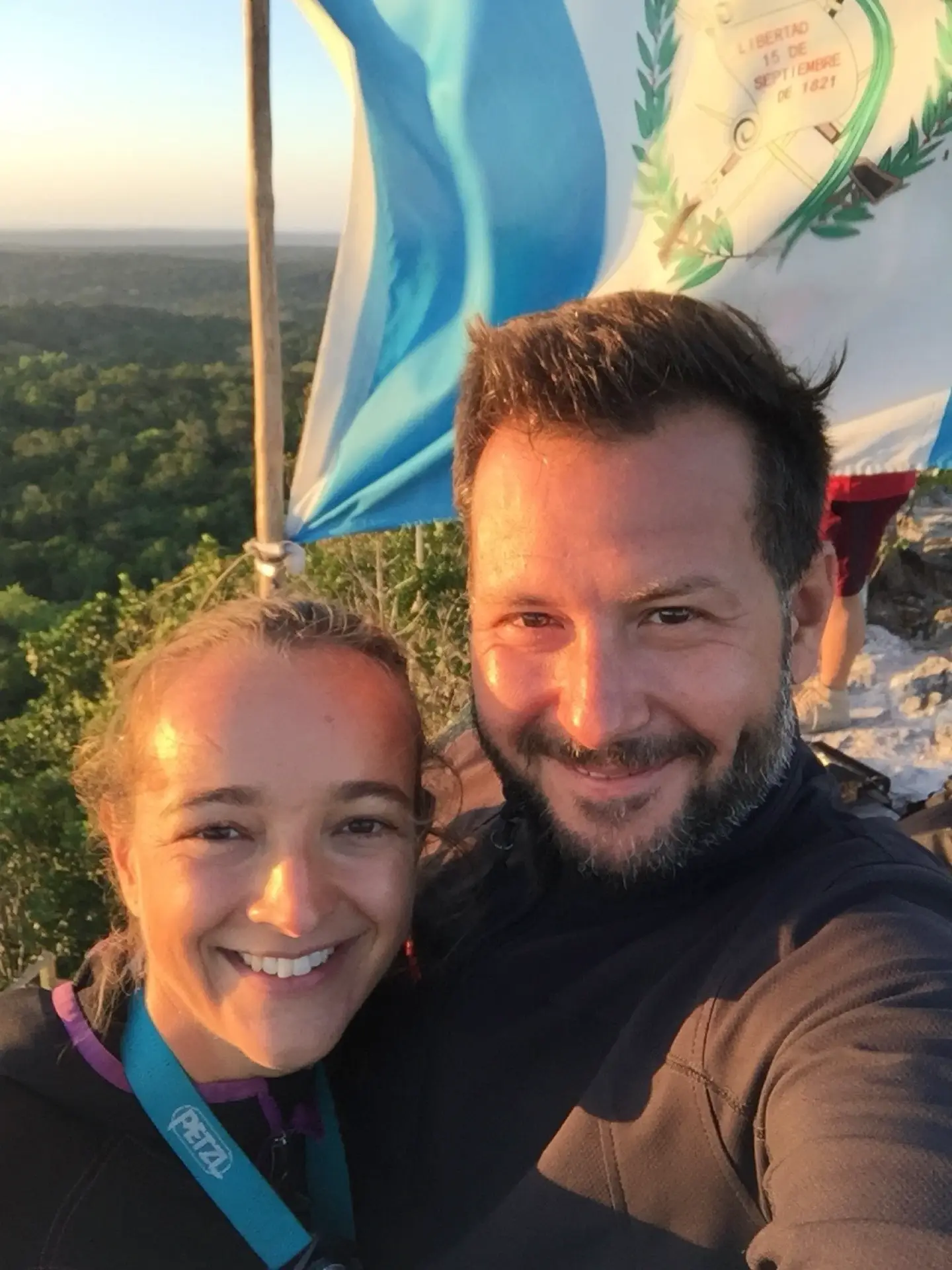
The steps go steeply up the last stretch to the pyramid. At the top, the view over the jungle is fascinating. We have good weather and can see quite far. Not that there’s much to see, because there’s nothing for miles around. It’s just beautifully quiet – no cars, no music, only our group, still making fun of the blond guy in the loincloth, whom we now call “the golden Mayan”! We’re a great bunch and laugh a lot together, and every one of us is waiting for the life-changing moment. The next day, Sunday 25 March and Christoph’s birthday, we get up early to watch the sunrise from the pyramid too. He picked a pretty cool birthday location.

Today we explore the site and walk from excavation to excavation and from pyramid to pyramid. The site is huge. Spider monkeys watch us and protest whenever we get too close. You’re probably wondering what it looks like when spider monkeys protest. They hang in the trees by their arms, legs and tails and shake them like crazy until branches break off, and then throw them down! The little fellows don’t come down, but we give them a wide berth anyway. We walk almost 14 kilometres that day too, and I’m glad that apart from a few steps it’s flat. My toe already hurts quite a lot. The next day there’s another hard stretch. We get up early again and march back to the first camp, El Tintal, at 6:30 am. It’s tiring for us, but the two cooks definitely have the hardest part. They’re up at 4 am every day, light the fire and cook for us. They walk the same route as we do, even if they take turns riding a horse, but they hardly get any breaks, because when we arrive at camp they’re already there and have prepared snacks for us again. We’re looked after so well that despite the exertion we even put on a little weight!

Our interpreter Juan, a 19-year-old Salvadoran who has done the tour about six times already, has organised beer for our last evening in camp. And what could be better than a cold beer after strenuous exercise! There are exactly enough hammocks for everyone in our group to really relax. We were really lucky – firstly to have such cool people in our group, and secondly to be the only group that started on 23 March. On the way back we meet several groups of up to 20 people, as Easter is approaching and the Guatemalans are on holiday.

At every camp we reach, everyone has to sign a book with their name, passport number and country of origin. That way, if someone gets lost along the way, at least you can work out where they got lost. I discover an entry by someone called AXXA from the country of origin Atlantis. Since then we’ve called our group the “Brothers from Atlantis”. We spend an extremely amusing last evening, because we still had to finish Christoph’s birthday bottle of wine, which we were simply too tired for the day before. There was also, as on the previous four days, a little weed, and one thing led to another while we were still waiting for the life-changing experience.

The 17.5 kilometres on the last day drag on endlessly, and I can hardly wait to pick Maya up again. We had a good feeling the whole time and were glad to know she was well looked after with Raul and his wife Dora. I’m curious whether she’ll be happy to see us and how she’s been. When after three hours we finally spot the first houses of Carmelita, the relief is great. We get a final lunch and are allowed to shower in the cooperative’s small hotel. Our guide Rosa also had fun with us and said she had never had a group that got on so well and had so much fun together. We say goodbye to the “Brothers of Atlantis” for now, with the prospect of meeting again in Flores, as everyone is going the same way.

Just as we’re about to leave Carmelita, we’re held up once more. A worker asks whether we can give him a lift; he has to go to Flores and now has two weeks’ holiday. Well, we don’t have a seat, but he’s welcome to ride on the cool box. So he bounces along with us for the next three hours. When we pick Maya up, she’s just running across Raul’s property with one of the children chasing after her. She’s doing great and is incredibly happy to see us again. I think she’s grown, especially her paws have got bigger. She always had two spots on her head between her ears where the fur was missing – they’ve now disappeared. Yes, she looks really good! Dora gives me her things; they even washed the lead and the towel and bathed Maya. We’re very happy that we found such a nice place for her at such short notice, and they obviously took very good care of her.

El Mirador - Eine 100-Kilometer - Wanderung durch den Dschungel Guatemalas – Foto 4

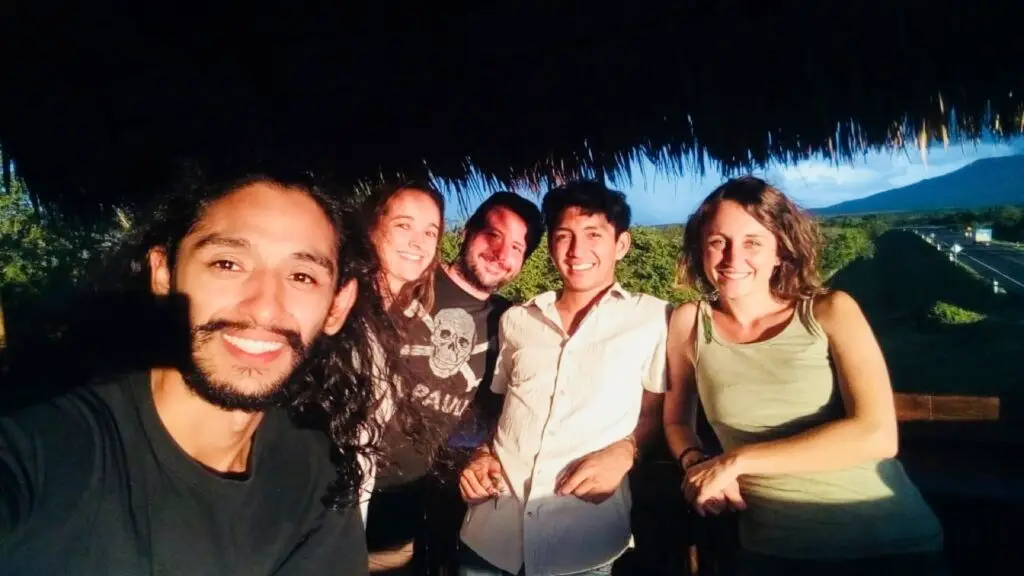
In the evening the “Brothers from Atlantis” meet for a farewell at the Sky Bar in Flores. We decide to stay in touch, and one of the crazy ones, Nerie, books a flight to Switzerland for September on his iPhone that very evening in the bar. I’ve never seen such spontaneity! Jannis suggests picking him up with us at Zurich airport on 18 September 2018 at 11 am. We’re looking forward to it!